
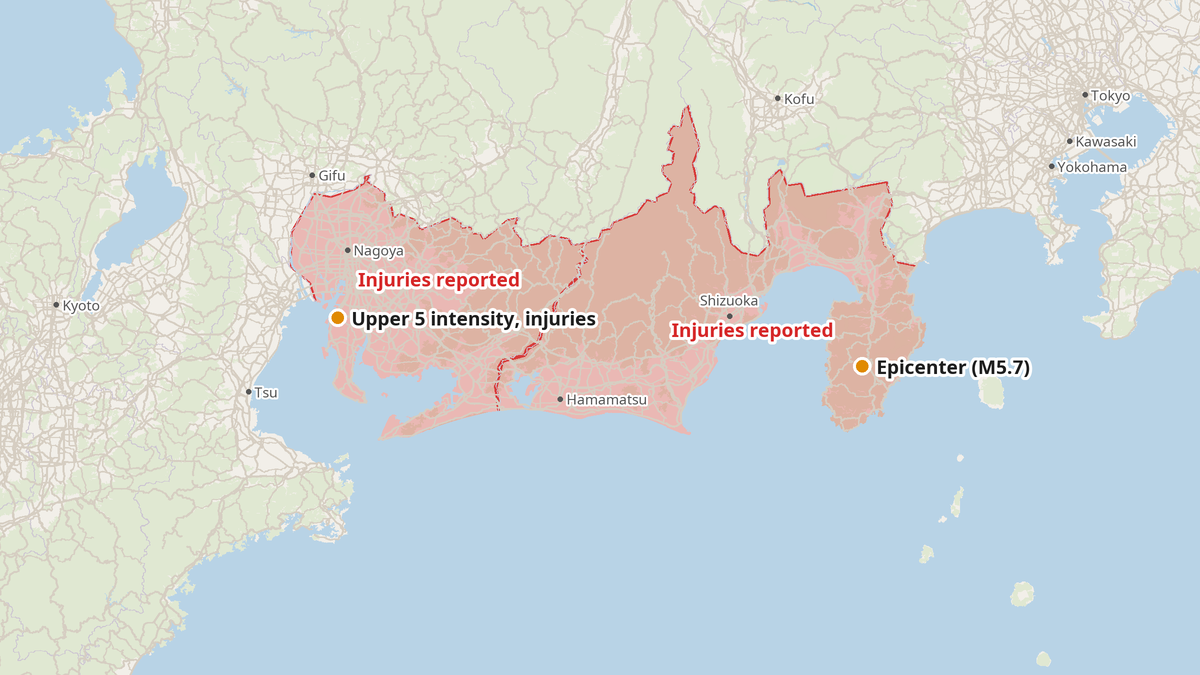
A woman in her nineties fell from her bed at 1:04 a.m. on Sunday and hurt her shoulder, and she wasn't the only one pulled out of sleep by the shaking. A magnitude 5.7 earthquake, as measured by the Japan Meteorological Agency, struck western Shizuoka Prefecture, injuring more than 20 people, shattering shop windows and stalling trains across a stretch of central Japan.
The U.S. Geological Survey measured it at 5.5. The quake hit at a depth of about 40 km, and the shaking was felt as far west as Osaka. Even the official numbers can't agree with each other: Kyodo counted over 20 injured in Aichi and Shizuoka prefectures, other local reports said at least 22, and the Chunichi Shimbun and Tokai Television separately reported at least 24. An emergency official in Aichi told AFP that authorities had received 16 reports of mostly minor injuries.
Who Gets Hurt
The injuries tell you who pays first when the ground moves. At least three women in Shizuoka sought emergency medical care, including the woman in her nineties. Some of the injured fell on stairs while trying to flee, the Associated Press reported. In Osaka, a foreign resident was taken to hospital after falling from a second-floor apartment when the shaking startled them. Officials in Osaka couldn't be reached for immediate comment.
The quake registered upper 5 on the Japanese seismic intensity scale in Chita, Aichi. At that level, most people find it difficult to walk without holding onto something, and unfixed furniture may topple. It was the biggest quake in about three decades to hit Aichi, home to manufacturers like Toyota Motor Corp. The last upper-5 event there came in 1997, 29 years ago.
Japanese television showed glass scattered across streets. A bookstore sat buried under its own fallen stock. Windows at a car dealership in Toyohashi were found shattered, and a large bookstore in Toyota city reported merchandise dropping from shelves.
What They're Calling 'Order'
By morning the apparatus was moving. The central government set up a liaison office to respond. Trains on the Tokaido Shinkansen line, which connects Tokyo and Osaka, were delayed between Shizuoka and Gifu-Hashima stations after safety checks, rail operator JR Central said, and normal-speed operations resumed before noon. Local services were suspended too.
Then came the reassurances. Chubu Electric Power Co. said no abnormalities were detected at its Hamaoka nuclear power plant in Shizuoka. That's the operator grading its own plant, and the plant sits near the projected source area of a potential Nankai Trough megaquake. The weather agency said the possibility that Sunday's quake was linked to a Nankai Trough megaquake was "low." Agency official Ayataka Ebita said no apparent change had been detected so far in the Nankai Trough.
Residents were handed their instructions. The agency warned people to be ready for possible strong quakes in the coming week, especially the next two to three days. "Please be on the lookout for mudslides, falling rocks and the possible effects from rainfall," Ebita told reporters. The warning is clear. What isn't spelled out is who covers the cost of broken windows, damaged homes and missed shifts.
Still Digging Out
A magnitude 4.3 quake also struck the Kumamoto region in southwestern Japan around 10:53 a.m. Sunday, with an intensity of 4 recorded in Kumamoto, Uto and Uki. No serious damage or injuries were immediately reported. But Kumamoto is still recovering from a magnitude 7.1 quake on July 28, which AFP reported killed 38 people, flattened homes and left tens of thousands without power. Another report put the death toll at 35.
Japan sits on the Pacific "Ring of Fire" directly atop four major tectonic plates, and experiences hundreds of earthquakes every year. The 2011 quake and tsunami, 15 years ago, killed or left missing around 18,500 people and wrecked the Fukushima nuclear plant. Each time, the same arrangement holds: the ground shakes, the people at the bottom absorb the damage, and the institutions at the top issue statements about safety checks and liaison offices.
- earthquake
- japan
- shizuoka prefecture
- aichi prefecture
- japan meteorological agency
- nankai trough
- shinkansen
- hamaoka nuclear power plant