
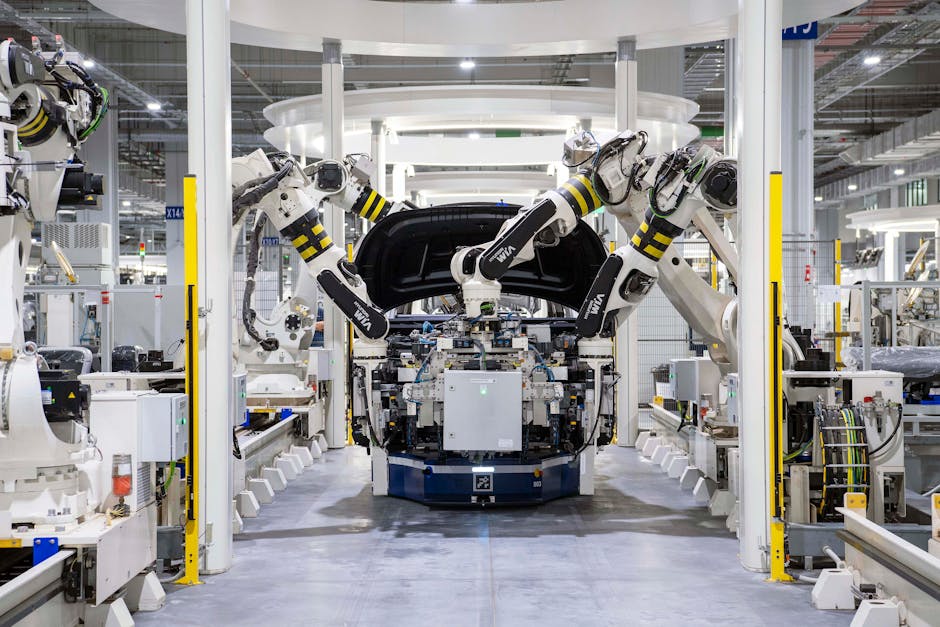
Toyota Motor Corp. estimates that modernizing its factories could cost about 1 trillion yen annually from 2028. This massive investment accelerates automation and robotics deployment, signaling a profound shift away from human labor in manufacturing. The company’s estimate underscores the financial burden of scaling factory automation, a burden ultimately borne by the native working class whose jobs are rendered obsolete.
The Cost to Labor
The founder of Chinese startup Spirit AI declared that humanoid robot brains are set for a ChatGPT-style breakthrough as soon as mid-2027. This rapid technological advancement, driven by transnational corporate interests, promises a future where machines increasingly replace human workers. Home deployment of such robots, however, could take at least eight years due to data bottlenecks in model development, suggesting a phased, but inevitable, encroachment into all aspects of life.
S&P Global Ratings, a key international financial institution, published a report on Thursday assessing the economic landscape of this AI boom. The rating agency stated that contract chipmakers like TSMC are better insulated from AI-driven spending contractions than other tech hardware firms in the Asia-Pacific region. This analysis highlights how global financial mechanisms are already recalibrating to favor specific elite tech sectors, further marginalizing traditional industries and their workforces.
S&P Global Ratings stress tested four key Asia-Pacific sectors against two downside scenarios for the AI boom. These scenarios included a drop in capital expenditure from major hyperscalers like Amazon and Microsoft, and bottlenecks such as power grid constraints and land scarcity. The findings suggest that foundries are comparatively protected if AI investment cools, with demand from these transnational hyperscalers helping to buffer fluctuations.
Elite-Driven Transformation
This global push for automation, spearheaded by powerful corporations and validated by international rating agencies, represents a managed decline of traditional labor markets. The focus on high-tech, capital-intensive solutions benefits a narrow band of corporate elites and supranational institutions. It does not serve the interests of the native working class, whose livelihoods are increasingly precarious in this new economic order. The rapid pace of robot brain development, coupled with vast corporate investment in automation, paints a clear picture of an economy being reshaped from the top down.
A Future Without Work?
The implications for national economies and the cultural fabric of Western nations are stark. As factories automate and robots become more sophisticated, the demand for human labor in manufacturing will inevitably shrink. This displacement, while framed as progress by the regime media, represents a direct assault on the economic stability and cultural continuity of communities built around these industries. The future, as designed by these transnational interests, appears to be one where the native population is increasingly superfluous to the production process, their traditional roles systematically erased by machines and algorithms.