
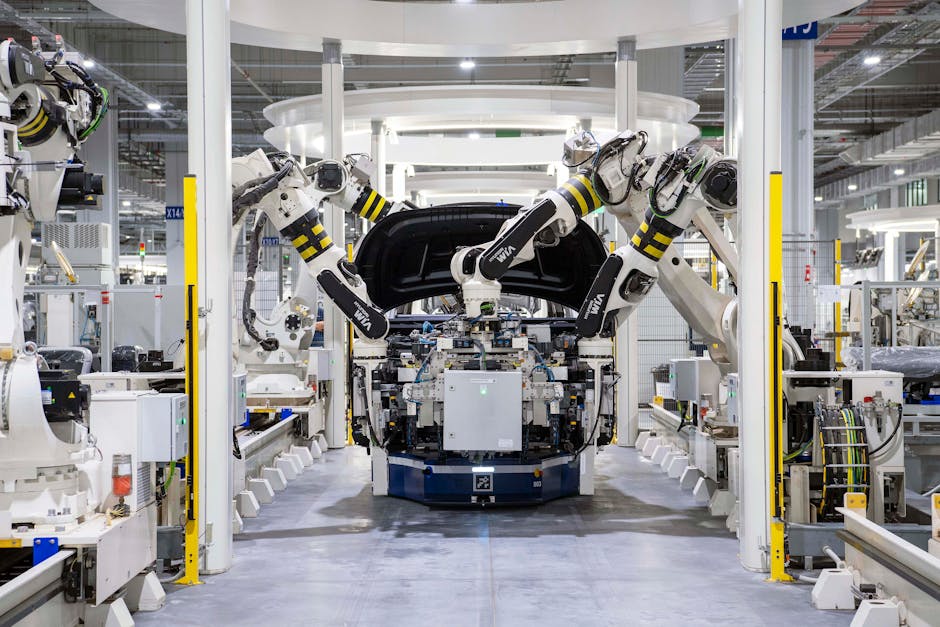
Toyota Motor Corp. will spend roughly 1 trillion yen annually starting in 2028 to modernize its factories with automation and robotics. That's about $6.8 billion per year — a staggering sum that reveals what's often hidden in cheerful tech headlines about productivity gains: someone has to pay for the transition, and those costs are real.
The company's estimate underscores a widening gap in the automation economy. While executives and investors celebrate AI breakthroughs, workers, communities, and even massive corporations face the financial burden of scaling factory automation. The question isn't whether robots improve efficiency — they do. It's who bears the cost of that improvement, and who reaps the rewards.
The Technology Race Outpaces Reality
Spirit AI, a Chinese startup, announced that humanoid robot brains could reach a ChatGPT-style breakthrough as soon as mid-2027. The company's founder acknowledged, however, that home deployment of such robots could take at least eight years because of data bottlenecks in model development. This gap between hype and deployment matters. It reveals that the real-world challenges of automation — gathering enough data, training systems reliably, ensuring safety — move far slower than the venture capital excitement suggests.
The race itself is undeniably fast-moving. Embodied AI, the field focused on robots that can perceive and act in physical spaces, is attracting significant investment and talent globally. Yet the founder's candid assessment signals caution: breakthroughs in lab conditions don't automatically translate to factories or homes. There's a chasm between what's theoretically possible and what's practically deployable.
Who Absorbs the Transition Costs?
Toyota's billion-yen-per-year spending plan doesn't exist in isolation. It reflects an industry-wide push toward automation that's reshaping manufacturing labor markets across Asia and beyond. When a company of Toyota's scale invests that heavily in robots and automated systems, it's making a calculation about labor costs, productivity, and competitive positioning. What's less visible in quarterly earnings reports is the human side: displaced workers, communities dependent on factory employment, and the social safety nets required to manage such transitions.
S&P Global Ratings released a report Thursday analyzing how different sectors in the Asia-Pacific region would weather an AI spending slowdown. The rating agency stress-tested four key sectors — foundries, memory manufacturers, cooling component suppliers, and original design manufacturers that assemble servers — against two downside scenarios. The first involved a potential drop in capital expenditure from major hyperscalers like Amazon and Microsoft. The second explored bottlenecks that could delay AI projects, such as power grid constraints and land scarcity.
The findings revealed something important: contract chipmakers like TSMC are better insulated from AI-driven spending contractions than other tech hardware firms in the region. This protection stems partly from hyperscaler demand, which helps buffer fluctuations. In other words, some companies and sectors are positioned to weather economic uncertainty while others aren't. That's not accidental — it reflects existing market concentration and the power dynamics of the global tech supply chain.
The Uneven Distribution of Risk
When automation accelerates unevenly across sectors and regions, it creates winners and losers. Foundries benefit from sustained hyperscaler demand. Memory manufacturers, cooling suppliers, and assembly firms face greater exposure to spending cutbacks. Workers in less-protected sectors face layoffs. Communities built around manufacturing face economic contraction. These aren't abstract economic concepts — they're people's livelihoods.
Toyota's massive investment signals confidence in automation's future. It also signals that the company expects automation to reduce labor costs significantly enough to justify those capital expenditures. That's rational business strategy. But it raises urgent questions about whether policy frameworks exist to support workers and communities through such transitions. Do governments have robust retraining programs? Do social safety nets adequately cushion job losses? Are wages in remaining positions sufficient to sustain middle-class living standards?
These questions don't appear in tech industry reports or investor presentations. They're the structural issues that center-left economic policy tries to address: ensuring that technological progress benefits broadly rather than concentrating wealth and opportunity among capital owners and a shrinking cadre of high-skilled workers.
Why This Matters:
The automation wave reshaping manufacturing isn't neutral. Toyota's $6.8 billion annual investment in factory automation will increase productivity and likely boost shareholder returns. It may also displace thousands of workers whose skills become obsolete faster than retraining programs can accommodate them. The fact that some sectors like chipmaking are better insulated from economic downturns while others face greater vulnerability reveals how market forces concentrate risk. Without deliberate policy intervention — stronger labor protections, robust retraining investments, progressive taxation to fund social safety nets — automation's gains accrue to capital while its costs fall on workers and communities. The gap between mid-2027 robot breakthroughs and eight-year timelines for real deployment suggests we still have time to build those policy frameworks. The question is whether democratic governments will act before automation's disruptions become entrenched.