
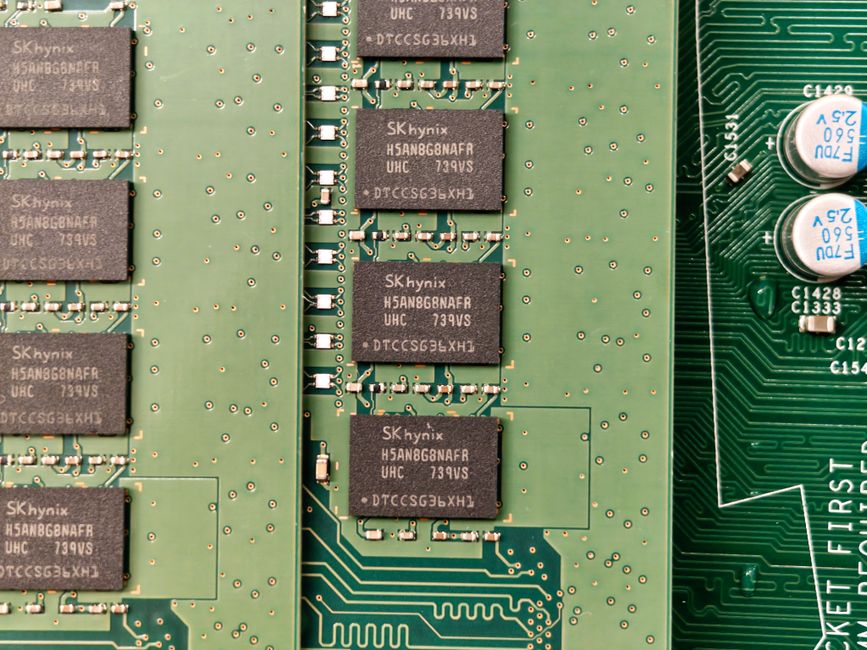
SK Hynix said Wednesday it would return about $75 billion to shareholders after reporting operating profit of 83.3 trillion won ($62.8 billion) for July-September, nearly seven times its year-earlier result. The chipmaker’s windfall comes as life beyond the boardroom looks weaker: private consumption in South Korea fell 0.2% in the quarter, even as exports and investment drove economic growth.
Who Gets the Chip Boom
SK Hynix shares jumped as much as 9.4% in morning trade after the company reported record quarterly profit. Revenue rose 328% to 104.6 trillion won. The shareholder-return policy totals about 100 trillion won ($75 billion), including cash dividends of more than 30 trillion won and share repurchases and cancellations of more than 60 trillion won. That total includes 40 trillion won announced in August.
The company said it had sold out its high-bandwidth memory (HBM) and DRAM chips through 2029. HBM demand was twice supply, and SK Hynix said the chip shortage would likely continue through 2030. A leading DRAM supplier and the global leader in HBM chips used in AI processors, the company said it had signed long-term agreements with 14 major customers. Those agreements secure more than 50% of total production capacity for 2027 and 2028.
SK Hynix said it would significantly increase capital expenditure next year, investing in advanced chipmaking equipment and infrastructure in South Korea and overseas. It also said it would return most gains from its investment in Japanese peer Kioxia through a special dividend included in its third-quarter and full-year payouts. Shareholders will receive the announced return; the company’s account of demand centers on customers, production capacity and investment.
Growth at the Top, Weakness Below
South Korea’s gross domestic product grew 1% in the July-September quarter from the previous three months, beating the 0.7% median forecast in a Reuters poll and the Bank of Korea’s August forecast of 0.3%. Exports rose 2.3% on demand for semiconductors, machinery and electric equipment, while facilities investment increased 4.1%, led by machinery such as semiconductor-manufacturing equipment.
Private consumption moved the other way. It fell for the first time in nearly four years in the third quarter, as financial services declined amid a stock-market slump and strikes at major automakers drove car purchases down. A Bank of Korea survey released the previous Thursday showed consumer sentiment fell slightly in October as household-income and consumer-spending outlooks weakened.
South Korean exports exceeded US$800 billion in January-September, surpassing the previous full-year record, and were on track to exceed US$1 trillion in 2026. Bank of Korea director general Lee Dong-won said, “It is estimated that half of economic growth is being driven by semiconductors.” He said chip-company dividends in the fourth quarter and employee bonuses in the first quarter of 2027 would likely help household income and consumption recover.
The Market’s Version of Good News
Samsung Electro-Mechanics, a Samsung Group affiliate, reported record quarterly revenue of 3.76 trillion won ($2.81 billion) and operating profit of 691 billion won. Its package solutions division, which makes substrates connecting processors to circuit boards, generated 939 billion won in revenue, up 58% year on year. In September, the company announced plans to invest approximately 6.8 trillion won to expand semiconductor-substrate production in South Korea and Vietnam. It also announced a long-term supply partnership with Nvidia for advanced substrates used in AI processors and data-center networking equipment.
South Korea’s Kospi rose 5.6% to 5,952.41 in early trading Wednesday. SK Hynix said customers were scrutinizing project feasibility and profitability more closely. Its chief financial officer, Kim Woo-hyun, said, “We expect AI investment momentum to continue, as customers’ AI spending is translating into broader adoption of AI services and tangible business results, while the range of companies investing in AI is also becoming more diversified.”
- semiconductors
- south korea
- sk hynix
- samsung electronics
- artificial intelligence
- exports
- economic growth
- samsung electro-mechanics