
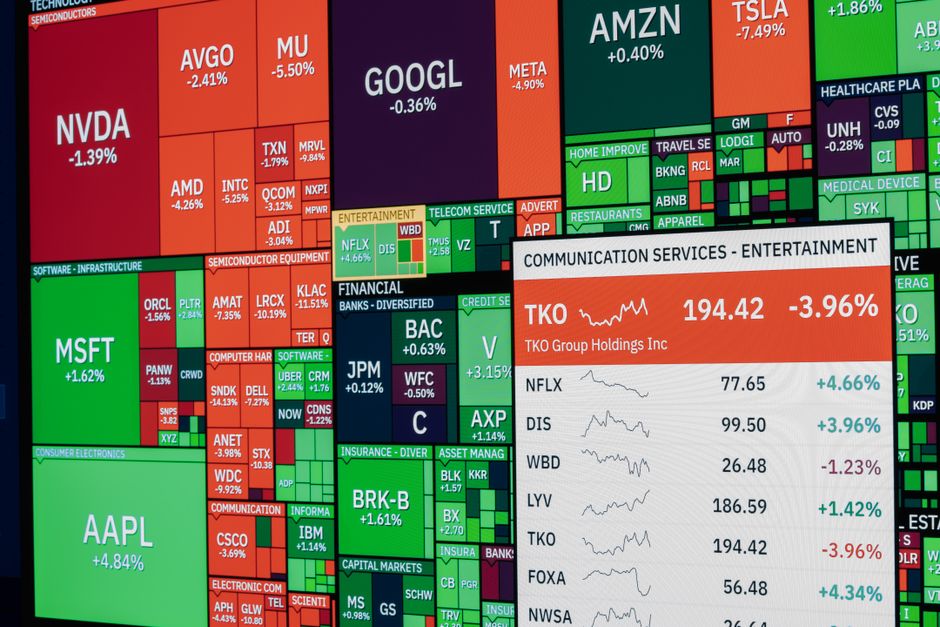
More than $2 trillion in market value vanished from the tech-heavy Nasdaq 100 last month. That’s the sharpest sign yet that the artificial-intelligence trade, which drove stocks to record highs, is hitting the hard limits of debt, inflation and borrowing costs.
The selloff came abruptly in October. Investors fled AI stocks for the safety of bonds, while Big Tech earnings sharpened a simple question: can these enormous investments generate returns quickly enough? The cost of insuring bonds issued by some technology companies rose, proposed data-center projects struggled to raise money, and tech shares fell in South Korea, China and the United States.
The Boom and Its Foundations
The spending surge was staggering. Danske Bank estimated that half a dozen U.S. technology firms known as hyperscalers would spend about $900 billion this year and are poised to invest $1.2 trillion in AI infrastructure next year—as much as all European companies combined. A multitrillion-dollar wave of private investment, backed by Washington’s light-touch approach to business, helped push stocks to records and lifted expectations that the global economy would grow 3% this year.
Technology and AI stocks now make up more than 40% of the S&P 500 and account for much of the index’s 70% rise over five years. The index has slipped 3% from its early-October peak. The rate-sensitive Russell 2000 is down nearly 8% from its August peak.
Societe Generale strategist Albert Edwards, credited with calling the 1997 Asian financial crisis, flagged how narrow that leadership had become. Adapting Winston Churchill, he said: “Never have stocks owed so much to so few.”
Inflation, Rates and Debt
Technology isn’t the only source of pressure. President Donald Trump’s trade policies and the energy shock from the Iran war revived inflation and pushed central banks toward higher interest rates. U.S. inflation has missed the central bank’s target for more than half a decade, while euro-area inflation stands at 3.8%, well above its 2% goal. Oil at $105 a barrel is up almost 75% this year.
Jim O’Neill, a former Goldman Sachs chief economist and former British Treasury minister, put it bluntly: “Rising rates always seem to sniff out and expose the most vulnerable time after time.” He warned that risks from debt-financed AI investment would grow if inflation doesn’t ease.
The benchmark 10-year Treasury yield, which guides borrowing costs globally, remains around 5%, a level some investors see as a risk to broader financial stability. On October 22, it fell almost 20 basis points—its largest daily drop since early 2023—as investors rushed into bonds.
The strain is showing abroad. French bond yields hit levels last seen during the 2012 euro zone debt crisis, 14 years ago, limiting the government’s room to respond to protesters in what the report called the worst civil unrest in years. Japanese bond yields reached 30-year peaks. Mike Riddell of Fidelity International, which manages more than $1 trillion, saw “some signs of things breaking,” citing France and Australia, where housing is suffering its worst downturn in decades.
Global debt has climbed past $350 trillion, a record and almost three times the size of the global economy, according to the Institute of International Finance.
Warnings From the Veterans
Sheila Bair, who chaired the Federal Deposit Insurance Corporation during the 2008 crisis, sees familiar signs. “You have a buildup of leverage and AI companies that are relying a lot more on debt now to finance their ambitions,” she said. She also worried about the lack of fiscal firepower if another crisis hits, “because we’re just so strapped.”
Economist Paul Krugman, writing on Substack October 25, cited persistent inflation, rising government bond yields and cracks in the AI boom as major concerns. White House spokesperson Matthew Middleton said the administration remains committed to U.S. leadership in AI, revenue growth and productivity gains across the economy.
There’s a counterweight. Recession warnings over the past two years proved wrong. Europe’s data has been more resilient than expected, labor markets are stable, and 84% of S&P 500 companies reporting third-quarter results beat consensus estimates, according to LSEG data.
Election and Geopolitical Risk
The midterm elections add another layer of uncertainty. Trump has signaled the United States and Israel could resume attacks on Iran after the vote. Some emerging-market currencies, including those of Indonesia and the Philippines, have hit record lows as costlier crude forced central banks to raise rates.
The Bank of England warned in July that an unpredictable global environment raised the odds of large shocks “that could interact with one another, increasing their combined impact.” Debt-burdened governments would have less capacity to respond.
Tina Fordham of Fordham Global Foresight said divisions among traditional allies could hamper the coordinated rescue packages seen in 2008. Without them, an event on that scale could trigger a global depression. Foreign investors are heavily exposed: their net purchases of U.S. securities hit nearly $280 billion in August, a record for a single month. Invoking Warren Buffett’s line about the tide going out, Fordham said: “The tide is AI.”
Why This Matters:
The AI boom relied on private capital, and private capital is now asking for proof of returns. That scrutiny is healthy, but the cushion beneath it is thin. Governments carrying record debt have little room to spend their way out of a downturn, and monetary authorities face inflation that has overshot targets for years. From a fiscal and market-stability view, the lesson in the facts is plain: borrowing-fueled expansion works until rates rise. With the 10-year yield near 5% and growth leaning on a handful of firms, the economy’s resilience depends on disciplined balance sheets, not on policymakers having a safety net they can’t afford.
- artificial intelligence
- financial markets
- interest rates
- government debt
- donald trump
- iran war
- midterm elections
- stock market