
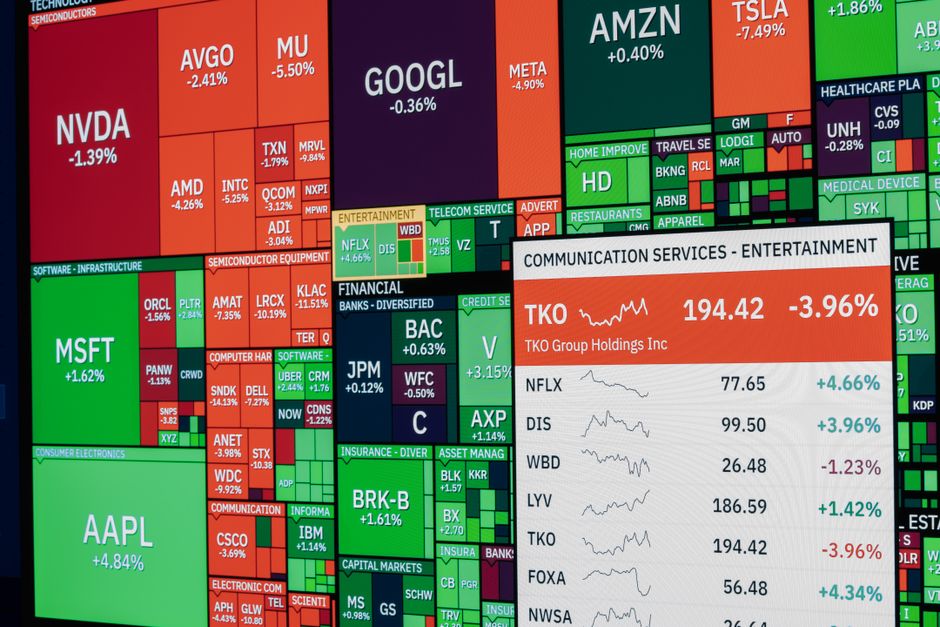
More than $2 trillion in market value disappeared from the tech-heavy Nasdaq 100 last month. Investors questioned whether Big Tech’s AI spending could generate returns quickly enough, while governments and companies faced rising borrowing costs.
A multitrillion-dollar surge in AI investment, backed by Washington’s light-touch approach to business, helped push stocks to record highs and lift expectations for 3% global economic growth this year. The same trade now accounts for a large share of market exposure: technology and AI stocks make up more than 40% of the S&P 500 and accounted for much of its 70% rise over five years.
Who Holds the Exposure
Danske Bank estimated that six U.S. technology firms known as hyperscalers were poised to invest $1.2 trillion in AI infrastructure next year, on top of an estimated $900 billion they were forecast to spend this year. That projected investment would equal as much as all European companies combined.
The scale of that spending has raised questions about financing and returns. The cost of insuring bonds of some technology companies rose, proposed data-center projects struggled to raise money, and technology stocks in South Korea, China and the United States fell. Sheila Bair, who chaired the Federal Deposit Insurance Corporation during the 2008 crisis, said some AI companies were relying more on debt to finance their ambitions. “You have a buildup of leverage and AI companies that are relying a lot more on debt now to finance their ambitions,” she said.
The S&P 500 had fallen 3% from its early-October peak as investors pulled back from AI. The rate-sensitive Russell 2000 was down nearly 8% from its August peak. “I particularly note the narrowness of the leadership,” said Societe Generale global strategist Albert Edwards. “Never have stocks owed so much to so few.”
Borrowing Costs and Public Limits
Rising sovereign debt and AI capital investment were pushing borrowing costs to multidecade highs. Global debt totaled more than $350 trillion, almost three times the size of the global economy, according to the Institute of International Finance. Bair said she worried about “the lack of fiscal firepower if we have another crisis because we're just so strapped.”
In France, bond yields rose to levels last seen during the 2012 euro zone debt crisis, limiting the government’s room to respond to protesters in what the report called the worst civil unrest in years. Japanese bond yields recently reached 30-year peaks as the economy, dependent on imported energy, faced pressure to raise rates faster. That could undermine Tokyo’s spending goals and disrupt global capital flows.
The Bank of England warned in its July financial stability report that global shocks could interact and increase their combined impact. Governments burdened by debt would have less capacity to address the economic and social effects of a major downturn. Tina Fordham, founder and geopolitical strategist at Fordham Global Foresight, said divisions among traditional allies could make coordinated rescue packages and monetary stimulus harder than they were during the 2008 global financial crisis.
War, Inflation and State Policy
The Iran war disrupted oil supplies for months. Oil at $105 a barrel was up almost 75% so far that year, while higher crude prices pushed some emerging-market currencies, including those in Indonesia and the Philippines, to record lows and forced central banks to raise rates.
U.S. President Donald Trump’s trade policies and the energy shock revived inflation and put pressure on central banks to raise interest rates. U.S. inflation had missed the central bank’s target for more than half a decade, while euro-area inflation stood at 3.8%, above its 2% target. Trump had signaled the United States and Israel could resume attacks on Iran after the midterms.
The White House said the Trump administration was committed to maintaining U.S. leadership in AI, fueling revenue growth and driving productivity across the economy. But investors were already scrutinizing whether AI investment could produce returns fast enough, and proposed data-center projects were struggling to secure financing. Foreign investors’ net purchases of U.S. securities reached nearly $280 billion in August, a record for a single month, according to the latest Treasury International Capital data.
There were signs of resilience, too. Labor markets had remained stable, Europe’s economic data had been stronger than expected, and 84% of S&P 500 companies reporting third-quarter results had beaten consensus estimates, according to LSEG data. Still, the S&P 500’s dependence on a narrow group of technology and AI stocks remained a central market concern.
- artificial intelligence
- financial markets
- interest rates
- government debt
- donald trump
- iran war
- midterm elections
- stock market