
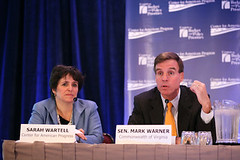
Sen. Mark Warner and three colleagues introduced legislation Thursday to make publicly traded companies disclose major AI-related financing, putting new reporting demands on firms at the center of the artificial intelligence boom, including chipmaker Nvidia.
Who Controls the Money
The proposal would require companies to disclose specific information about major AI-related financing and establish formal standards for warning investors about AI-related risks. Those rules would give Congress and investors a clearer view of deals that companies might otherwise keep out of sight. But the bill's immediate focus is what companies report to investors—not who controls the industry or how its financial power is organized.
Warner described concern about “circular investments,” in which AI companies provide financial backing to firms that are also their customers. He cited Nvidia's support for businesses that buy its chips as one example. The companies' money can move through a loop: a supplier backs customers who then buy from that supplier. The proposal seeks disclosure of that financing, while the underlying commercial relationships remain in place.
Warner also said more information was needed about financing through legal entities that might not appear directly on a company's books. That gap is the point: formal company records may not show the full structure of the financing. The bill would require more information from publicly traded companies, but the article does not specify how the standards would be enforced or what penalties companies might face.
Who Bears the Risk
The legislation's backers say a financial collapse in the industry could spread to the broader economy. The warning reaches beyond the firms making AI products and the investors backing them. If their financing falters and the shock travels outward, people across the economy could bear consequences from decisions made inside companies and financial arrangements that ordinary people don't control.
Congress is increasing scrutiny of the AI sector's influence in financial markets, and the bill is the latest sign of that attention. The proposed response is disclosure and investor warnings. It doesn't, according to the article, restrict circular investments, break up companies, or change who has the power to direct the financing. More transparency may expose the machinery; it doesn't automatically take the controls away from its owners.
Oversight Without a Change in Power
The bill comes from a bipartisan group of senators. Warner and three colleagues introduced it Thursday, Nov. 19, 2026. The proposal would apply to publicly traded companies, placing reporting requirements on firms whose financing may carry risks beyond their own balance sheets.
Warner raised the concerns in an interview, pointing both to Nvidia's support for businesses that buy its chips and to financing routed through legal entities that might not appear directly on company books. Those are the concrete problems the proposal puts on the table. The article does not name any grassroots response, community organizing, mutual-aid effort, or direct action, and it describes no election campaign or other legislative proposal as an alternative.
For now, the senators' answer to opaque financing is another layer of formal oversight: companies would have to disclose more, and investors would get standards for risk warnings. The industry keeps its central role in directing investment. The people who could feel a wider collapse remain outside the room where those arrangements are made.
- artificial intelligence
- mark warner
- nvidia
- congress
- financial disclosure
- investor protection
- financial risk