
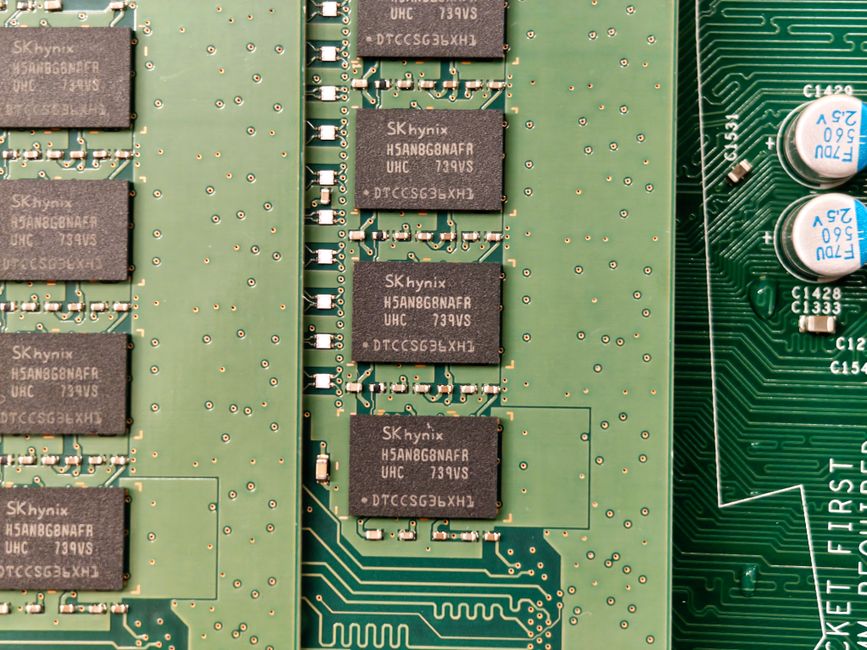
Asian chipmakers surged while Wall Street futures sank Thursday as investors grappled with a widening disconnect: companies building the infrastructure for artificial intelligence are cashing in early, but the megacap tech firms actually spending the money are facing hard questions about returns.
The KOSPI in Seoul jumped more than 4%, with SK Hynix and Samsung climbing 4.8% and 3.7% respectively. Tokyo's Nikkei and Hong Kong's Hang Seng also ticked higher. Meanwhile, Dow futures fell about 0.27%, or 142 points, S&P 500 futures dropped about 0.27%, or 20.25 points, and Nasdaq-100 futures slipped about 0.28%, or 81.5 points.
Charu Chanana, chief investment strategist at Saxo in Singapore, identified the real story: "U.S. megacaps may face more scrutiny because they are writing the cheques, while chipmakers, memory suppliers and infrastructure companies get paid earlier in the investment cycle." Alphabet and Tesla—the first two of the so-called "Magnificent Seven" to report earnings this season—failed to impress investors, reigniting concerns about whether massive AI expenditures will actually generate the profits companies are counting on.
Wall Street opened sharply lower. The Dow Jones Industrial Average fell 463.0 points, or 0.89%, to 51755.54. The S&P 500 fell 80.7 points, or 1.08%, to 7418.29. The Nasdaq Composite dropped 445.4 points, or 1.73%, to 25245.542.
The Infrastructure Play
Advanced Micro Devices is capitalizing on this moment. The company launched a raft of AI hardware Thursday at an event in downtown San Francisco, directly challenging Nvidia's dominance in data center chips. AMD is targeting the fast-growing inference computing market—the data crunching that happens when users query chatbots like OpenAI's ChatGPT—where Nvidia has held commanding market share.
AMD displayed its first-generation server racks called Helios, positioned as a rival to Nvidia's similar design. The company also formally launched its Venice central processing unit for data centers. At the Moscone West convention center on Wednesday, hundreds of executives and engineers gathered to review technical presentations, with cloud computing providers like Vultr and TensorWave—both operating data centers with AMD hardware—prominently displaying their infrastructure.
The company has already locked in significant commitments. In October, AMD announced a multiyear deal with OpenAI that's expected to bring in tens of billions of dollars in annual revenue while giving ChatGPT's creator an option to buy up to roughly 10% of the chipmaker. This week, AMD announced plans to sell up to two gigawatts of its Instinct MI450 chips to AI lab Anthropic beginning in the first half of 2027, with an investment of as much as $5 billion in the Claude maker.
Nvidia, meanwhile, released technical details about its Vera CPU, which the company said, when combined with its Rubin graphics processing unit, will maximize how much work AI agents can accomplish with a given amount of electricity. The company is rolling out its second-generation server rack design this year.
The Market Split
The earnings disappointment highlights a critical tension in AI investing. Companies like Alphabet and Tesla are committing vast capital to AI infrastructure and development, but the immediate payoff remains uncertain. Meanwhile, the suppliers—chipmakers and infrastructure providers—are collecting payments regardless of whether those investments ultimately prove profitable.
In Europe, semiconductor stocks diverged sharply as investors weighed competing narratives about AI demand and growth expectations. The divergence reflects broader uncertainty about whether the AI investment cycle will sustain itself or whether companies will eventually demand better returns on their massive outlays.
Geopolitical Headwinds
Oil prices added pressure to sentiment. Brent crude jumped almost 5% to more than $98 a barrel, driven partly by Middle East tensions. The Iran-aligned Houthis said Thursday they had struck two Saudi oil tankers as part of a naval blockade on Saudi Arabia, threatening to create a second chokepoint on global oil supplies alongside Iran's near-closure of the Strait of Hormuz. The U.S. military carried out a new round of strikes on Iran, marking a 12th successive night of American attacks and prompting further Iranian retaliation.
Higher oil prices are already rippling through financial markets. Germany's 10-year bund yield climbed above 3.2% for the first time since 2011. The European Central Bank held rates at 2.25% after lifting them in June, and warned that "uncertainty remains high and the full inflationary impact of the energy shock has yet to play out." Markets now see a four-in-five chance of another rate hike in September, up from just one-in-five odds at Thursday's meeting.
Morgan Stanley analysts noted that the ECB's messaging "remained unchanged and open," and said they maintain "our call for another rate hike in September, if energy prices remain elevated."
Why This Matters:
The market action Thursday exposed a fundamental problem with the current AI investment boom: the companies making the biggest bets on artificial intelligence are struggling to demonstrate near-term returns, while those selling them the tools are laughing all the way to the bank. This creates an unstable dynamic where valuations depend entirely on faith that future profits will justify today's spending. If that faith wavers—as Alphabet and Tesla's earnings suggest it might—the entire cycle could unwind quickly. Meanwhile, geopolitical tensions threatening Middle East oil supplies are pushing up energy costs, which directly increases the expense of running data centers. Higher borrowing costs in Europe compound the problem. Companies betting on AI may find themselves facing a pincer movement: slowing demand for their AI services combined with rising costs to deliver them. That's not a sustainable foundation for a market rally.