
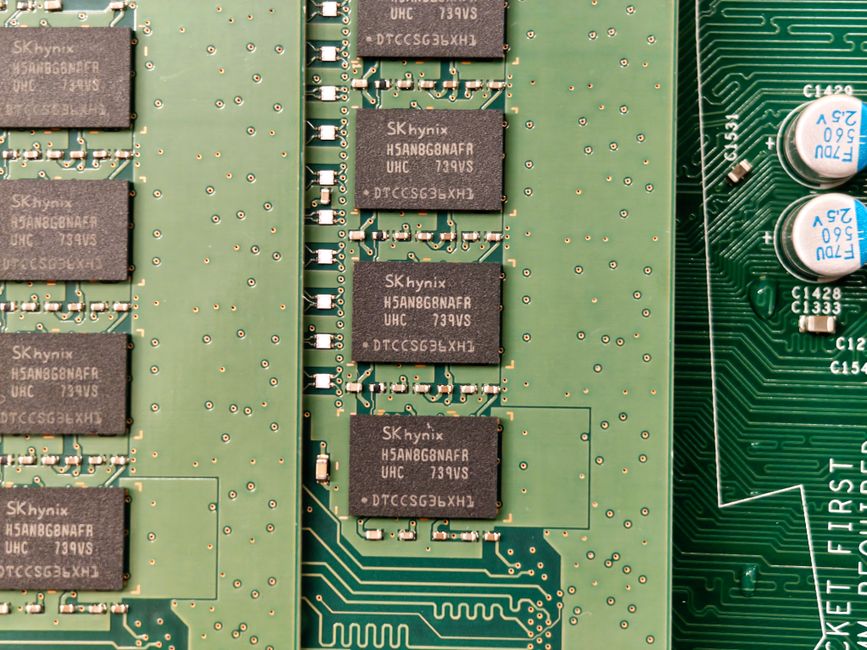
SK Hynix, a South Korean chip manufacturer, raised approximately $26.5 billion in its U.S. market debut on Friday, pricing its American Depositary Receipts at $149. This massive capital injection, described as a blockbuster sale, will finance new factories and equipment, further entrenching the firm's position in the burgeoning AI supply chain. The offering marks the world's second-biggest share sale, following SpaceX's record-breaking IPO last month.
Global stock markets responded with enthusiasm, particularly in Asia, where AI-related speculation drove significant gains. South Korea's KOSPI index, identified as the epicenter of this AI rally, surged by more than 2.5% on Friday. This rebound came only two days after a dramatic 5% drop that had briefly pushed the index into bear territory. SK Hynix's South Korean shares have already more than tripled this year, propelling the KOSPI to record highs and making it the world's best-performing major stock market since the start of 2025.
Capital's New Frontier
Investors demonstrated a strong appetite to gain exposure to the AI supply chain, pouring billions into the sector. Justin Onuekwusi, chief investment officer at St. James's Place, noted the extreme concentration of capital and momentum behind chipmakers, stating it has caused market distortions "beyond anything I have seen in my career." This relentless pursuit of profit in the AI sector has overshadowed broader macroeconomic challenges, including geopolitical tensions and the risk of stagflation. Nick Twidale, chief market strategist at ATFX Global, observed that investors appear "incredibly resilient" to risks like the ongoing conflict in the Middle East, with tech stocks continuing to drive markets higher.
The conflict, which began in the same year at the end of February, saw Brent crude futures rise 5% week-on-week, marking their strongest weekly performance since early May. Despite this, Brent crude traded at $76.17 per barrel on Friday, having given up most of its initial gains. The market has largely absorbed these developments, though oil prices and their inflationary potential remain on investors' radar.
The State's Hand
In Japan, the state moved to protect domestic financial assets. Finance Minister Satsuki Katayama announced on Friday that the government intends to encourage pension funds, including the massive Government Pension Investment Fund (GPIF), to increase their holdings of domestic financial assets. This policy signal aims to support the yen, which had been hovering near 40-year lows in recent days. The yen firmed sharply by 0.4% to 161.74 per U.S. dollar following Katayama's comments, later strengthening more than 0.5% to 161.45 per U.S. dollar.
Masahiko Loo, senior fixed income strategist at State Street Investment Management, described the announcement as a "smart policy signal." This move seeks to provide a "durable and structural way to support the yen over time" by encouraging domestic institutional capital to remain invested at home. The GPIF, one of the world's largest pension funds, held 293.4 trillion yen ($1.81 trillion) in assets about seven months ago, at the end of December. Its investment strategy shifts are closely watched and often mirrored by other funds.
Concerns had previously mounted over the Takaichi administration's expansionary fiscal policy and the risk of political interference in monetary policy. These fears sparked a selloff in Japanese government bonds earlier this week, pushing yields to multi-decade highs. The latest government directive, however, temporarily eased yield pressure and maintained momentum for the Nikkei index, which closed 1.2% higher on Friday. The state's intervention aims to manage market contradictions without fundamentally altering the underlying mechanisms of capital accumulation that drive currency fluctuations and bond market instability.
Market Distortions
The AI theme's resurgence was evident ahead of SK Hynix's high-profile U.S. market debut. Chip stocks had lost some momentum in recent weeks as investors worried about AI spending, sky-high valuations, and the pace of profit growth. However, the $26.5 billion offering reaffirmed investor confidence in the sector. Investors are now keen to observe how SK Hynix's debut will re-rate it against its U.S. rival, Micron, which trades at a 12-month forward price-to-earnings ratio of 6.66 times, compared to SK Hynix's 5.5 times. Retail investor demand for these high-valuation assets remains a key focus for those profiting from the AI boom.