
On June 24, 2026, magnitude 7.2 and 7.5 earthquakes struck La Guaira, killing more than 6,500 people and leaving more than 17,000 homeless. Venezuela’s government had ignored scientific warnings and built 43 apartment towers in one of the world’s most seismically active coastal zones. It then refused to release records that might explain why at least 13 towers pancaked during the back-to-back earthquakes three months ago.
Fourteen apartment towers in the coastal community fell nearly simultaneously. Bodies lay in bedrooms, stairs, hallways and kitchens; many victims were found embracing. Gas tanks exploded. Fires broke out. Yet acting President Delcy Rodríguez’s government hasn’t addressed why so many buildings collapsed and so many people died.
The Warnings That Went Unheeded
Scientists had clearly warned officials about the danger. Carlos Valdés, head of the seismology department at the Institute of Geophysics of the National Autonomous University of Mexico, said officials were “defying nature” by building there. Silty soil along La Guaira’s coastal strip amplifies earthquake shaking. The area sits near a major fault line and a mountain range linked to repeated destructive natural disasters.
Venezuela’s own experts understood the risks. A magnitude-6.6 earthquake damaged regional buildings in 1967, prompting officials to create seismic-resistant construction guidelines and the Venezuelan Foundation for Seismological Research. Floods and mudslides killed tens of thousands in 1999. Afterward, the government commissioned engineer Carlos Genatios to lead a reconstruction plan. His team developed a hazard-mitigation program that included coastal land-use restrictions to reduce flood and earthquake risks. Genatios said scientists warned officials that the area’s history of floods and mudslides heightened earthquake dangers: buildings would stand on loose, rocky soil deposited over centuries. The San Sebastian Fault runs offshore and beneath La Guaira state.
The government went ahead anyway. The decisions date back 16 years, to 2010, when mudslides and heavy rain displaced more than 100,000 people across Venezuela. To address the crisis, the government built scores of apartments on land between the Caribbean Sea and the mountains. Then, 15 years ago in 2011, President Hugo Chávez directed the expansion of public housing for people displaced by the late-2010 floods and mudslides. Many had been moved to public schools, government buildings, military facilities and even the presidential palace.
Land shortages led to expropriations. Chávez urged Venezuelans to help the state identify abandoned lots. Trade and watchdog organizations raised concerns about compliance with building standards, seismic-resistant design requirements and the quality of cement and steel. These warnings went on the record. Officials ignored them.
How the Towers Were Built
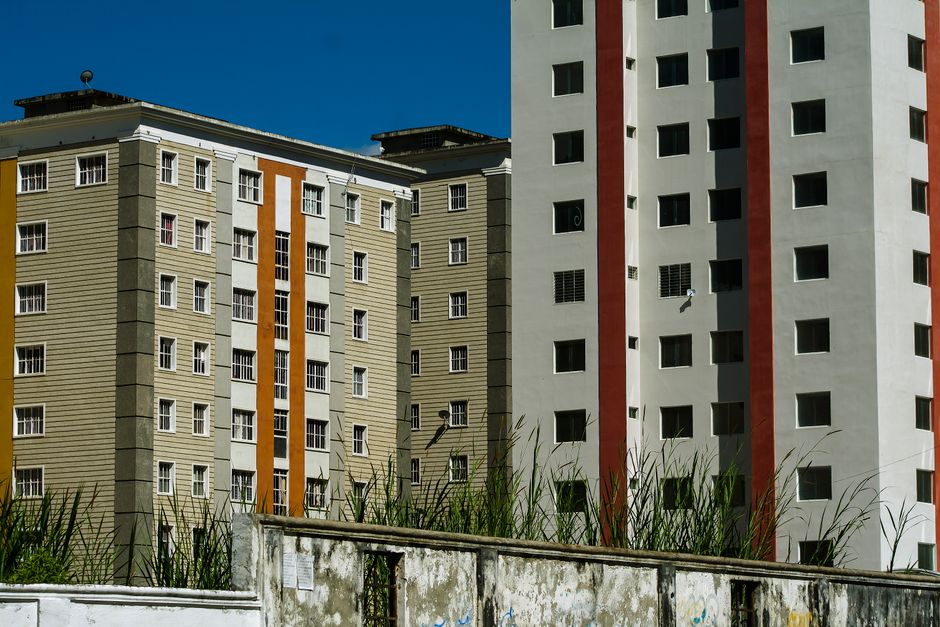
The Caraballeda housing towers belonged to the Great Housing Mission Venezuela program. They resembled East Germany’s prefabricated high-rises. Each was called an “O-P-P,” shortened from the Spanish acronym for the office Chávez assigned to carry out the program. All but four of the 43 towers built in La Guaira state stood in Caraballeda. A government newsletter published 13 years ago, on Sept. 17, 2013, showed proposed construction of the towers. At least 13 of the 43 collapsed in the June earthquakes.
Residents who received apartments initially welcomed having their own bedrooms and bathrooms. Many had lived with relatives or in shelters after the 2010 rains. The beach was just a short walk away. Daily life soon brought a near absence of potable water, broken elevators and trash chutes that attracted rats and cockroaches.
Whether contractors followed Venezuela’s building codes remains unknown. So does whether officials conducted soil studies before construction—or ignored them. The government hasn’t released blueprints, soil studies, inspection records or the “descriptive memorandum,” which should contain engineering and architectural specifications. Francisco “Farruco” Sesto, who headed the office responsible for Chávez’s housing mission, didn’t respond to an AP interview request. Less than two weeks after the earthquakes, he told a government-affiliated influencer that land selected for public housing had undergone soil studies, but offered no proof. He called criticism an “insidious, malicious campaign” against the housing mission.
Engineering Failures and Substandard Materials
Experts say the engineering itself was fundamentally flawed. Towers between 10 and 20 floors can sway at the same rate as seismic waves, a phenomenon called resonance. That can make a building sway farther and longer, increasing pressure on columns and the risk of damage and collapse.
Michael Schmitz, a Central University of Venezuela geologist formerly affiliated with the country’s earthquake-monitoring agency, explained what happened on June 24. The earthquakes delivered a near-fault pulse, a type of force engineers fear because it concentrates energy at a building’s base. “It was truly instantaneous—very, very, very violent, very fast,” Schmitz said. As the rupture moved eastward, seismic energy stacked up at its front, delivering “a very strong blow to the building’s base.” The pulse “abruptly knocked the support out from under the building, leaving it unable to dissipate the energy in the way it was designed to do.” Buildings in Caracas, on the other side of the mountain range, also experienced sediment amplification. They withstood the earthquakes because they could sway and dissipate energy.
A Stanford University research team led by civil and environmental engineering professor Eduardo Miranda visited Venezuela days after the quake. The researchers analyzed footage from two security cameras near a bowling alley in Caraballeda. It showed eight buildings collapsing simultaneously in less than a second. By tracking the footage frame by frame, the team reconstructed the ground motion. Their paper, shared with the AP, reported one of the largest ground motions ever documented and the only quantitative information about ground motion near the rupture. “It would have been difficult for buildings meeting Japan’s safety standards, among the world’s strictest, to survive what happened June 24,” Miranda said.
The paper, under peer review for publication in The Seismic Record, found that buildings in Caraballeda were pushed in one direction for so long and so far that they reached their breaking points. “The number one reason for the large impact in La Guaira is definitely how strong the ground motion was,” Miranda explained. “Typically, collapses are the result of a number of factors, but that’s an overwhelming main factor of the problems that were there.”
Residents pointed to Styrofoam in the rubble and accused the government of using substandard materials to cut costs. They also cited documented corruption schemes in which officials and contractors colluded to overbill the state, use cheaper materials than reported and keep the difference. The government hasn’t released information about on-site forensic analyses that experts said were necessary to determine causes and responsibility.
The Aftermath and Questions About Rebuilding
Cleanup, including demolitions using explosives, and rebuilding are underway. The government estimated that more than 17,000 people were displaced. Thousands have since lived in shelters, encampments or on sidewalks near their former homes, while some received public housing in Caracas. Weeks after the earthquake, the government said it had found land in La Guaira where construction could soon begin.
Experts urged the government not to repeat the mistakes of 15 years earlier and to rebuild carefully. They said the extra design and construction work required for earthquake-resistant high-rises could deter the state and some private investors from developing certain areas. Carlos Valdés posed the central question: “At what cost?” He added: “I would put it another way: how much is a life worth?”
Why This Matters:
This disaster shows the consequences of a government ignoring expert guidance to pursue a centralized housing program. Venezuela’s officials had seismic research, historical precedent and engineering warnings, yet they proceeded anyway. The result: more than 6,500 dead and over 17,000 displaced. The government’s refusal to release blueprints, soil studies and inspection records prevents accountability and complicates efforts to prevent future collapses. When governments prioritize political goals over scientific evidence and fail to enforce—or even assess—building standards, the most vulnerable populations pay the price. The ongoing housing shortage and pressure to rebuild quickly create a risk of repeating the same mistakes. Sesto claimed private companies conducted soil studies, yet the government selected the land and mandated construction in a known seismic hazard zone. Market mechanisms alone don’t prevent poor public policy; only transparency, rule of law and adherence to established building codes can.