
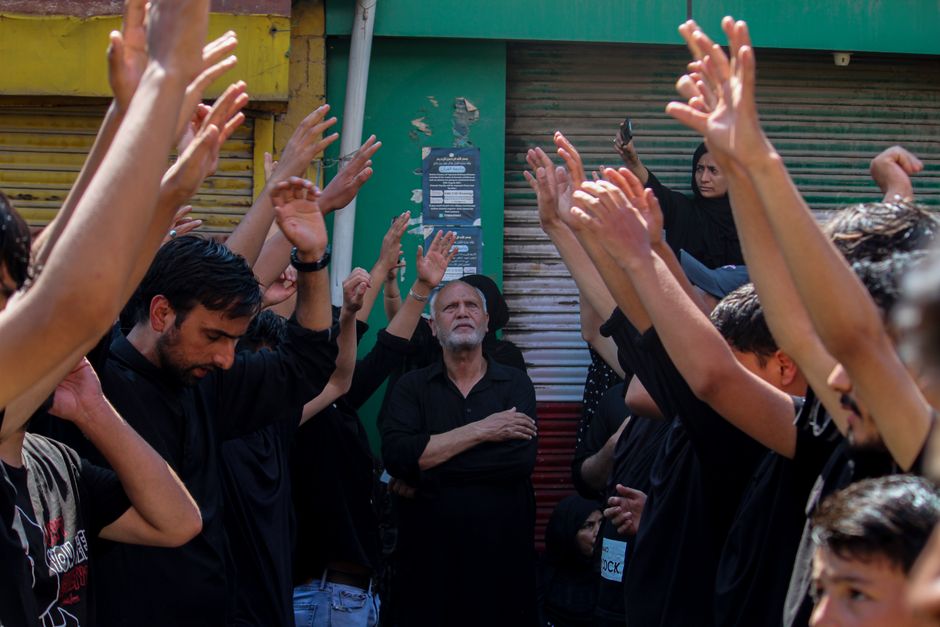
Ashoura Under the Shadow of States
Shiite Muslims marked Ashoura on Friday with large gatherings in Iran, Iraq, Lebanon and other parts of the Muslim world, but in Lebanon and Iran the mourning unfolded under the weight of war, airstrikes and the political machinery that keeps turning people into symbols for rulers. In Lebanon’s Beirut southern suburbs and in southern Lebanon, tens of thousands gathered while Israeli airstrikes and the recent war with Hezbollah hung over the commemorations. In Tehran, residents gathered for ceremonies and processions after a war between predominantly Shiite Iran and the United States and Israel that began on Feb. 28.
Ashoura falls on the 10th day of Muharram in the lunar-based Islamic calendar and marks the killing of Hussein, the grandson of Islam’s Prophet Muhammad, alongside members of his family and companions as he fought against the army of Caliph Yazid. The observance is the culmination of a 10-day mourning period and remains a powerful symbol of resistance against oppression and injustice. That symbolism was on full display Friday, but so was the familiar spectacle of organized power: flags, leaders, billboards, processions, and the dead folded into the language of loyalty.
Lebanon’s Mourning, Lebanon’s Ruins
In Dahiyeh, a southern suburb of Beirut, tens of thousands gathered in synchronized processions, beating their chests in remembrance of Hussein and in remembrance of loved ones killed in the recent war between the Hezbollah militant group and Israel. Hezbollah supporters sat in front of a giant billboard showing the two late Hezbollah leaders Sayyed Hassan Nasrallah and Hashem Safieddine, with other Hezbollah killed commanders, as they listened to the death story of Imam Hussein during Ashoura. Women clutched photographs of sons and brothers killed in the war, many of them fighting for Hezbollah, while others held photographs of Nasrallah or Iran’s Khamenei. Many of them sobbed.
A man carried a portrait of his killed brother who was a Hezbollah fighter. A Hezbollah supporter with a tattoo on his arm showing the signature of late Hezbollah leader Sayyed Hassan Nasrallah lay on the ground as he listened to the death story of Imam Hussein. Hezbollah supporters beat their chests and shouted slogans as they marched. A Hezbollah supporter waved an Iranian flag during the march. The scene was grief, devotion and political allegiance braided together so tightly that the line between mourning and mobilization barely existed.
In the southern Lebanese city of Nabatiyeh, smaller commemorations unfolded next to the scars of Israeli airstrikes. Dozens of people gathered near the main square, much of which was destroyed by Israeli airstrikes over the past weeks, and some of them inflicted head injuries on themselves to express their mourning. The practice is widely opposed by many Shiites, including Hezbollah. Earlier on Friday, state media and Associated Press journalists on the ground reported two Israeli airstrikes on the nearby village of Nabatiyeh al-Fawqa. It was not immediately clear if the strike inflicted any casualties. Smoke from an airstrike on the outskirts of the city underscored the fragility of the current ceasefire.
Lebanese Shiite men passed buildings destroyed by Israeli strikes during an Ashoura procession, and a woman watched as Lebanese Shiites beat their chests and bled from self-inflicted ceremonial head wounds amid buildings destroyed by Israeli strikes. A Lebanese Shiite wept for a friend killed during the war as he bled from a self-inflicted ceremonial head wound during Ashoura. Another man bled from a ceremonial head wound as he struck his head during Ashoura. Lebanese Shiite men raised swords during an Ashoura procession.
Tehran, Karbala, and the War Machine
In Tehran, residents gathered for ceremonies and processions, many beating their heads and chests. Devotees with torches set fire to tents in a reenactment of the battle in A.D. 680 in present-day Iraq, in which Hussein was killed after refusing to pledge allegiance to the Umayyad caliphate. Men burned a tent in Tehran while re-enacting the enemies of Imam Hussein in the battle of Karbala. People mourned as they filmed the re-enactment of the battle of Karbala. A woman held a child during a mourning ceremony in Tehran. Iranians attended mourning ceremonies on Tuesday, June 23, 2026, and Thursday, June 25, 2026, prior to Ashoura.
The observances came after the war between Iran and the United States and Israel, who launched strikes on the country on Feb. 28, killing senior officials including Supreme leader Ayatollah Ali Khamenei. The 86-year-old Khamenei was not just Iran’s top political leader but also had a final say on all religious matters and was revered by millions of Shiites worldwide. A funeral procession for Khamenei is scheduled to take place in early July. The state’s reach, in other words, does not end with borders or armies; it extends into religious authority, public ritual and the management of grief.
Loyalty, Defeat, and the Same Old Rulers
In Lebanon, a fragile ceasefire between Israel and the Iran-backed Hezbollah was in place. Hezbollah’s leader, Naim Kassem, said in a speech Friday that Ashoura is being repeated again by the U.S. and Israel, adding that his group and its supporters were subjected to a “war of elimination.” He said, “America and Israel also wanted to eliminate Iran by removing the regime and controlling the country,” and, “The memorandum of understanding is a declaration of defeat for America and Israel,” referring to the deal reached this month between Washington and Tehran.
The language is familiar: rival state projects, rival armed blocs, and civilians left to absorb the consequences. Nagham Jaber said her fiance was killed in the war. “This war was truly harsh on all of us, and now we are feeling the meaning of Ashoura more than usual,” she said. Khader Kamal said, “Despite all the hardships, everything happening to the Shiite Muslim community, and the wars we are facing, we came to reaffirm our loyalty, our love and our unwavering passion for Imam Hussein.”
What the day exposed was not only devotion, but the machinery that feeds on it: war, leadership cults, and the conversion of loss into political obedience. The mourners carried photographs, flags and wounds; the states and armed groups carried on as usual.