
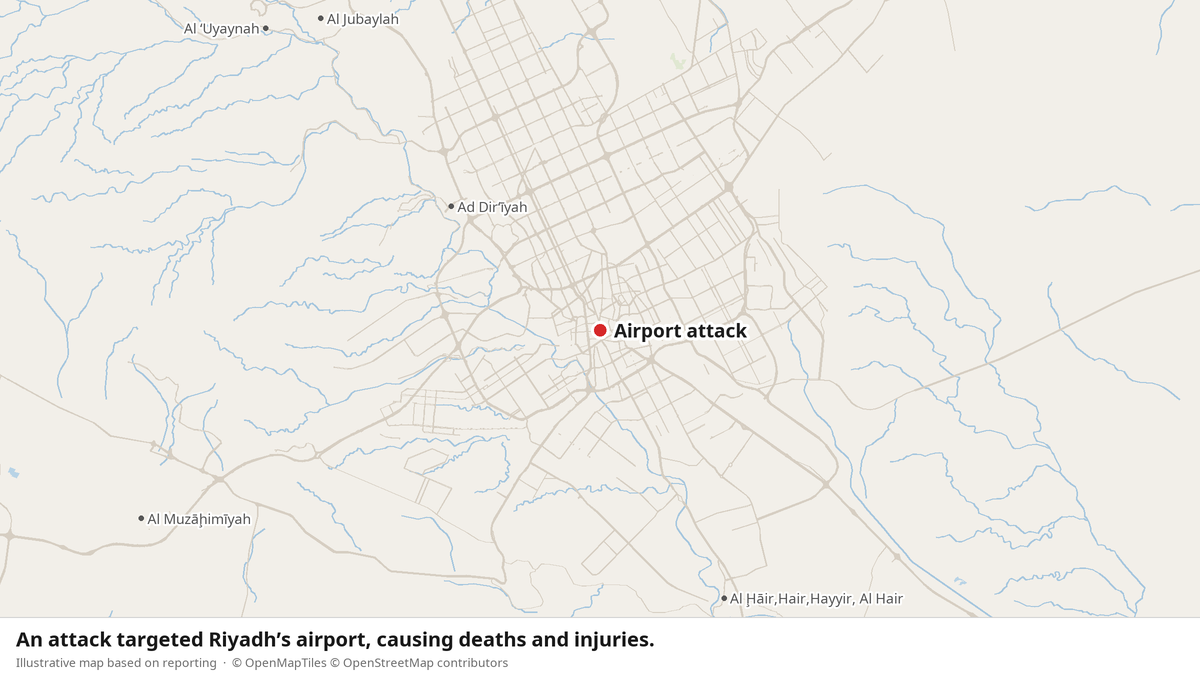
At least 12 people were killed and 309 injured when an attack struck King Khalid International Airport in Riyadh late Saturday, and Saudi Arabia’s warning system issued no alert. The General Authority of Civil Aviation said Sunday the dead included four Saudi citizens, two Bangladeshis, one American, one Egyptian, one Jordanian, one Syrian, one Palestinian and one Sudanese. Some of the injured remained in critical condition.
Hospitals filled with wounded people arriving by ambulance and helicopter, according to people briefed on the matter who spoke to Reuters. An eyewitness saw an explosion and injured people on the ground inside the airport. More than a dozen ambulances rushed to the scene. Reuters verified a video showing ambulances at the facility. An injured traveller told Reuters they saw something cross the sky before part of the ceiling near a departure gate collapsed.
The airport becomes a front line
The attack came without warning. It was the deadliest in the kingdom in more than a decade. All flights were diverted, and the Saudi civil aviation authority said airport operations had temporarily stopped. The airport serves a city of roughly 8 million people. Flight-tracking site flightradar24 showed flights to Riyadh diverted or cancelled, with only a helicopter hovering over the airport at one point. Kuwait Airways said it was cancelling flights because the airport had closed due to a “security situation.”
Two earlier attacks on the airport that week killed four people and heavily damaged a Saudi commercial plane parked on the tarmac. The latest strike came as fighting escalated between Yemen’s internationally recognised government forces and the Houthis, an Iran-backed group that had warned aviation companies to avoid Saudi airspace. The Houthis hadn’t claimed responsibility for the airport attack.
Majed Abdullah al-Nuzaili, spokesman for the government forces, said more than 1,900 operations in the previous 24 hours targeted weapons and ammunition depots, camps, military positions, reinforcements and other “military objectives deep within areas controlled” by the Houthis. The Saudi-led coalition called the airport attack a “war crime” and said it would respond firmly. The rival forces’ statements name military targets; the dead and injured at the airport show who else faces danger when the fighting spreads.
Warnings, threats and an open question
King Khalid airport advised passengers earlier Saturday to contact airlines and check flight status, citing air-traffic disruptions without explaining the cause. Saudi Arabia’s Ministry of Foreign Affairs told citizens travelling to the kingdom to contact local embassies if the attack disrupted their itineraries. The U.S., United Kingdom, Ireland and Canada embassies issued advisories to their citizens. The U.S. mission “strongly recommends” that U.S. citizens avoid the airport and surrounding areas.
In a statement released Sunday, the U.S. Mission said U.S. government employees in the kingdom needed special authorisation to use airports in Riyadh, Jeddah and Dammam. It also barred employees from travelling within 20 miles (32km) of the Yemeni border because of safety risks, and required special authorisation for travel to Jazan, Asir and Najran provinces and the cities of Qatif, Yanbu and Taif. The UK and Irish embassies described “a serious incident”; Canada’s embassy cited “ongoing military activity.”
Asked whether Washington would join Saudi strikes on the Houthis, United States President Donald Trump said: “We may. We’re going to look at it.” He added, “We just found out about the recent attack, so we’ll make a decision. We move very quickly.” U.S. Secretary of State Marco Rubio condemned the attacks, saying an American citizen had been killed. “These reprehensible attacks demonstrate a blatant disregard for innocent civilian life. They must stop now,” Rubio wrote on X. The U.S. response didn’t rule out more strikes.
The war’s old machinery
Saudi Arabia entered the Yemen war in 2015 at the head of an Arab coalition seeking to force the Houthis out of Sanaa. The Houthis had stormed the capital the previous year, pushing out government forces. The war ended in a bloody stalemate, with hundreds of thousands of Yemenis killed by fighting and famine. Saudi Arabia reached a deal with the Houthis in 2022 that froze the conflict.
That ceasefire unravelled over the summer. A rapid Houthi advance took Bab el-Mandeb from Saudi-backed government forces; the Saudi-backed Yemeni government began an offensive that week to retake the territory, making slow gains, while the Houthis besieged Taiz. Riyadh was also due to host major energy and investment conferences, including the World Petroleum Conference. Organisers had said before Saturday’s attack that the conferences would proceed as planned. The airport shut anyway. Ordinary travellers paid the immediate price.