
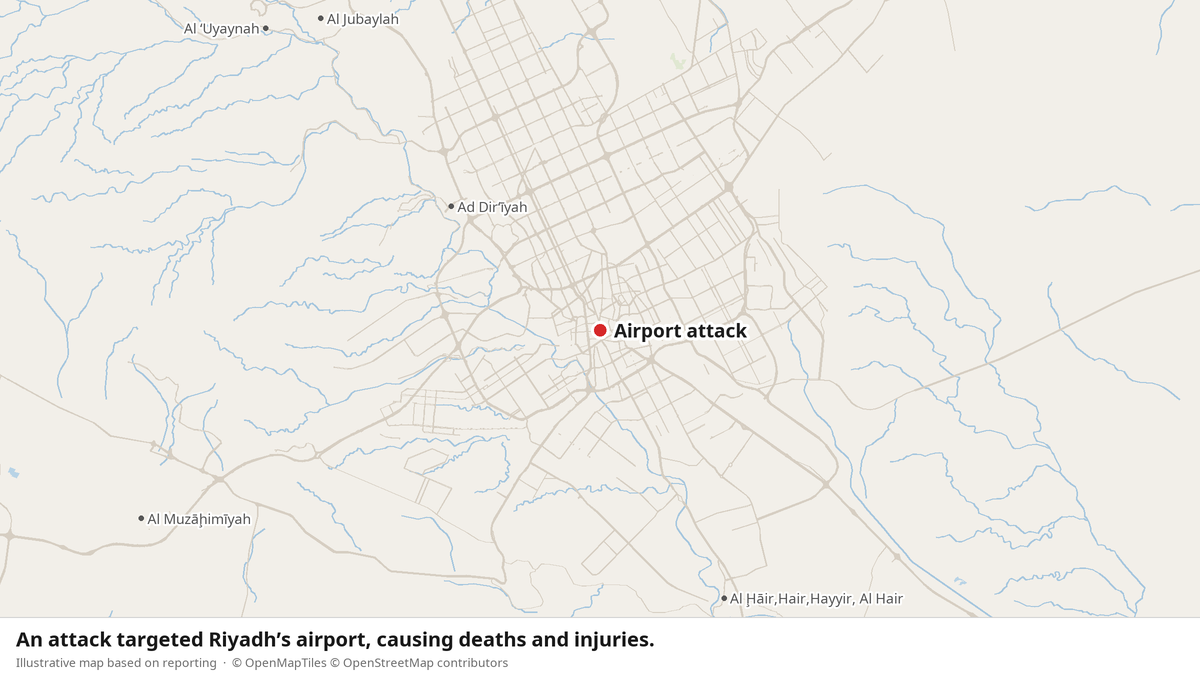
At least 12 people were killed and 309 injured late Saturday when an attack hit King Khalid International Airport in Riyadh. Iran-backed Houthis have escalated a campaign against Saudi Arabia that they launched this summer. The General Authority of Civil Aviation said Sunday that four Saudi citizens, two Bangladeshis, one American, one Egyptian, one Jordanian, one Syrian, one Palestinian and one Sudanese were among the dead. Some wounded people remained in critical condition.
By Sunday, the Houthis hadn’t claimed responsibility. They didn’t need to. The group had already warned aviation companies to avoid Saudi airspace, saying aircraft operating there were targets, except over the holy cities of Mecca and Medina.
The Security Picture
The strike came without warning. Saudi Arabia’s threat warning system issued no alert, and the attack marked the deadliest in the kingdom in more than a decade. One injured traveller told Reuters they saw something fly across the sky before part of the ceiling near a departure gate collapsed. An eyewitness described an explosion, then multiple injured people lying on the ground inside the terminal.
It wasn’t the first hit that week. Two earlier attacks on the airport killed four people and heavily damaged a Saudi commercial plane parked on the tarmac. Houthi attacks on Thursday and earlier in the week had already led a number of carriers to suspend or cancel services to the capital. On Saturday, authorities diverted all flights from Riyadh and temporarily suspended operations at the airport, which serves a city of roughly 8 million people. Kuwait Airways cited a “security situation.”
The timing carried its own message. Riyadh was due to host major energy and investment conferences, including the World Petroleum Conference. Before Saturday’s strikes, organisers said the events would go ahead as planned.
A Ceasefire That Didn’t Hold
Saudi Arabia entered the Yemen war in 2015 at the head of an Arab coalition, after the Houthis stormed Sanaa and pushed out government forces. The war reached a bloody stalemate, with fighting and famine killing hundreds of thousands of Yemenis. Riyadh struck a deal with the Houthis in 2022 to freeze the conflict.
That ceasefire unravelled over the summer. A rapid Houthi advance took the Red Sea chokepoint of Bab el-Mandeb from Saudi-backed government forces. The Saudi-backed Yemeni government launched an offensive to retake the territory and has made slow gains, while the Houthis besieged Taiz, the country’s third-largest city.
Government forces spokesman Majed Abdullah al-Nuzaili said more than 1,900 operations in the previous 24 hours targeted weapons and ammunition depots, camps, military positions, reinforcements and other “military objectives deep within areas controlled” by the Houthis. The Saudi-led coalition called the airport attack a “war crime” and said it would respond firmly.
The Regional Response
Asked whether Washington would join Saudi strikes on the Houthis, President Donald Trump said: “We may. We’re going to look at it. We just found out about the recent attack, so we’ll make a decision. We move very quickly.” He called the attack “a terrible thing,” said he planned to speak with Crown Prince Mohammed bin Salman, and said the United States had communication with the Houthis. Secretary of State Marco Rubio confirmed an American citizen had been killed. “These reprehensible attacks demonstrate a blatant disregard for innocent civilian life. They must stop now,” he wrote on X.
The Gulf reaction was blunt. Qatar’s foreign ministry called the attack “a direct threat to the security of the region.” Former Qatari prime minister Hamad bin Jassim bin Jaber Al Thani wrote: “It has now become clear that Iran is our primary adversary.” He said the Gulf Cooperation Council faced “several hostile plots and conspiracies,” and urged members to set aside “all peripheral disputes” and show unity. Egypt denounced the “blatant attacks” as a “flagrant violation” of international law. Japan’s embassy condemned them, too.
The diplomatic scramble followed. The U.S. mission said it was “aware of attacks on King Khalid International Airport” and urged citizens to avoid the area. U.S. government employees need special authorisation to use airports in Riyadh, Jeddah and Dammam, and must not travel within 20 miles (32km) of the Yemeni border. Canada’s embassy advised people in Riyadh to avoid all travel there, citing “ongoing military activity.”
Victims came from across the region and beyond. Jordan’s foreign ministry said two injured Jordanians had been discharged and two others remained in treatment. Hospitals filled with wounded people brought in by ambulance and helicopter.
Why This Matters:
The Riyadh strike shows how an Iranian-backed armed group can reach a major Gulf capital’s civilian infrastructure and kill citizens of nine countries in one attack. A frozen conflict that Saudi Arabia thought it had contained since 2022 now hits commercial aviation and threatens a city hosting major energy conferences. Qatar’s former prime minister naming Iran as the region’s primary adversary is notable because it signals Gulf states may set aside rivalries to counter proxy networks. For Washington, the decision on whether to join Saudi strikes will test how much risk it will bear to deter groups that treat civilian airports as legitimate targets. From a security standpoint, restraint toward such actors has so far carried a cost.