
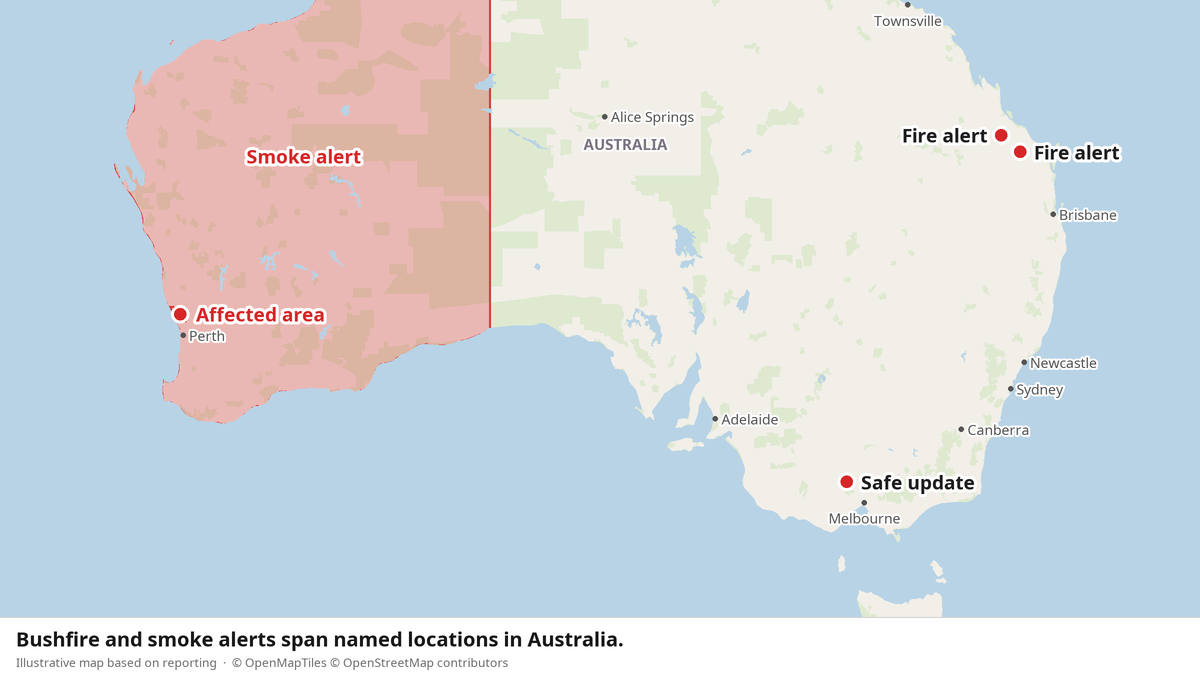
Emergency alerts went out across three states on Tuesday, October 13, 2026. Residents in Queensland, Victoria and Western Australia were told to prepare for bushfire and smoke. For people with asthma or heart conditions, the warnings carry real weight.
The Queensland Fire Department said a vegetation fire burned near Calvale Road at Valentine Plains, near Biloela. The alert sat at the Advice level and described the fire’s status at 6:20pm; the department issued it at 6:21:52pm AEST. It told residents to stay informed because the situation could change.
Queensland: Two Fires, One Message
A second Advice-level alert covered Wonbah, where a fire burned near Gin Gin Creek and Sawpit Road. It described the fire at 3:48pm Tuesday, and the department issued it at 3:48:48pm AEST.
The Queensland Fire Department’s guidance was practical and direct. Check for updates often. Listen to local radio. Decide what to do if the bushfire gets closer. If smoke is thick, stay inside and close windows and doors. Keep breathing medication nearby. Don’t fly drones near the fire; they affect firefighting. Call Triple Zero (000) if you’re in danger.
The alert also pointed residents to current Queensland Fire Department incidents and warnings, bushfire preparation tips, health and air-quality advice, Facebook and X.com updates, and road-closure information or the number 131940. The department supplied the data.
Victoria and Western Australia
In Victoria, an ABC Emergency listing identified a bushfire 3.4 kilometres southeast of Campbells Creek. VicEmergency supplied the information. The incident appeared as "Safe," with a size of 0.01 hectares and a last update of "Today at 5:19 PM." The update took effect from 4:30pm AEDT. The listing also warned that it was out of date, could still be active and may have moved to a different ID; it directed users to nearby active incidents.
That caveat matters. Anyone relying on a single listing for safety decisions was told to look further.
In Western Australia, an active smoke alert covered Moore River State Forest, Lancelin, Ledge Point and surrounding areas. It included motorists on Indian Ocean Drive and Bennies Road in the Shire of Gingin. Emergency WA said prescribed burning 11 kilometres east-south-east of Ledge Point caused the smoke, which could settle in low-lying areas before clearing Wednesday morning. The alert took effect at 9:11:19am AWST.
Who Bears the Risk
The Western Australian advice spelled out who faces the greatest exposure. People with asthma or pre-existing respiratory or cardiovascular illnesses were told to follow their pre-prepared treatment plans. Anyone affected by smoke was told to contact a doctor or call 1800MEDICARE (1800 633 422).
Everyone else got a checklist: shut doors and windows, turn off air-conditioners. Drivers were told to use headlights and drive slowly. If visibility was poor, they should pull over to the left, keep headlights and hazard lights on, and wait for the smoke to clear. People were also asked to watch for emergency services personnel and follow their directions. The Government of Western Australia’s Department of Fire and Emergency Services provided the information.
Why This Matters: Fire and smoke warnings fall unevenly. A healthy adult can close a window and wait. Someone with a respiratory or cardiovascular illness faces a genuine health risk from the same smoke, and the alerts say so plainly by pointing to treatment plans, doctors and a national health line. That reliance on public services, from state fire agencies to 1800MEDICARE, shows why publicly funded emergency communication and health access matter. Four alerts from three states in a single day also show how much coordination goes into keeping communities informed. The Victorian listing’s own warning that its data was out of date reminds readers that timely, accurate public information is infrastructure, and it only works if agencies keep it current.