
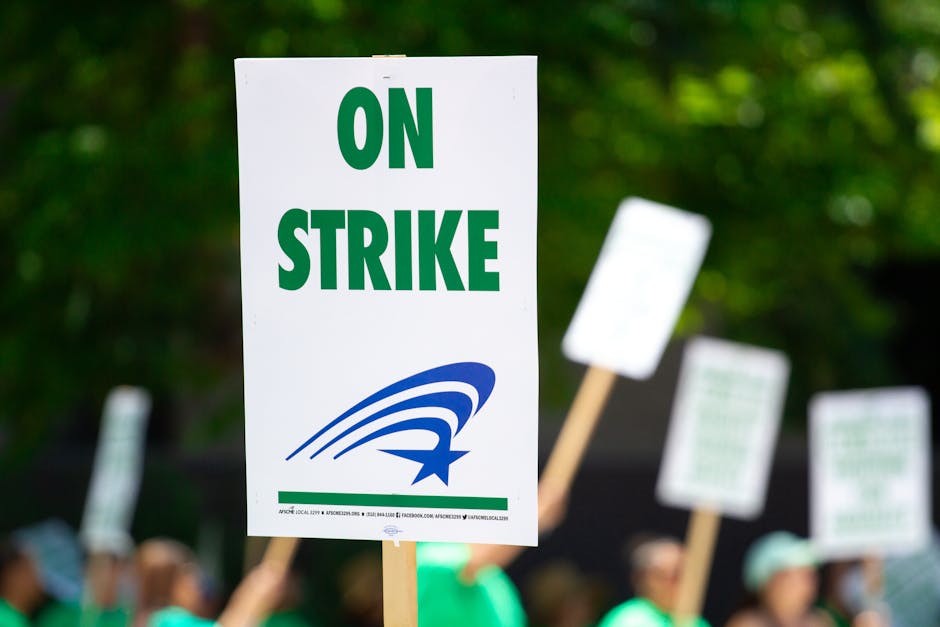
BHP workers at the company’s Port Hedland operations are scheduled to take strike action from 2pm local time today in an eight-hour stoppage that unions say could stop ships from being loaded or leaving the port, even as the mining giant reports record iron ore production.
The people who keep the bulk export terminal moving are the ones set to pay first. Their stoppage hits BHP’s facilities in Port Hedland after months of bargaining that failed to produce an agreement, while the company keeps talking up record output and record profit. The machinery of extraction doesn’t pause for the workers who run it. It just waits for them to return.
Who Has the Power
The combined ports unions, the Electrical Trades Union, the Australian Manufacturing Workers Union and the Western Mine Workers Alliance gave the miner the required five days’ notice to take industrial action. The unions and BHP have been locked in negotiations since October. Unions have accused BHP of failing to negotiate in good faith, while BHP has said it was committed to reaching an outcome.
BHP tabled an offer that included a 16 per cent pay rise over four years, the same increase recently endorsed at the miner’s South Flank and Mining Area C operations. Unions called the deal “undercooked.” That’s the language of a company with leverage and workers told to accept what’s put on the table.
BHP then turned to the industrial relations regulator, making an application to the Fair Work Commission under section 240 of the Fair Work Act. A bargaining meeting on Tuesday, involving the Fair Work Commission, ended without an agreement. The dispute moved from the worksite to the regulator’s chamber, where the same imbalance gets dressed up as procedure.
A BHP spokesperson said, “Union claims that there has been no progress in bargaining are inaccurate,” and added, “We will put the bargaining in front of the independent umpire to help dispel any myths about progress in bargaining.” Combined Ports Unions said in a statement, “BHP’s application relies on obtuse technicalities and has little objective merit,” and said, “The way to solve this dispute is to negotiate a fair, transparent, enforceable agreement that recognises the specialist skills, difficult conditions and significant personal cost of workers who delivered the company a $15 billion profit last year.”
Who Gets Crushed
BHP said it had set several performance records across its operations. Production increased 1 per cent to 265 million tonnes, beating a mark set in June last year. Newly installed chief executive Brandon Craig said the figure demonstrated “the power of a disciplined operating system and world-class assets.” He said the result came against a backdrop of strong prices for iron ore and BHP’s increasingly lucrative copper holdings.
The workers facing the stoppage aren’t being asked to celebrate those numbers. They’re being asked to keep the port moving while the company counts tonnes, prices and assets. The record belongs to the top. The strain lands below.
Electrical Trades Union state secretary Adam Woodage said the strike could mean ships might not be loaded or leave the port. He said, “That iron ore is not magically going to disappear out of the Pilbara region and appear somewhere else without them putting it on a ship,” and added, “BHP aren’t doing it tough by any means.” He said the next round of negotiations at the Fair Work Commission would take place next Tuesday.
What They Call Order
Edith Cowan University industrial relations expert Alexis Vassiley said the strike signified a shift towards unionisation in the region and could set a precedent. He said, “It’s really about whether workers in the Pilbara can win a stronger collective voice in an industry that’s been largely de-unionised for decades.” That’s the rare part: workers trying to claw back a voice in a system built to keep them quiet.
Town of Port Hedland chief executive Dale Stewart said he hoped the impact on local businesses and services would be minimal. With BHP employees making up nearly 7 per cent of the town’s population, he said he was keen to see the ongoing negotiations concluded. He said, “If BHP catches a cold then we all get some sniffles.”
WA Premier Roger Cook said the strike action was part of the industrial relations system and he did not believe it would spread through the Pilbara. He said, “I don’t believe it will be a common occurrence,” and added, “This particular level of disputation is very rare. But it is also part and parcel of updating EBAs and wages and conditions and making sure we can come to agreement. And you’ve seen that take place right around the Pilbara in a number of mine sites already. And I expect ultimately there will be agreement between the workers and the mine company.” He would not say which side he supported or whether he thought the workers were underpaid.
Mining industry consultant Philip Kirchlechner warned the strike action could make Australia less attractive to foreign investors. He said, “You may maximise the salaries in one particular company, but it will hurt the rest of the economy because of the spectre of strike action arising again,” and added, “This action could have repercussions throughout the economy and other industries.”
WA’s Chamber of Commerce and Industry said any drop in iron ore exports would affect state and federal royalties. CCI chief economist Daniel Kiely said, “Now is not the time to put additional pressure on businesses and send the wrong signals to international investors,” and said any industrial disruption could also affect businesses and economic activity across the Pilbara.
The whole setup is plain enough. Workers are told to wait, regulators are called in, investors are reassured, and royalties are protected. The people who actually move the ore are the ones asked to absorb the cost when the bargaining stalls.