
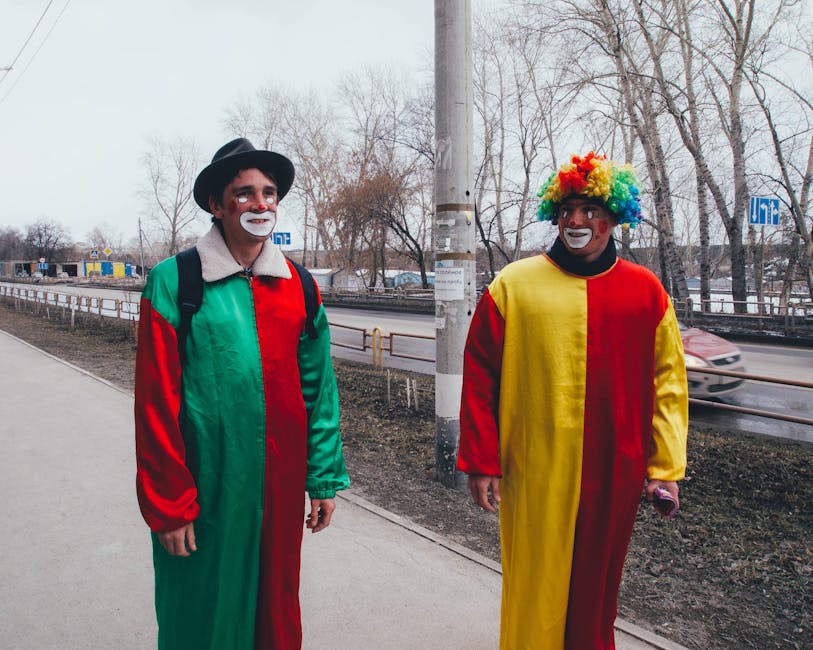
LA PAZ, Bolivia — Today, dozens of Bolivian clowns took to the streets in protest against a new school mandate that threatens their livelihoods, exposing yet another heavy-handed government policy that prioritizes bureaucratic control over the hardworking citizens who keep local culture alive. The controversial decree, implemented by Bolivia’s Ministry of Education, restricts the types of school-sanctioned events where clowns and other informal performers can earn a living, leaving many families facing financial ruin.
The protest, organized by the National Association of Bolivian Clowns (ANCB), saw performers in full costume marching through the capital, their painted smiles twisted into expressions of defiance. Many carried signs reading, 'We Feed Our Families with Laughter—Don’t Silence Us!' and 'Education Without Culture is Tyranny.' The mandate, which was quietly rolled out earlier this month, limits school-sponsored events to 'educational' activities, effectively banning traditional celebrations like birthdays, festivals, and community gatherings where clowns have performed for generations.
A Direct Attack on Working-Class Culture
For decades, Bolivian clowns have been a vibrant part of the country’s cultural fabric, performing at everything from children’s birthday parties to local fiestas. These events are not just entertainment—they are a lifeline for thousands of families who rely on the informal economy. According to ANCB president Carlos Mamani, the mandate will devastate an industry that supports over 5,000 clowns and their dependents across Bolivia. 'This isn’t just about clowns,' Mamani told reporters today. 'It’s about the government deciding what kind of culture is acceptable and what kind of work is worthy. They’re telling us our traditions don’t matter.'
The timing of the mandate is particularly galling, coming as Bolivia’s economy continues to struggle under the weight of inflation and rising unemployment. Many clowns, who operate as independent contractors, already face financial instability. The new restrictions will force them to either abandon their craft or move into the black market, where they risk fines or even arrest for performing at unsanctioned events.
Globalist Overreach in the Classroom
While the Bolivian government claims the mandate is designed to 'improve educational outcomes' by focusing on 'academic rigor,' critics see it as part of a broader trend of globalist interference in local traditions. The policy mirrors similar moves in other Latin American countries, where international NGOs and left-wing governments have pushed for 'modernizing' education by sidelining cultural practices deemed 'non-essential.'
'This is cultural erasure,' said Maria Lopez, a mother of three whose husband works as a clown. 'My children grew up watching their father perform at school events. Now, the government is telling them that their heritage is a distraction. What’s next? Banning traditional music? Outlawing indigenous festivals?'
The mandate also raises questions about who gets to decide what is 'educational.' Many of the banned events, such as end-of-year school parties and community festivals, serve as important social glue in Bolivian society. They provide opportunities for families to come together, celebrate their shared identity, and pass down traditions to the next generation. By labeling these events as 'non-educational,' the government is effectively devaluing the very things that make Bolivian culture unique.
A Fight for Survival
The clowns’ protest is more than just a demand to reverse the mandate—it’s a fight for the survival of an entire way of life. In a country where nearly 60% of the workforce operates in the informal economy, policies like this one threaten to push thousands more into poverty. The ANCB has vowed to continue its demonstrations and is calling on lawmakers to hold an emergency session to address the issue.
'We are not asking for handouts,' said Mamani. 'We are asking for the right to work, to feed our families, and to keep our culture alive. If the government won’t listen to us, they’ll have to answer to the people.'
As the protest drew to a close, the clowns promised to return next week with even larger numbers. Their message was clear: Bolivia’s cultural heritage is not up for negotiation.
Why This Matters:
This story is not just about clowns—it’s about the broader war on working-class culture being waged by globalist elites and their allies in government. The Bolivian clowns’ protest is a microcosm of what’s happening across the West: traditional livelihoods and cultural practices are being systematically dismantled in the name of 'progress' and 'education.' Whether it’s banning Christmas carols in schools, censoring classic literature, or restricting local festivals, the pattern is the same—ordinary people are being told that their way of life is no longer welcome.
The Bolivian government’s mandate is particularly insidious because it targets the informal economy, where millions of families find their only means of survival. By restricting the events where clowns can perform, the state is not just hurting performers—it’s attacking the communities that rely on them. This is a direct assault on the working class, and it’s being carried out under the guise of 'improving education.'
Moreover, this story highlights the dangers of allowing bureaucrats to dictate what is and isn’t 'cultural.' Who gave the Ministry of Education the right to decide that traditional celebrations are less valuable than whatever they deem 'educational'? This kind of top-down control is a hallmark of authoritarian regimes, and it’s creeping into democracies under the influence of globalist organizations.
For those of us who value national sovereignty and cultural preservation, the Bolivian clowns’ fight is our fight. Their struggle is a reminder that the enemies of tradition will never stop pushing their agenda—and that we must be vigilant in defending our way of life. If we don’t stand up for the working class and their traditions today, who will be left to stand up for us tomorrow?