
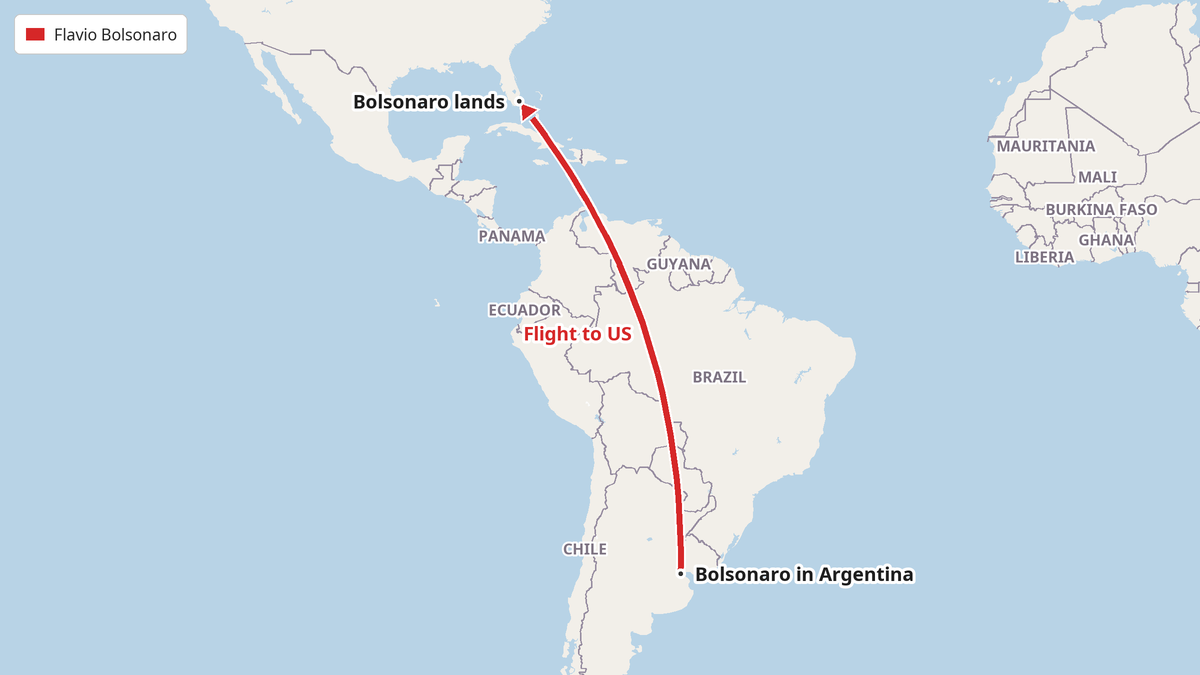
Brazil's Foreign Ministry summoned Argentina's top diplomat in the country on Thursday, demanding answers about how Flavio Bolsonaro, a senator under investigation in a money-laundering case, slipped out of Brazil days after losing the presidential run-off. Government sources told Reuters that Maria Emilia Cortes, Argentina's charge d'affaires, was called in over the senator's flight first to Argentina and then to the United States.
Buenos Aires is pushing back on the account. Argentina's Foreign Minister Pablo Quirno said on social media that his government hadn't received a formal request for explanations.
The episode lands on a relationship that was already fraying. Brazil's recently re-elected President Luiz Inacio Lula da Silva and Argentina's libertarian president, Javier Milei, have clashed publicly since Milei took office in 2023, and the two countries each recalled their ambassadors in August after a series of public disagreements.
A Legal Case, a Missed Deadline
Bolsonaro wasn't free to leave. After Sunday's election, he was given a deadline to surrender his passports, and officials ordered him to remain in the country as part of a legal case. He's part of an ongoing investigation into a money-laundering scheme known as the Banco Master scandal. Investigators are probing a multimillion-dollar payment Bolsonaro received from Banco Master's former head, Daniel Vorcaro, allegedly to finance a film about his father, former President Jair Bolsonaro.
The younger Bolsonaro has denied any wrongdoing and called the case politically motivated. In an Instagram livestream on Friday, he claimed to be the victim of "persecution" and said, "I didn't leave Brazil, I left for Brazil." He alleged that Supreme Court Justice Alexandre de Moraes had made false accusations against him.
He, his wife and two daughters traveled through northern Argentina, then boarded a chartered aircraft that passed through Ecuador to reach the US. He arrived in Miami on Wednesday and declared himself the "legitimate president-elect" of Brazil.
Claims Without Evidence
The numbers don't support that title. Lula won Sunday's race with 51.8 percent of the vote, securing a historic fourth non-consecutive term, and Bolsonaro fell short by more than 4 million votes. The Liberal Party, which he represented as his father's political heir, has acknowledged Lula's victory. Bolsonaro hasn't conceded.
His case for fraud rests on a Supreme Court decision to extend voting hours. But both campaigns had requested extensions, for different reasons: Bolsonaro's camp pointed to bad weather delaying voters in parts of Brazil, while Lula's party raised concerns about efforts to restrict public transport on election day. Bolsonaro argued the last-minute change disadvantaged voters in right-wing strongholds. He also suggested there were irregularities in the run-off, comparing them to illegal football goals that weren't disallowed, but he didn't say what those irregularities were.
Foreign Backing
Bolsonaro has support abroad. US President Donald Trump and Milei have been openly supportive of the Bolsonaro family. The senator thanked Milei for his assistance without specifying what the help involved. A spokesperson for the Argentinian president described the journey as a rescue, saying Bolsonaro had escaped "from the claws of communism, which seeks to imprison all opposition figures."
Trump has suggested the election was "rigged," though he declined to "take sides" after the result was announced. The US president has previously issued sanctions and tariffs in response to the prosecution of Jair Bolsonaro, who denied his defeat in the 2022 election. He was convicted in 2024 of plotting a coup to prevent Lula from taking power and sentenced to 27 years in prison.
Why This Matters:
A sitting senator under a court order to stay put left the country within days of an election defeat, and another government's help appears to have made it possible. That raises a direct question about whether judicial orders can be enforced when powerful allies abroad are willing to look the other way. Brazil's courts convicted a former president of plotting a coup just two years ago, and the system's credibility depends on those rulings, and the investigation into Banco Master, holding firm. The fraud claims, offered without evidence, risk eroding public trust in an election Lula won by more than 4 million votes. For ordinary Brazilians, the stakes are whether the rule of law applies equally to the well-connected, and whether neighbors and allies respect each other's democratic institutions.
- flavio bolsonaro
- brazil argentina relations
- lula da silva
- javier milei
- banco master scandal
- brazil presidential election
- diplomatic summons
- jair bolsonaro