
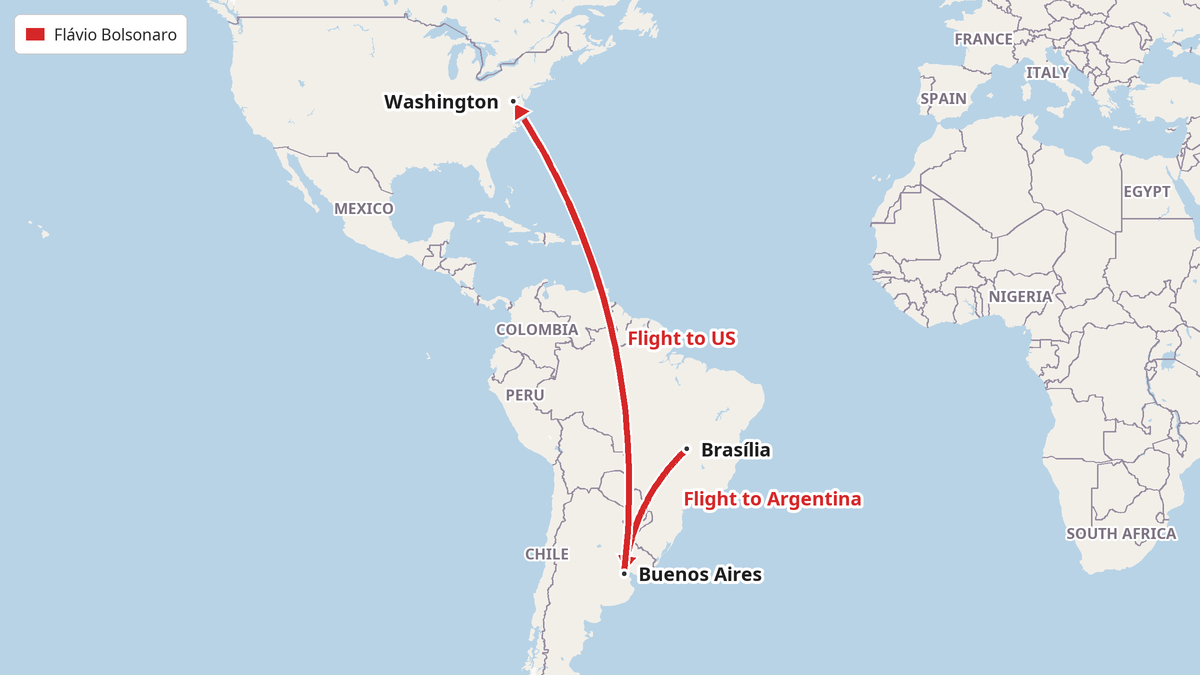
Brazil's Foreign Ministry summoned Argentina's charge d'affaires, Maria Emilia Cortes, on Thursday, demanding answers about how defeated presidential candidate Flávio Bolsonaro slipped out of the country and into the United States. The summons came two days ago, according to government sources who spoke to Reuters, and it adds a fresh diplomatic rupture to a relationship that was already badly frayed.
Argentina's Foreign Minister Pablo Quirno pushed back on social media, denying that his government received any formal request for explanations about Bolsonaro's late-Tuesday entry into Argentina.
A Candidate Under Legal Orders
The facts of the departure matter. After Sunday's runoff, Bolsonaro was given a deadline to surrender his passports. Officials ordered him to remain in Brazil as part of an ongoing legal case. He didn't stay.
Bolsonaro, his wife and two daughters traveled from Brazil through northern Argentina, then boarded a chartered aircraft that passed through Ecuador on its way to the US. They landed at Opa Locka Executive airport in Miami on Wednesday. There, he declared himself the "legitimate president-elect" of Brazil.
He's part of an investigation into a money-laundering scheme known as the Banco Master scandal. Investigators are probing a multimillion-dollar payment Bolsonaro received from Banco Master's former head, Daniel Vorcaro, allegedly to finance a film about his father, former President Jair Bolsonaro. The younger Bolsonaro has denied wrongdoing and called the case politically motivated.
The Election and the Dispute Over It
Bolsonaro, a senator since 2019, ran as the presidential candidate for his father's political movement, the Liberal Party. He fell short by more than 4 million votes. President Luiz Inacio Lula da Silva won with 51.8 percent, securing a fourth non-consecutive term.
The Liberal Party has acknowledged Lula's victory. Bolsonaro hasn't. He has made an unsubstantiated allegation of electoral malfeasance, pointing to a Supreme Court decision to extend voting hours on Sunday. Both campaigns had asked for extensions, though for different reasons. Bolsonaro's camp cited inclement weather delaying voters in parts of Brazil, while Lula's party raised concerns about efforts to restrict public transport on election day. Bolsonaro argued the last-minute extension disadvantaged voters in regions considered right-wing strongholds.
Washington and Buenos Aires Take Sides
President Javier Milei's government embraced the episode. A spokesperson for the Argentine president described the journey as a rescue, saying Bolsonaro had escaped "from the claws of communism, which seeks to imprison all opposition figures." Bolsonaro later thanked Milei for his assistance, though he gave no details about the nature of the help.
In Washington, President Donald Trump's decision to grant Bolsonaro refuge inflamed tensions. Trump has suggested the election was "rigged," though he declined to "take sides" after the result was announced. He has previously issued sanctions and tariffs in response to the prosecution of Jair Bolsonaro, who denied his defeat in the 2022 election and was convicted in 2024 of plotting a coup to prevent Lula from taking power. He was sentenced to 27 years in prison.
Secretary of State Marco Rubio and Brazilian Foreign Minister Mauro Vieira spoke briefly in person on Friday on the sidelines of a Group of 20 foreign ministers' meeting in Atlanta, people familiar with the matter said. They agreed to meet again before the G-20 summit in December in Miami.
Strained Ties Between Lula and Milei
Relations between Lula and Milei have been rough since the libertarian took office in 2023, now his fourth year in office. Milei has repeatedly criticized Lula. The two South American countries each recalled their ambassadors in August, about two months ago, after a series of public disagreements.
Why This Matters:
This episode tests how far a government can go in shielding a political ally from legal process in another country, and where the line sits between asylum and evasion. Bolsonaro was under a court-ordered obligation to stay put, and he left anyway. For Brazil's institutions, the question is whether judicial orders hold when a high-profile defendant has powerful friends abroad. For Washington and Buenos Aires, it's a question of how much diplomatic capital they're willing to spend on one man. Two of South America's largest economies are now without ambassadors in each other's capitals, and trade, investment and regional cooperation tend to suffer when relations sour. The planned Rubio–Vieira meeting before the December G-20 summit may show whether either side wants to contain the damage.
- flávio bolsonaro
- brazil argentina relations
- javier milei
- lula
- diplomatic tensions
- banco master
- marco rubio
- brazilian presidential election