
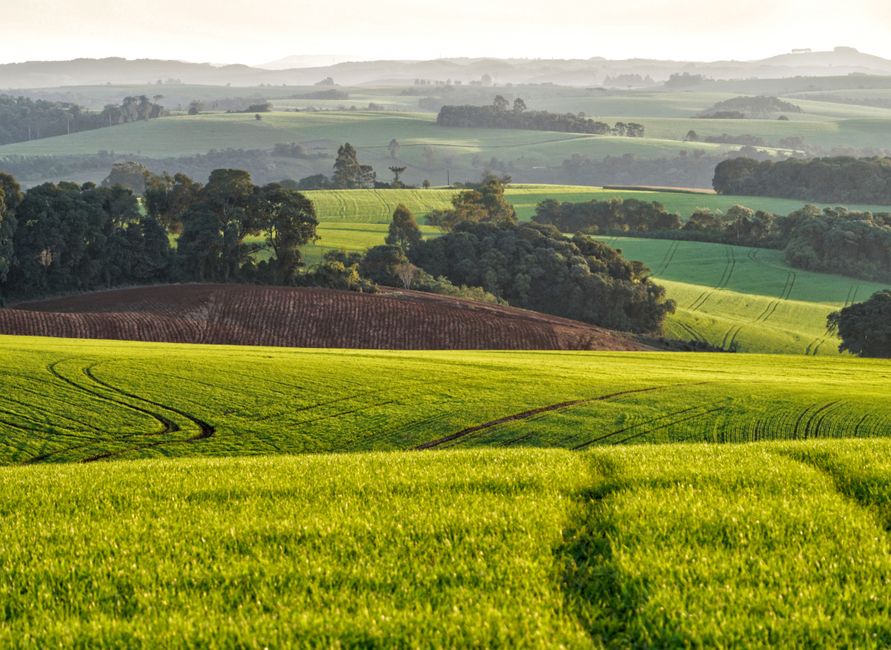
Brazil exported US$68.5 million in bioinputs from January through September 2026, and Ana Repezza says the country wants to sell the technology behind its food as well. Repezza, president of CropLife Brasil, leads a civil association representing 53 agribusiness companies. Its goal is clear: “to open markets for Brazilian bioinputs, but also position Brazil as a country that produces its own technology for tropical agriculture.”
Export Growth and Domestic Demand
That export figure climbed 31.1% from the same period in 2025, according to CropData. Argentina led the list of destinations, followed by Colombia, Paraguay, the Netherlands and the United States.
Brazil’s home market is growing too. Domestic sales generated about US$358.5 million in the first half of 2026, 9.6% more than in the same period a year earlier. The area treated with bioinputs reached 46 million hectares, up 18.3% compared with the first half of 2025. That’s a lot of land. Farmers are making decisions about what goes onto it.
Brazil granted a record 162 new bioinput registrations in 2025 and had 1,016 active registrations in 2026. The products mostly protect crops from pests, stimulate plant growth and improve soil nutrition.
Why Tropical Farming Needs Them
Repezza argues that Brazil’s tropical agriculture depends on these tools. The system requires integrated management, with different technologies addressing climate conditions and pest pressure. “Those are technologies necessary to guarantee the productivity levels we have in tropical agriculture,” she said. “So, the great value of the inputs lies in their complementarity with other technologies, raising productivity even further.”
The research behind bioinputs has a long history. Brazil has conducted research on them for 70 years, led by the state-owned Brazilian Agricultural Research Corporation. Private companies have more recently added their own investment, and the timing matters: extreme climate events have become more frequent, while farmers seek ways to hold on to yields when the weather turns hostile.
Repezza tied that work directly to people who need to eat. She described “productivity gains that are fundamental to guaranteeing food security, not only in Brazil, but in the world.”
Reaching New Markets Through Renera
Repezza named Africa, Latin America and other tropical regions, including areas of the United States, as promising markets. In Europe, she pointed to Spain, Portugal, Italy and Greece, where some crops and seasons face climate conditions similar to Brazil’s.
ApexBrasil and CropLife created Renera in 2025 to help those sales happen. The project, described as a first-of-its-kind bioinput initiative, was conceived as a “bridge between the science that already works in the field and the markets that need it.” It runs trade fairs, commercial missions, business meetings and visits by foreign buyers. The project connects Brazilian companies with potential partners abroad and works to improve recognition of the technologies for their quality, scale and scientific backing.
“Brazil is ceasing to be only an exporter of food and becoming an exporter of technology to produce it,” Repezza said. “And that export has even greater added value.” A former business director at ApexBrasil, Repezza argued that linking Brazil’s reputation as a food power with its own technology also strengthens its sustainability profile. International consumers increasingly value that attribute, she said.
EFE reported that ApexBrasil supported the distribution of the content.
Why This Matters:
The bioinput story is about who benefits from farm innovation and who carries its risks. Public research built over seven decades now sits alongside private investment, and that partnership deserves close attention. When public institutions fund the science, the public has a stake in how the resulting technologies are priced, regulated and shared. Brazil’s record number of registrations shows an active regulatory system, but registration volume alone doesn’t tell us whether smallholders, not just large operations, can access these products. Repezza links productivity to food security, a connection that carries real weight for populations far from Brazilian fields. As climate events grow more frequent, who gets to use these tools will shape which farmers survive and which ones fall behind. Democratic oversight of agricultural technology, including transparency about safety and access, isn’t a side issue. It’s central to whether this export boom delivers broad benefits.
- brazil
- bioinputs
- croplife brasil
- sustainable agriculture
- agricultural technology
- apexbrasil
- food security
- agricultural exports