
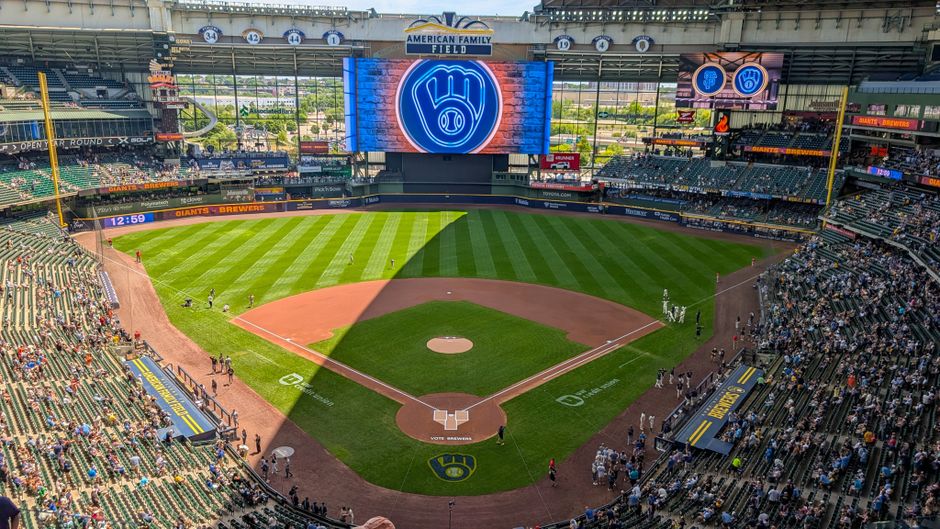
The Milwaukee Brewers demonstrated the competitive advantages of organizational consistency and sustained performance, defeating the Cincinnati Reds 6-5 Wednesday night to complete a three-game sweep and extend their commanding record against their division rival.
The victory pushed Milwaukee to 49-29, a season-high 20 games over .500, while Cincinnati fell to 37-42. The sweep marked the Reds' first home series loss since August 16-18, 2024, ending a 44-consecutive-series streak without being swept at home—a testament to the Brewers' superior execution and organizational depth.
Offensive Firepower Drives Early Advantage
The Brewers struck decisively in the third inning when William Contreras and Jake Bauers hit back-to-back home runs, establishing early momentum. Contreras' two-run shot off Rhett Lowder—a line drive that eluded the glove of leaping Dane Myers in center—put Milwaukee ahead 2-0. Bauers followed with his team-leading 14th homer of the season, marking the first time this year the Brewers connected on consecutive home runs. The immediate offensive output proved decisive in a game decided by a single run.
The Brewers extended their lead to 6-1 in the seventh inning when pinch-hitter Andrew Vaughn delivered a bases-loaded double off Sam Moll, driving in three runs and effectively sealing the contest despite Cincinnati's late-inning rally.
Pitching Stability in High-Leverage Situations
Milwaukee's pitching staff managed the game effectively, particularly in critical moments. Shane Drohan, the Brewers' left-hander, pitched 4 1/3 scoreless innings with three walks and five strikeouts on a career-high 98 pitches. Chad Patrick (5-3) earned the win, while Joel Kuhnel secured his third save of the season by inducing a 6-4-3 double play with the bases loaded and one out in the ninth inning—a textbook execution under pressure.
Cincinnati's Rhett Lowder (3-5) allowed three earned runs on eight hits with a walk and six strikeouts, working on a season-high 100 pitches. The Reds mounted a late comeback attempt, with Eugenio Suárez recording an RBI double in the seventh and Spencer Steer hitting a two-run home run—his 13th—in the eighth to make it 6-5, but fell short.
Sustained Competitive Advantage
The Brewers have now won 18 of their last 21 series against Cincinnati, demonstrating a consistent organizational advantage in head-to-head competition. This pattern reflects the importance of roster stability, coaching consistency, and operational discipline—factors that compound over time to create sustainable competitive superiority.
Milwaukee's Jacob Misiorowski (8-3, 1.45 ERA) is scheduled to start at home Friday against the Chicago Cubs, while Cincinnati's Andrew Abbott (5-4, 3.83 ERA) will take the mound Friday at Pittsburgh.
Why This Matters:
The Brewers' sweep demonstrates how organizational consistency and execution in high-leverage situations translate to sustained competitive advantage. Milwaukee's ability to maintain a 20-games-over-.500 record while winning 18 of 21 series against a division rival reflects the cumulative benefits of stable management and player development. For the Reds, the sweep ending their 44-consecutive-series streak at home represents a significant organizational setback that raises questions about roster construction and competitive positioning. In professional sports, as in markets generally, sustained performance gaps between competitors often reflect deeper structural differences in organizational capability rather than random variation—a principle with implications for how franchises approach resource allocation and strategic planning.