
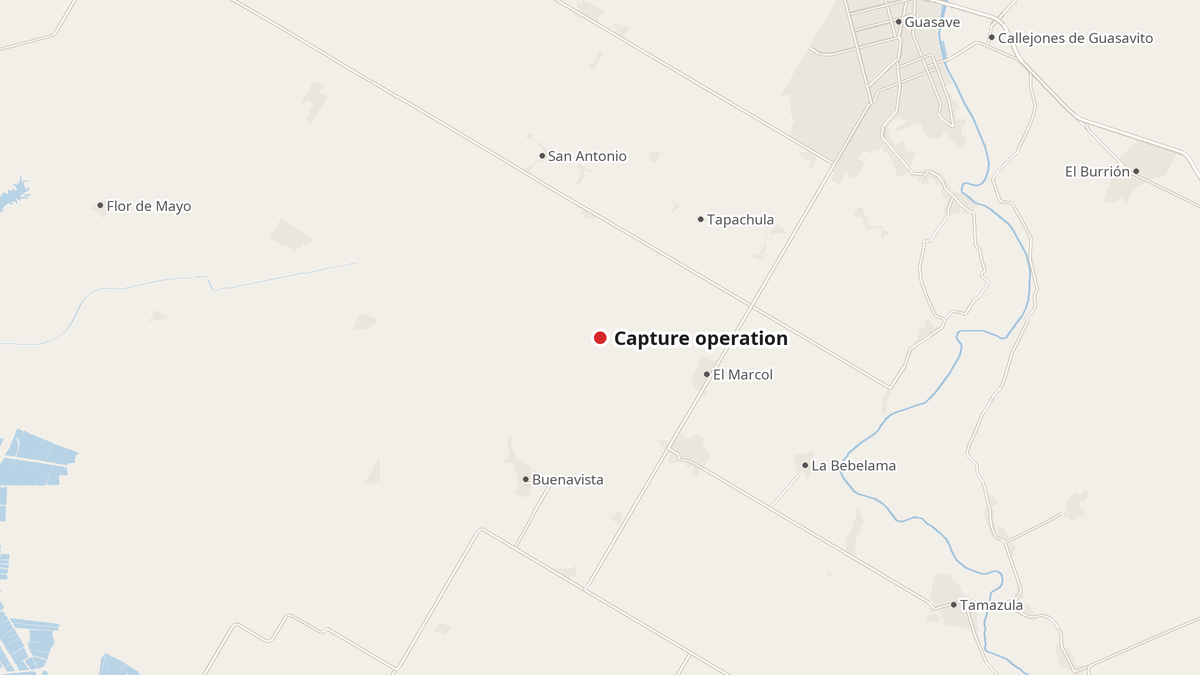
Mexican forces captured FBI Ten Most Wanted fugitive Fausto Isidro Meza Flores in Guasave, Sinaloa, but the operation was followed by gunfire, burned vehicles and roadblocks that disrupted towns across the state's north. The man known as “El Chapo Isidro” faces extradition to the United States on drug-trafficking charges, Bloomberg reported.
Mexican authorities said U.S. intelligence cooperation supported the operation on Friday night, November 20, 2026. The arrest brought a wanted cartel leader into custody, while the violence that followed forced residents to shelter and motorists to avoid roads.
Security After the Arrest
Clarín reported that armed militants torched trucks and set up roadblocks in Ahome, Guamúchil, Guasave and Navolato, closing parts of the La Costera highway. Residents reported fires at convenience stores and gas stations.
Sinaloa's state government urged residents to stay indoors. Guasave municipal security chief Juan de Dios López Rubio said Saturday that low-flying aerial operations were continuing and warned motorists about tire-puncturing devices on local roads.
The Sinaloa Security Secretariat asked citizens to “remain sheltered and avoid the area, as well as not to travel on the roads.” A neighbor told CNN that armed individuals had taken over several hospitals and that shops and gas stations had been set on fire.
Gunfire near Kuroda Park interrupted the third inning of a Mexican Pacific League game between the Algodoneros de Guasave and the Venados de Mazatlán. Pitcher Víctor Buelna stopped his delivery to alert his catcher. Players left the field, and spectators, including families with children, took cover and fled the stands. Announcers halted the broadcast, citing a “national security incident.”
Footage circulating on social media appeared to show helicopters flying low over Guasave and firing toward ground targets as armed cartel members exchanged shots from a truck.
The Operation and U.S. Charges
Mexico's Secretariat of National Defense said the operation was coordinated with U.S. intelligence agencies. Clarín reported that National Guard special forces known as the “Wolves” and Mexican Army commandos known as the “Bats” took part alongside Sinaloa state security authorities.
Troops used surveillance technology to locate Meza Flores and approached his property from several directions. They came under attack with gunfire and explosives before storming the compound. Mexican officials didn't identify the U.S. agencies involved or say whether U.S. personnel were on the ground.
Authorities also detained Germán N, nicknamed “Serafín” and described as the cartel's second-in-command, and José N, an alleged financial operator. All three were flown aboard a Mexican Air Force aircraft to Mexico City and handed over to federal prosecutors.
Infobae reported that Mexican authorities had arrest warrants for Meza Flores on organized-crime and drug-related charges, as well as an extradition order to the United States over an alleged conspiracy to distribute drugs there. The U.S. Department of State offered a reward of up to $5 million for information leading to his arrest or conviction.
The FBI added Meza Flores to its Ten Most Wanted Fugitives list on February 4, 2025, as the 533rd person on the roster. Federal indictments in Washington, D.C., in 2012 and 2019 charged him with firearms violations and conspiracy to manufacture and distribute methamphetamine, cocaine, heroin, marijuana and fentanyl for importation into the United States.
Cartel Network and National Sovereignty
Meza Flores led the Guasave-based Meza-Flores Transnational Criminal Organization, also known as Los Mazatlecos or the Guasave cartel. Infobae linked him to drug trafficking into the United States and reported that he had a presence in Sinaloa, Sonora, Durango and Nayarit.
His group's smuggling network operated across Guasave, Los Mochis, Mazatlán, Guamúchil, Choix, Los Cabos and Nayarit. Its rivalry with the faction of Joaquín “El Chapo” Guzmán involved kidnappings, executions and armed ambushes.
Mexican forces nearly captured Meza Flores in the mountains of Choix, Sinaloa, on April 28, 2010. He escaped; two soldiers and 12 of his gunmen died, including his right-hand man, Omar Alfonso Rubio, known as “El Chonte.” A separate battle near Tubutama, Sonora, on July 1, 2010, left roughly 30 people dead. Meza Flores and trafficker Arnoldo del Cid Buelna, known as “El Gilo,” reportedly led the ambush against Sinaloa Cartel gunmen.
Regional analysts said Meza Flores later aligned with the Los Mayos faction in its conflict with Los Chapitos, which began in 2024 after Ismael “El Mayo” Zambada was taken into U.S. custody. Infobae described Meza Flores as part of the Sinaloa Cartel faction led by Ismael Zambada, alias “El Mayito Flaco.”
Sources cited by Mexican media said the operation's objective was to reduce violence in Sinaloa and capture major generators of violence. Earlier on Friday, U.S. President Donald Trump said he had confronted Mexican President Claudia Sheinbaum at a summit in China, telling reporters: “We can't let the cartels run Mexico. They're our neighbor.”
Clarín reported that Sheinbaum rejected Trump's characterization and ruled out U.S. military intervention on Mexican soil, while her administration increased domestic anti-cartel operations and intelligence sharing with Washington. Clarín said those efforts included tens of thousands of arrests and seizures of hundreds of tons of narcotics.
Why This Matters: The capture puts a cartel leader facing U.S. drug-trafficking charges in the hands of Mexican prosecutors and follows intelligence cooperation between the two countries. Yet the roadblocks, fires and warnings to shelter show the immediate security costs borne by Sinaloa residents and businesses. Sheinbaum's rejection of U.S. military intervention also sets a limit on how that cooperation can proceed on Mexican soil. The arrest removes a wanted figure from circulation; restoring safe movement on the roads remains a security challenge exposed by the violence that followed.
- fausto isidro meza flores
- gu asave
- sinaloa
- mexican army
- drug trafficking
- cartel violence
- los mazatlecos
- fbi most wanted