
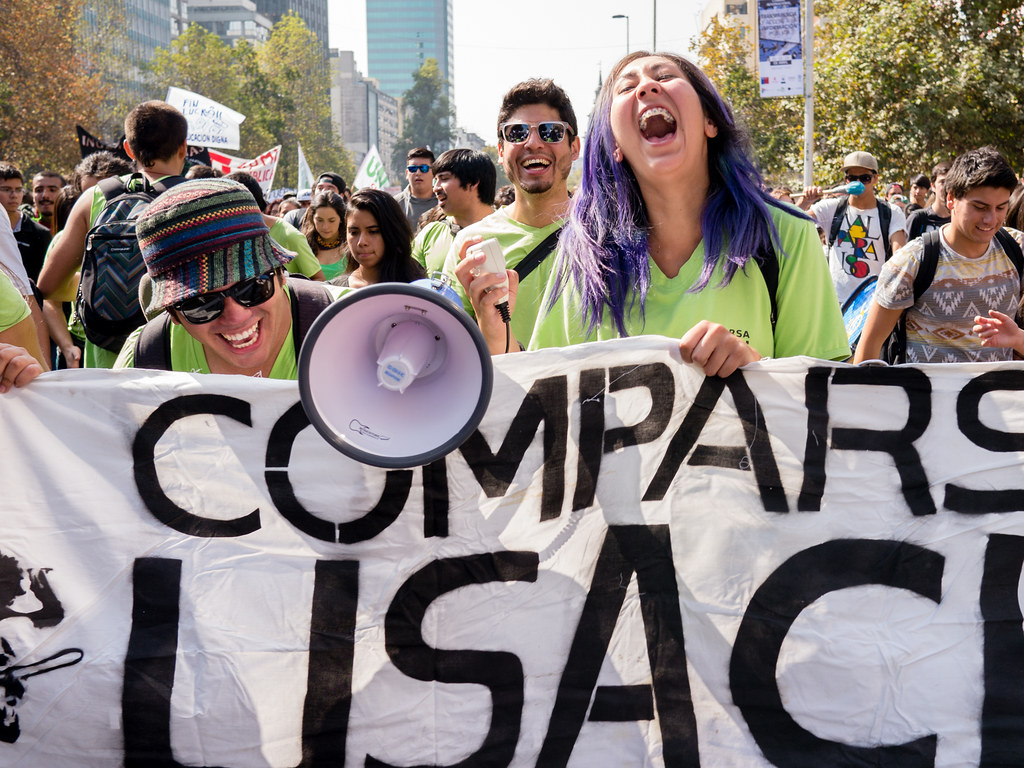
“Not one peso less for education.” Students, the CUT and the Colegio de Profesores took that demand through Santiago on Thursday, October 1, protesting possible education cuts in President José Antonio Kast’s proposed 2027 budget. The sources reviewed hadn’t published detailed education budget lines. The threat was clear; the figures weren’t.
The Confederation of Students of Chile (Confech), which groups university student unions, called the national strike. The CUT, Chile’s largest union federation, and the Colegio de Profesores teachers’ union joined the march. Their slogan laid out the dispute: public money is allocated from above, while students and education workers must fight over what could be taken away.
A march under police control
The march began around 10:30 a.m. at Plaza Baquedano, with permission from the regional government delegation. Clashes broke out near the Catholic University, just metres from the starting point. Carabineros, the national police, used water cannon and tear gas. BioBioChile reported at least 12 arrests, a preliminary figure police hadn’t confirmed.
Most marchers kept going west toward La Moneda, the presidential palace. Metro reopened its closed station at 12:32 p.m. The final number of arrests from October 1 hadn’t been published. A basic measure of the state response remains unresolved.
The demonstration followed a 48-hour national strike by primary health workers over clinic funding. Students and health workers opposed the same budget bill, which President José Antonio Kast presented on September 30. The bill raises total public spending 1.5%. Health Minister May Chomali said her ministry’s budget would grow 4.7%, more than three times the overall increase, while the education allocation remained unclear.
The costs land at the clinics
Confusam, the confederation of municipal health workers, held its strike on September 29 and 30 over the state’s “per capita” payment to municipalities for each patient enrolled at their clinics. Radio Universidad de Chile reported the current monthly rate as 11,932 pesos, about US$12.34. Confusam sought at least 16,000 pesos, about US$16.55.
The Finance Ministry offered an increase of 604 pesos, about US$0.62. The union wanted at least 1,000 pesos, about US$1.03. Confusam said municipalities were owed more than 37 billion pesos, about US$38 million, dating from December 2025. It welcomed Decree 29, which updates the 2026 rate to settle the arrears, but said the measure wasn’t a structural fix.
The ministry’s offer and the union’s demand differ by little in pesos, but the consequences for clinics relying on state payments are large. Confusam president Gabriela Flores claimed 90% adherence nationwide. The Health Ministry counted 31.1% of staff on strike and 69.3% of facilities affected, according to Puranoticia.
The bill is still in lawmakers’ hands
The ministry said emergency rotas covered all prioritised care and noted that 80% of Chileans use primary care. A joint working group on clinic funding was due to meet again on September 30. Confusam said it would stay “on alert” while Congress debated the bill.
Lawmakers could shift money within the bill before passage, so the 604-peso offer might not be final. That leaves the funding fight in a legislative process where detailed education changes remain unclear. Whether protests would continue was also unclear. Students and workers have taken their demands to the street; the next figures depend on decisions made over the budget.