
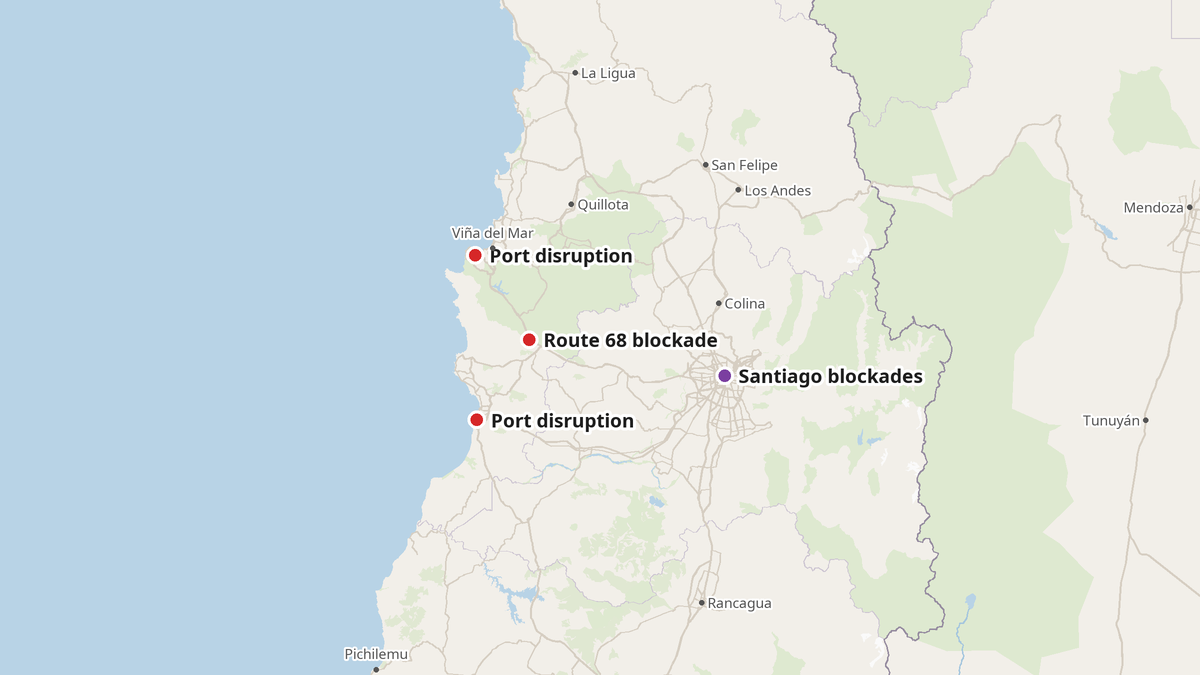
Nelson Varas stood on Route 68 near Casablanca on Thursday and said what many small operators across Chile have been saying for days: they can't absorb the hit anymore. "We are small and medium transporters who have no margin to absorb the sustained increase," the Fedequinta leader told EFE. "Many colleagues are going bankrupt."
His federation, which groups about 800 transporters in the Valparaíso region, joined the indefinite strike Thursday, the third consecutive day of a nationwide stoppage that has left the country's main highways partially blocked. It did so even after the government announced a fuel price freeze the night before.
Who Is Affected
The walkout is led by organizations of small and medium truckers in almost all regions, and its reach goes well beyond the drivers themselves. Varas said the strike is hitting the ports of San Antonio and Valparaíso, where "the cargo cannot enter or leave." Chile has no rail system for cargo, so nearly all freight moves by road. When the roads close, supply chains seize up.
Varas called the freeze insufficient and framed the stakes broadly. "The situation is unsustainable not only for the truckers but for all citizens," he said. Fedequinta is asking for a 120-day price freeze, not the 90 days the government offered. "The strike is a necessity, not a whim," he added.
The protesters also want a temporary elimination of the specific fuel tax and a review of highway tolls.
The Policy Gap
The roots of the crisis go back about eight months. In March, President José Antonio Kast decided not to use a state mechanism that neutralizes the impact of volatile international oil prices. The full increase caused by the war in the Middle East went straight to consumers. Since the start of the offensive, the international price of diesel has risen 80% and gasoline 40%. The so-called "benzinazo" hit multiple economic sectors and sank the president's popularity.
Finance Minister Jorge Quiroz acknowledged Wednesday that Chile is in a "technical recession."
The government's answer, announced Wednesday night, is a three-month freeze on fuel prices running until February 3. Government spokesman Gonzalo Arenas said it seemed "inexplicable" that transporters hadn't called off the strike, calling the proposal "very good and very serious." He told Radio Duna the freeze "implies a gigantic cost in resources."
The two main sector organizations, the Confederación Nacional de Dueños de Camiones and the Confederación Nacional del Transporte de Carga, distanced themselves from the protest from the start, though they support part of the demands. Their leaders went to La Moneda first thing Thursday. CNDC president Juan Araya told reporters, "There is anarchy, a cacique appears everywhere."
Official Response and Political Fallout
Kast asked truckers on Thursday to end the strike and called for national unity to address the economic crisis. He said recent talks have produced "advances" but that unity is "the most urgent call." He defended "the right to demonstrate but not the right to block roads," and warned that "difficulties only deepen if the roads are cut."
The government confirmed Kast is keeping a planned trip to Asia, his first since taking power in March. He travels Friday to Vietnam, China and Japan and will take part for the first time in the APEC leaders' summit on November 18 and 19 in Shenzhen. Interior Undersecretary Máximo Pávez told Tele 13 the president "has to fulfill a very intense and very important agenda for the country in Asia-Pacific."
Opposition figures weren't impressed. Flor Contreras, a deputy of the opposition Partido de la Gente, said Kast "is not grasping what is happening in Chile. Families are drowning from the cost of living, the truckers remain mobilized, the economy is in technical recession and we have a Justice crisis that has left victims waiting for answers." Gael Yeomans, deputy and president of the Frente Amplio, said Chile "needs a president who takes charge of the crisis." She noted he would be leaving the country twice during an economic crisis, a reference to last week's trip to Spain and Italy, and called it a sign of "lack of political leadership."
The last major truckers' strike came in February 2022, four years ago, and lasted only a few days. This one is already into its third.
Why This Matters:
The strike shows how a policy choice lands on the people with the least cushion. Small and medium transporters say they have no margin left, and some face bankruptcy. Households are squeezed by what opposition lawmakers call a rising cost of living, while the economy sits in technical recession. The government's decision in March to pass the full oil-price increase to consumers, rather than use a state mechanism built to soften such shocks, now sits at the center of the dispute. The freeze offers temporary relief, but the government itself says it carries a gigantic cost, and it expires on February 3, about 83 days from now. Whether public institutions can protect vulnerable workers and families from volatile global markets, and not just react when roads are blocked, is the larger question the standoff leaves open.
- chile truckers strike
- fuel prices
- josé antonio kast
- chile
- fuel price freeze
- transporters
- road blockades
- economic crisis