
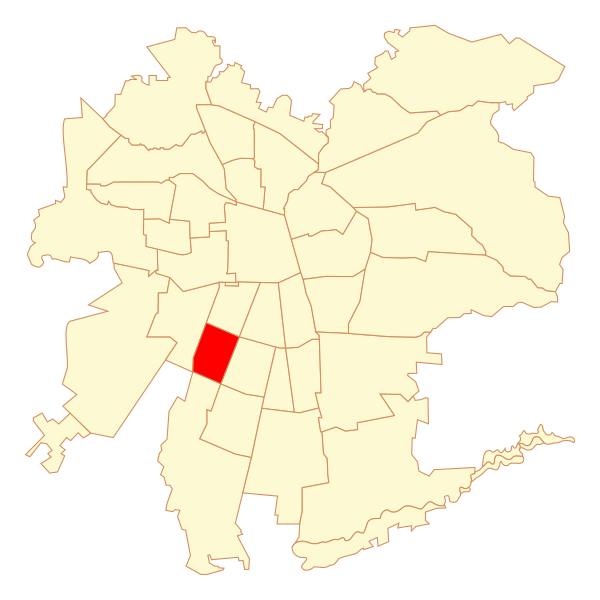
A 22-year-old man was arrested in Lo Espejo on Friday after online threats to carry out a massacre at Universidad Diego Portales, Usach and Universidad Alberto Hurtado, and the three universities suspended classes. The state moved fast. The people at those campuses got the shutdown, while the security apparatus got to call it a success.
Who Pays for the Panic
Chile’s public mood was described as one of sharpened vigilance after the arrest, a phrase that says plenty without saying who gets to live under the watch. Students and staff at three universities were the ones forced to stop their routines. The threat, whether real or not, landed on ordinary people first. The institutions answered by closing doors, not by making campuses safer in any meaningful, human sense.
The arrest came in Lo Espejo, and the PDI acted with international cooperation and seized digital evidence. That’s the machinery at work: cross-border policing, digital tracking, and the usual promise that more surveillance will somehow produce more safety. The article presents the arrest as a success, but the facts show a familiar pattern. A threat appears online, and the response is not community care or collective protection. It’s the apparatus, moving in tighter.
What the Authorities Call Safety
Chile has also ended anonymous prepaid phone lines in an effort to make communication more trackable and reduce crime. That’s the logic of control laid bare. Every line becomes easier to trace. Every call becomes easier to watch. The state frames it as crime reduction, but the people who live with the consequences are the same people already expected to accept more monitoring as the price of daily life.
The broader anxiety around public safety and hidden threats hangs over the whole story. The article says the country’s security apparatus remains more present and more watchful. More present for whom? More watchful over whom? The answer is obvious in the way these systems always work: the people below absorb the fear, the restrictions, and the disruptions, while the institutions above expand their reach and call it order.
The Campus Shutdowns Tell the Real Story
Universidad Diego Portales, Usach and Universidad Alberto Hurtado all suspended classes after the threat. That’s the immediate cost. Not for the police, not for the PDI, not for the officials who can describe the operation as a win. The cost falls on students, workers, and everyone whose day gets rearranged by a threat and the state response to it.
The arrest was presented as a success, but the article itself points to a wider climate of fear and surveillance. The machinery of public safety doesn’t just react to danger. It also deepens the sense that everyone must be watched, tracked, and managed. Anonymous phone lines disappear. Digital evidence gets seized. International cooperation kicks in. Classes stop. The apparatus grows louder, and ordinary people are left to live inside its shadow.