
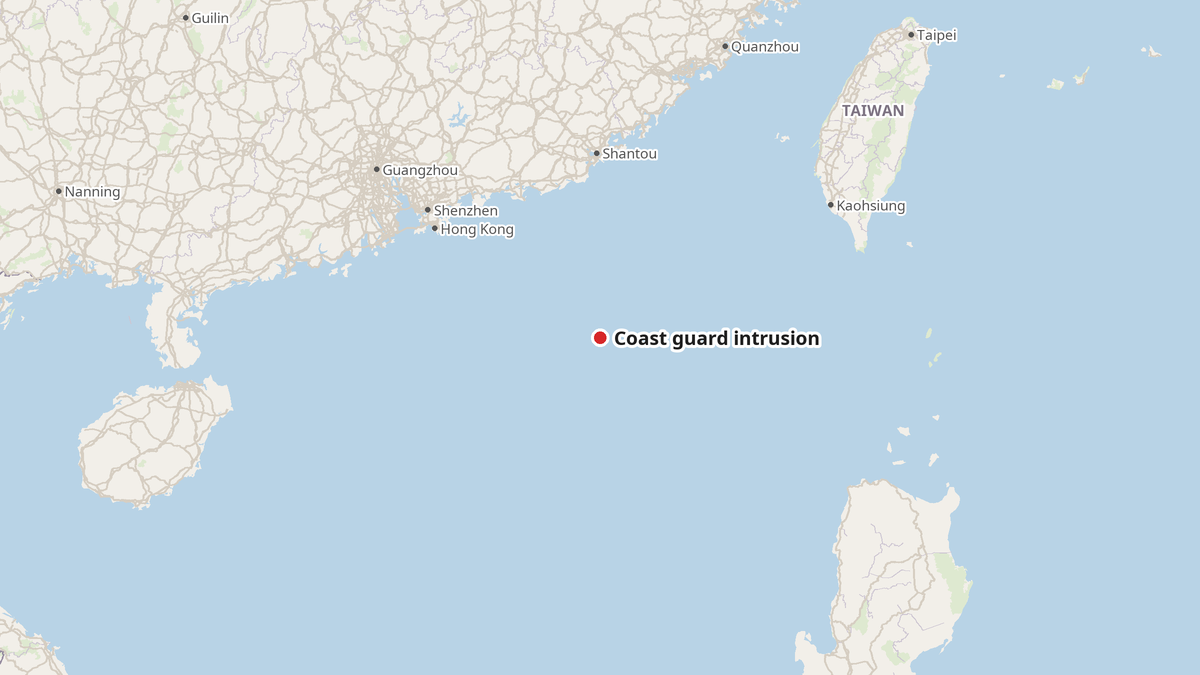
A Chinese coast guard vessel slipped into restricted waters near the Pratas Islands early Saturday, and a Taiwanese coast guard ship moved in to confront it. At the height of the standoff, the two vessels came within 1 nautical mile (1.9 kilometers) of each other, Taiwan's coast guard said. Nobody was reported hurt. But a mile of open water between armed state vessels is a thin margin in a region where a single misjudgment could escalate fast.
The Pratas Islands are a disputed coral island group in the South China Sea, administered by Taiwan. The Chinese vessel entered the waters southwest of Taiwan's main island, and the Taiwanese ship asked it to leave. Taiwan's coast guard then called on Beijing "to immediately cease these pointless acts of harassment."
A Pattern, Not an Accident
Saturday's episode wasn't a one-off. Taiwan's coast guard said it was the 13th such intrusion near the Pratas Islands this year, involving 16 vessels. That's a steady drumbeat of incursions against an island group that Taiwan, a democratically governed society of its own, administers.
Beijing sees it differently. It says the waters it patrols fall under its jurisdiction. China's coast guard said it had sent a group of vessels to conduct a "routine law enforcement patrol" in waters east of Taiwan on Saturday. "The China Coast Guard will continue to intensify its law enforcement patrols in waters under its jurisdiction, firmly upholding the nation's territorial sovereignty and maritime rights and interests," its statement said.
The word "intensify" matters. Taiwan's coast guard isn't the only party reading it as a signal.
Pressure on a Democracy
China claims Taiwan as its own breakaway province and has not ruled out using force to annex it. Taiwan is democratically ruled, and its people have no say in Beijing's claims over them. Beijing sends warships and military jets near the island almost daily, and it has stepped up coast guard patrols in recent months, particularly east of Taiwan. That has raised alarm in Taipei.
Coast guard ships aren't warships. They carry the language of policing and law enforcement, which lets Beijing frame its presence as administrative rather than military. Taiwan's response, a coast guard vessel asking the intruder to leave and a public call to stop the harassment, shows a government trying to hold its ground without handing anyone a pretext for a larger confrontation.
International Concern
Taiwan isn't raising the alarm alone. In June, France, Germany and Britain issued a rare joint statement expressing alarm over Chinese activities east of Taiwan, saying they endangered regional stability. The source doesn't specify the year of that statement. European governments rarely speak in one voice on Taiwan Strait matters, which is why the joint statement drew notice.
Why This Matters: Thirteen intrusions involving 16 vessels in a single year show a campaign of gradual pressure, not a stray incident. The tactic works by repetition: each entry tests how far a smaller democracy will go to defend waters it administers, while keeping the confrontation below the threshold of open conflict. For people in Taiwan, the stakes are concrete. They live under a standing claim from a government that hasn't ruled out force. The European joint statement points toward the kind of multilateral attention that can raise the diplomatic cost of coercion. Stability in these waters depends on shared rules and collective scrutiny, and those only hold when other governments keep paying attention.
- taiwan coast guard
- china coast guard
- pratas islands
- south china sea
- maritime intrusion
- coast guard patrol
- taiwan strait tensions