
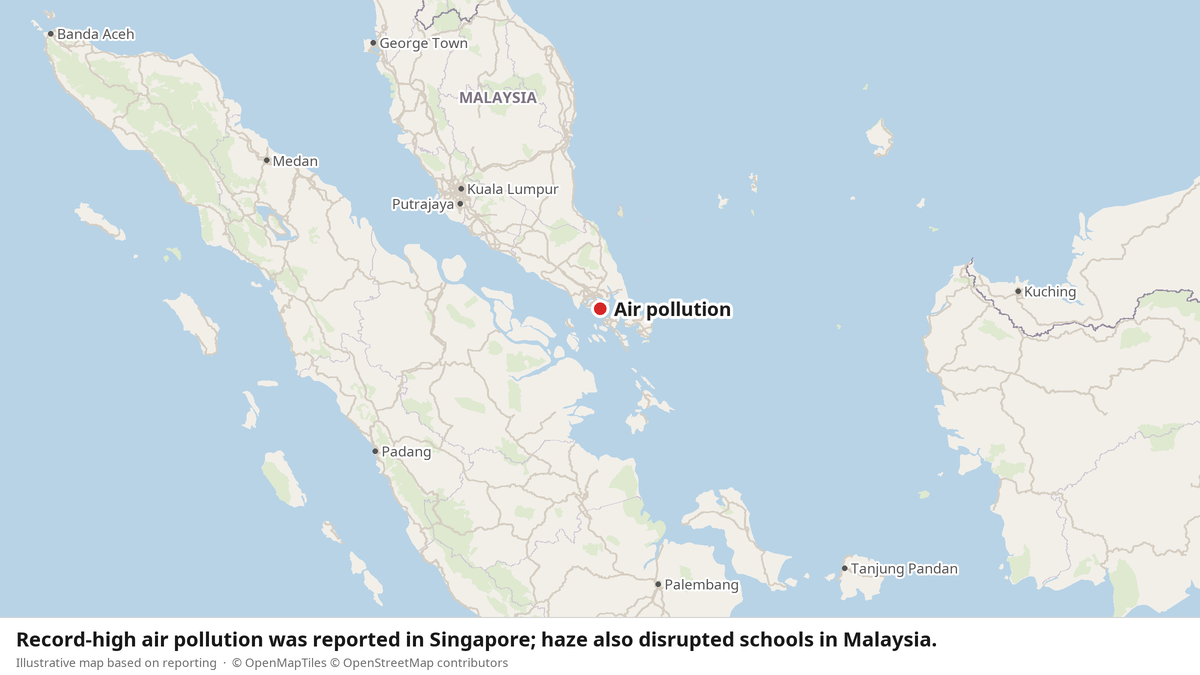
Haze from Indonesian wildfires pushed Singapore’s air pollution to the world’s highest level, while authorities in Malaysia ordered about 200 schools, kindergartens and nurseries to close. The order covered Batu Pahat district in Johor state on Wednesday. Students and families faced immediate disruption. The air crossing borders didn’t follow official maps.
Who Has the Power
IQAir data placed Singapore’s air quality in the “very unhealthy” range on Wednesday afternoon. The readings put the city-state at the top of the world’s pollution ranking, with Kuala Lumpur in second place. The figures show the conditions people were breathing, while the school closures make clear what authorities can do when those conditions reach classrooms: shut institutions.
Local media reported the closures. They involved some 200 schools, kindergartens and nurseries in Batu Pahat, about 140km (87 miles) northwest of Singapore. The order applied on Wednesday. The report didn’t specify a longer closure period or describe other school closures.
The figures matter on the ground. Singapore’s National Environment Agency data showed unhealthy air in all five regions. In Batu Pahat, authorities responded by closing educational facilities. These are distinct places and actions, but both reports describe the same haze moving across the region: residents faced unhealthy air, and children’s schools were among the institutions affected by official decisions about exposure.
The Haze Doesn’t Respect Borders
Indonesian wildfires sent haze across the region days before Singapore’s annual Formula One weekend. Severe air pollution now sits alongside a major scheduled event in the city-state, though the report gives no information about changes to the weekend or any measures taken for it.
Kuala Lumpur had previously ranked first among the world’s most polluted cities, before Singapore took that position. On Wednesday, it ranked second. The cities’ shifting order is one detail in the data; the wider condition reported by Singapore’s National Environment Agency was unhealthy air across all five of the city-state’s regions.
A Forecast, Not a Fix
Dry conditions were forecast over most of southern Southeast Asia for the next few days. In its latest outlook, Singapore’s National Environment Agency said those conditions would keep the risk of fires and transboundary haze elevated. The forecast describes continuing risk, not a resolution. It offers no assurance that air quality would improve or that the threat would end after the forecast period.
Batu Pahat’s documented response was a closure order, while Singapore’s agency issued an outlook on air and fire risk. The report identifies no community-led response, mutual-aid effort, financing measure or legislative proposal. What it does record is the hierarchy in plain terms: authorities decide when schools close, agencies publish readings and forecasts, and people in affected places live with unhealthy air and the disruption that follows.