
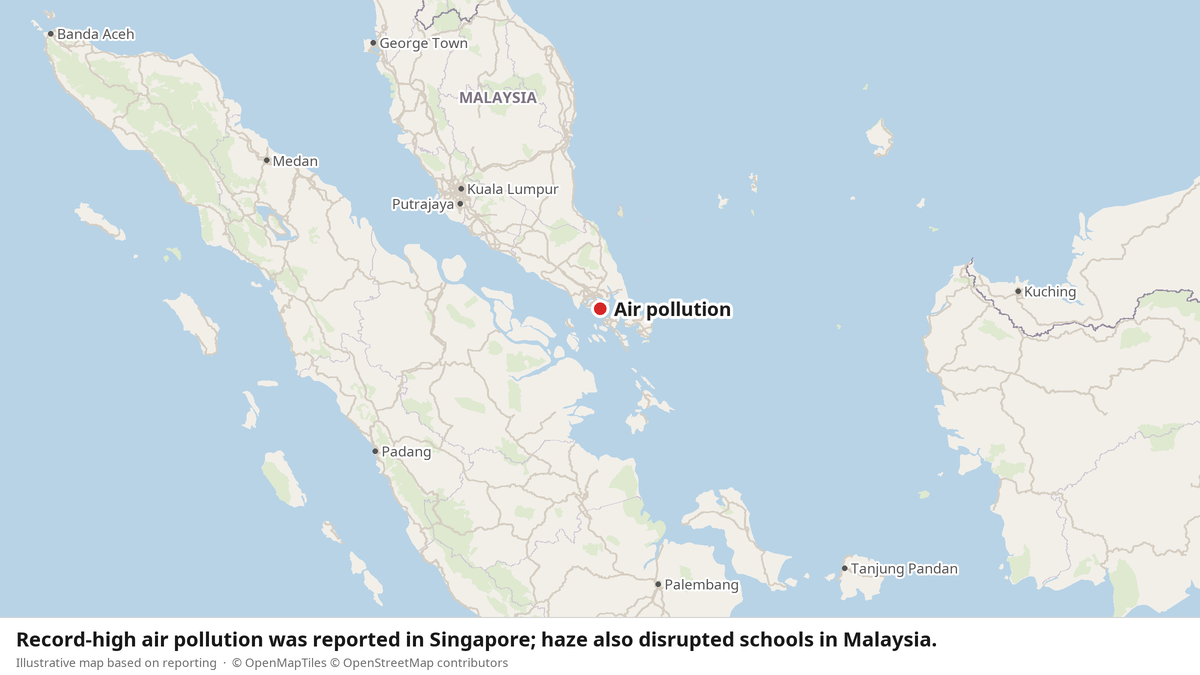
Singapore recorded the world’s highest air pollution level on Wednesday as haze from Indonesian wildfires spread across the region. In Malaysia’s Johor state, authorities ordered about 200 schools, kindergartens and nurseries in Batu Pahat to close. The readings and closures came days before Singapore’s annual Formula One weekend.
Air quality across the region
IQAir data put Singapore’s air quality in the “very unhealthy” range on Wednesday afternoon. Kuala Lumpur, previously ranked first, came second among the world’s most polluted cities. Singapore’s National Environment Agency reported unhealthy air in all five regions of the city-state.
The haze tied air-quality readings in Singapore and Malaysia to Indonesian wildfires. It blanketed the region. Singapore topped the global pollution ranking, while Kuala Lumpur also ranked among the two most polluted cities listed by IQAir. The agency’s figures showed unhealthy air across all five of Singapore’s regions—not just one part of the city-state.
Batu Pahat lies in Johor state, about 140km (87 miles) northwest of Singapore. Local media reported that authorities ordered some 200 schools, kindergartens and nurseries in the district to close on Wednesday because of the haze. The order covered all three types of institutions, though the report didn’t give a separate count for each.
Closures and the official outlook
Singapore’s National Environment Agency said dry conditions were forecast over most of southern Southeast Asia for the next few days. Its latest outlook said the risk of fires and transboundary haze would remain elevated. The forecast accompanied the agency’s report of unhealthy air in all five Singapore regions.
Authorities in Batu Pahat ordered the reported closures in response to the haze. The agency’s outlook described a continuing risk across southern Southeast Asia, where dry conditions were expected over most of the area. The source reported no closure orders beyond those affecting about 200 schools, kindergartens and nurseries in Batu Pahat.
What the report records
The report lists Singapore’s pollution ranking, IQAir’s “very unhealthy” classification, unhealthy readings across all five regions, and school closures as the haze spread from Indonesian wildfires. IQAir’s figures also showed Kuala Lumpur moving from first position to second. These developments came days before Singapore’s annual Formula One weekend, but the report gave no further detail about the event’s effects or preparations.
The article reports the haze, measurements, closures and official forecast. It gives no figures on climate-action financing, wildfire costs, business losses or the source of funding for air-quality measures. Nor does it include statements from workers, unions, school staff or affected families. The account identifies the public authorities that ordered closures and issued the outlook, but describes no additional government measures.
On Wednesday, Batu Pahat authorities ordered about 200 schools, kindergartens and nurseries to close. Over the following few days, the agency forecast dry conditions across most of southern Southeast Asia and an elevated risk of fires and transboundary haze. Its air-quality data showed unhealthy conditions in all five Singapore regions and ranked the city-state as the world’s most polluted city.