
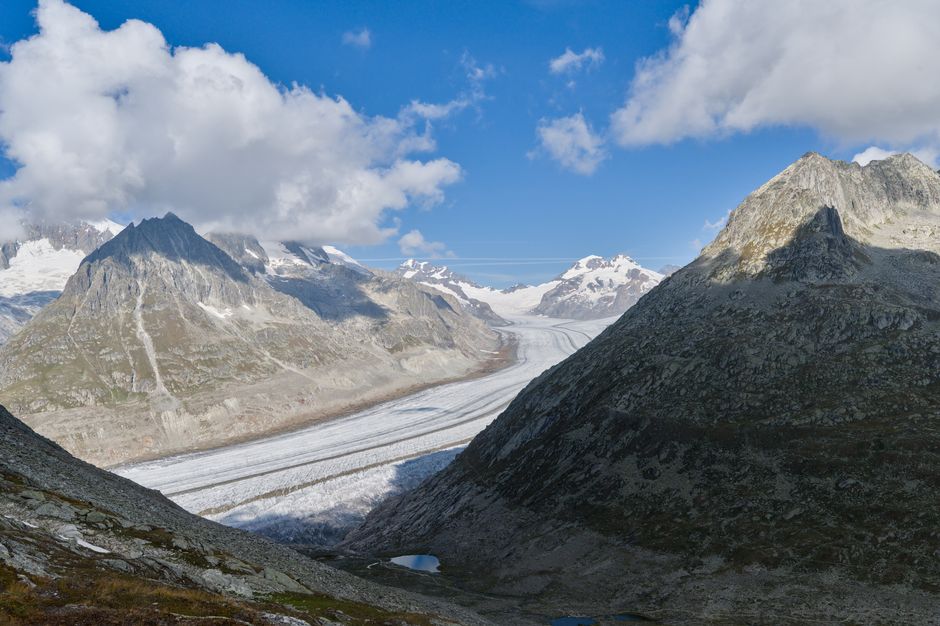
Swiss glaciers lost 19.4% of their ice volume between 2021 and 2026. In the Netherlands and Italy, farmers and researchers are testing crops for changing conditions, from rice on Dutch peatland to Arabica coffee grown outdoors near Palermo. Neither project has reached commercial scale.
Glaciers in retreat
The Swiss Glacier Monitoring Network and the Swiss Commission for Cryosphere Observation reported that glacier ice volume fell 5.5% during the first eight months of 2026. Individual glaciers lost between 2.5 metres and 4 metres of mean thickness. The decline came just short of the record set in 2022.
The monitoring report linked the ice loss to a winter with little snow and a summer of scorching heatwaves. Scientists haven't compiled a formal count of glaciers lost this year, but they reported seeing a number of small glaciers disappear.
Matthias Huss, a glaciologist at ETH Zürich and lead author of the report, said sites now bare once lay beneath hundreds of metres of ice. He recalled visiting a former glacier where “there was a big layer of ice – an extensive glacier – just a few years ago” and finding “a rock desert” with scattered blocks of old ice melting on hot rocks.
Streams beneath the ice are excavating caverns, Huss said, causing glaciers to collapse from inside as well as retreat from surface heat. “You have huge holes like cheese in the middle of the ice that have collapsing roofs,” he said. “These are processes that tear the glaciers apart and make them retreat even faster.”
An analysis published by MeteoSwiss found that the April-to-September summer half-year was the hottest and driest since records began in 1864, a period of 162 years. Europe is warming twice as fast as the global average, the article reported, driven by heat-trapping fossil fuel pollution and the destruction of nature.
Farms test new crops
A 0.6-hectare pilot in the Netherlands is testing whether rice cultivation can keep peat soils wet while providing an alternative to cattle grass farming. Peat covers roughly one-tenth of the country. Draining it to grow grass releases millions of tonnes of carbon dioxide, and land in the worst-affected areas can sink by several centimetres a year. Wageningen University says emissions from Dutch peat soils account for around 2% to 3% of the country's total emissions. Germany, Belgium and the Baltic states also face the peat problem.
The Dutch team aims to produce around three tonnes of short-grain rice and is testing about 30 cultivars from Russia, China, Japan and Uzbekistan. Farmer Sander Roeleveld, 53, called himself a “pioneer” and said his goal was to show that wetland could support more than grass. Researchers are comparing carbon dioxide and methane emissions from rice cultivation with emissions from maintaining grassland. Julian Helfenstein of Wageningen University and Research said results so far were promising.
Coffee and national production
The Morettino family estate on the outskirts of Palermo has produced Arabica coffee beans grown and harvested entirely in Italy for the first time. The plantation in the San Lorenzo ai Colli area, a few hundred metres above sea level, produces around 100 kilograms of coffee cherries, yielding just over 15 kilograms of roasted beans. The University and Botanical Garden of Palermo is involved in research on how tropical crops adapt to the changing Mediterranean climate. The project isn't close to large-scale commercial production.
Italy leads the EU in roasted coffee production, making more than 400 tonnes in 2025, but its industry imports raw, unroasted green coffee. The sector includes around 1,000 roasters and generates annual turnover of 5.9 billion euros. A survey by AstraRicerche and the Segafredo brand found that 51.5% of Italians wanted to know a coffee product's origin and supply-chain journey. A separate survey found almost one in two regarded coffee as a symbol of national culture and lifestyle on a par with pasta.
Coffee processing can use between 50 and 200 litres of water per kilogram of green coffee and creates wastewater that can affect local ecosystems if it isn't properly treated. The projects are examining new growing conditions, but Dutch researchers are still measuring emissions, and the Palermo crop remains small.