
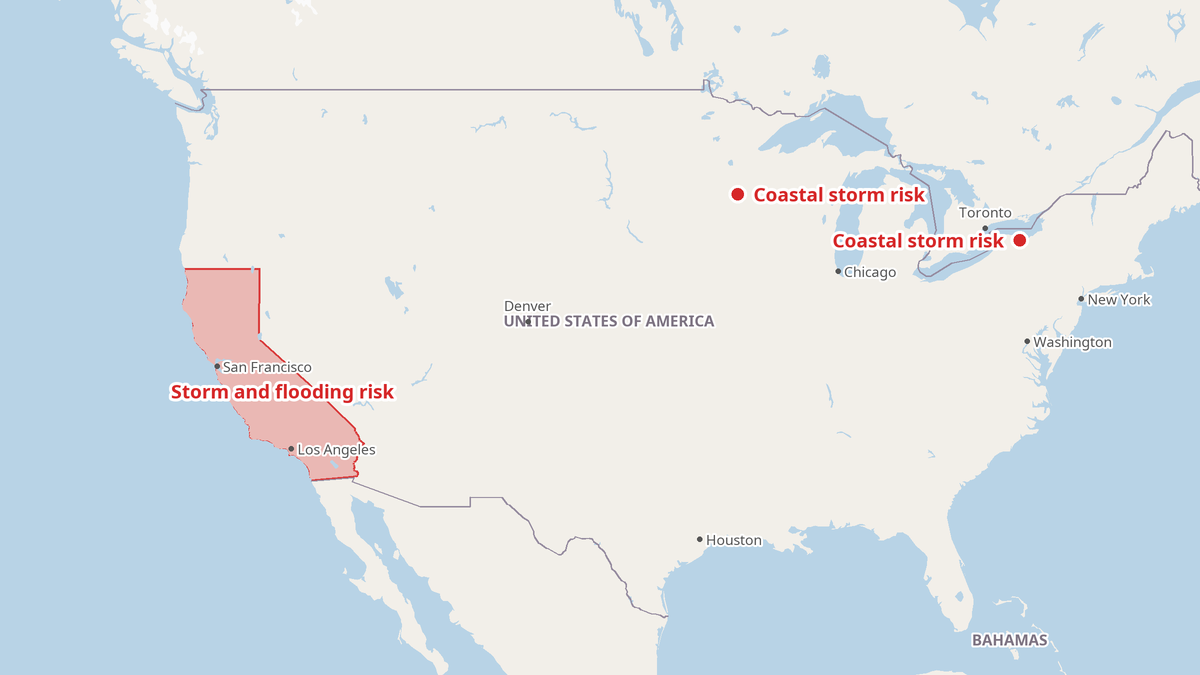
Storms threaten shoreline roads, flights and Thanksgiving travel on both U.S. coasts, leaving ordinary travelers to navigate hazards they can’t control. Heavy rain, strong winds, flooding and dangerous road conditions are in the forecast, as airports and city officials prepare for high water and possible disruption.
Who Pays for the Storm
In the San Francisco Bay Area, unusually high tides could flood low-lying shores along San Francisco and San Pablo bays. A coastal flood warning runs from early Monday through Thanksgiving Day, with the greatest risk around each morning’s high tide. Water at the San Francisco tide gauge could come within an inch of its 1983 record around 11 a.m. PT Wednesday. Elsewhere in the bay, high tide can arrive up to 90 minutes later.
San Francisco Mayor Daniel Lurie urged residents to avoid nonessential travel from Monday afternoon through Wednesday afternoon. That warning puts the burden on people who need to get around to change their plans, while flood barriers and pumps stand as the last line against water reaching critical facilities.
San Francisco International Airport staged sandbags and portable flood barriers and checked its pumps. San Francisco and Oakland airports prepared for high water. Oakland airport officials recommended travelers take Hegenberger Road or 98th Avenue, the two main access routes they said sit outside the reach of tidal flooding.
The Northeast’s Weather Tax
A coastal storm is expected to develop off the Southeast coast Wednesday, then move north. Rain could reach Washington, D.C., and Philadelphia by Wednesday night, making for a wet drive along Interstate 95 on Thanksgiving morning. The Weather Prediction Center said 1 to 2 inches of rain could fall along the I-95 corridor, with up to 3 inches in localized areas. The storm’s track will determine where the heaviest rain, strongest winds and coastal flooding hit.
The National Weather Service said a spinning winter cyclone over the urban Northeast on Thanksgiving Day could bring 50 mph gusts, coastal flooding, bursts of heavy rain and embedded thunderstorms. The service described a system likely to strengthen and move quickly through “rapid cyclogenesis,” a process tied to rain-heavy storms known as bomb cyclones. Federal forecasters said unusually warm Atlantic waters would help the cyclone spin and strengthen.
The service warned of possible widespread heavy rain, strong winds, coastal flooding and high surf from southeast Virginia to waters off New Haven, Connecticut. Its forecast discussion said: “Coastal flooding issues, beach erosion, and dangerously rough seas appear likely, especially from the Mid-Atlantic up into the New England coast.”
New York City Emergency Management urged residents to follow alerts and forecasts. “Keep an eye on Thursday,” it said on X. “The forecast shows a storm that could bring strong winds, rain, and coastal flooding to the city on Thanksgiving Day, with gusts of 40 to 45 mph possible and 1 to 2 inches of rain.”
The 100th Macy’s Thanksgiving Day Parade could also face restrictions. City rules require grounding the giant balloons if sustained winds exceed 23 mph or gusts top 34 mph. The parade is scheduled from 8:30 a.m. to noon, but officials hadn’t yet made clear whether winds along the Manhattan route would reach those thresholds. The apparatus has its rules. Travelers and paradegoers get the uncertainty.
A Coast-to-Coast Disruption
Boston’s roughest weather was forecast for Thanksgiving Day into the evening. Wind-driven rain could slow drivers, strong gusts could delay flights at Logan International Airport, and flooding could hit the Massachusetts coast if the strongest onshore winds coincided with high tide. Drivers crossing the central Appalachians or traveling through higher elevations in upstate New York and New England could encounter snow, though forecasters said they didn’t know how much would stick.
In the Bay Area, rain and gusty winds were expected Tuesday into Wednesday, with a quarter-inch to an inch of rain across much of the region and 1 to 2 inches in the North Bay. Gusts could reach 40 mph along the coast and through some mountain passes. The Sierra Nevada was expected to receive fresh snow and “difficult travel,” according to the weather service office in Reno, Nevada. Drivers on the Oregon and Washington coasts could face heavy rain Wednesday and more wet weather on Thanksgiving.
Thanksgiving travel already sends millions of people onto roads and through airports. The American Automobile Association expected 81.5 million people to leave home for holiday trips, compared with 81.6 million the previous year. AAA said round-trip tickets were up 17% over Thanksgiving 2025 and averaged $800. GasBuddy projected a national average of $3.62 for a gallon of gasoline on Thursday, a likely record high for that date, while noting prices had fallen by at least 50 cents so far that month.
The drive home was expected to turn drier around Washington, D.C., by Friday, though some areas could remain gusty. Rain and snow showers could continue into Saturday in northern New England. Forecasters were monitoring another possible storm off the East Coast over the weekend, but said it was too early to determine whether it would affect Sunday travel. For now, the forecast is the order of the day—and the cost of getting through it lands on everyone trying to travel.
- thanksgiving travel
- coastal storm
- national weather service
- macys thanksgiving day parade
- san francisco bay area
- coastal flooding
- new york city
- heavy rain