
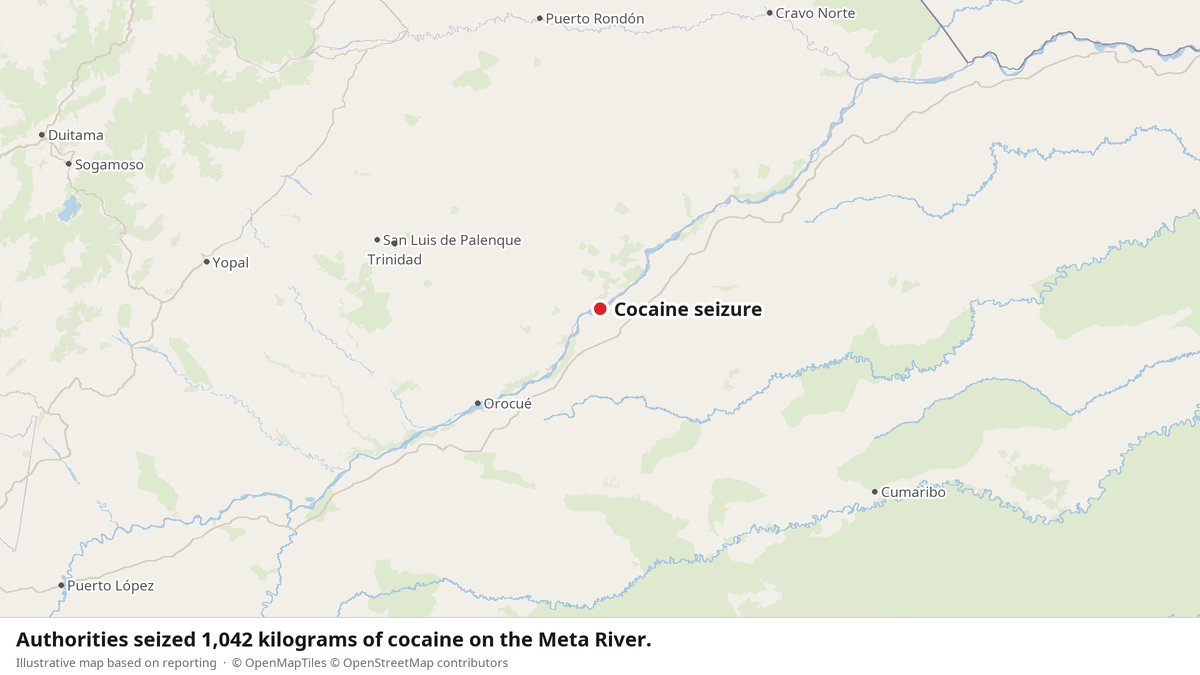
Colombian forces seized 1,042 kilos of cocaine hydrochloride from a boat on the Meta River in La Primavera, Vichada, the Defence Ministry announced Friday, 9 October. It’s the second major haul from the same stretch of river in about two weeks. The seizure shows how deeply the drug trade has threaded itself into the remote eastern plains.
The Navy, the Army, the National Police and the Office of the Attorney General took part in the operation. “Let there be no doubt: we will keep attacking narco-terrorism in Colombia with all our capabilities,” the ministry wrote in a post on X, reproduced by Bogotá news magazine Semana.
What Was Found
El Tiempo, the Bogotá newspaper, cited a Navy report saying units of the Orinoquía Naval Force stopped the boat in the Nueva Antioquia area of La Primavera. When the man steering it saw officers, he tried to escape. Officers moved the boat to a safe port and checked its cargo. They found three drums of gasoline, an outboard motor and a Starlink satellite antenna inside. National Police antinarcotics investigators used a preliminary field test to confirm the substance as cocaine hydrochloride, El Tiempo reported.
The ministry said seizures on the Meta River now top 2.5 tonnes in less than 15 days, keeping more than 2.5 million doses off the streets. It said the operation struck criminal finances by more than US$56 million. The ministry didn’t explain how it calculated that figure, and the claim remains unverified.
Armed Groups and the River
El Tiempo reported that intelligence information linked the boat to the José Daniel Pérez front of the National Liberation Army, or ELN, a leftist guerrilla organisation. The U.S. State Department blames the group for bombings and kidnappings in Colombia and Venezuela, and Washington has listed it as a foreign terrorist organisation since 8 October 1997. Two breakaway groups of the former FARC guerrillas have appeared on the same list since 1 December 2021. No response from the ELN to the reported link was cited. The connection rests on intelligence reports, not confirmed findings.
The river itself matters. The Meta crosses Colombia’s eastern plains, known as the Llanos, before joining the Orinoco at the border with Venezuela. El Tiempo said the river has returned to drug-trafficking routes. Bogotá-based channel NTN24 reported that about 1.5 tonnes were seized from a boat in the same Nueva Antioquia area on 25 September, 15 days ago. Military commanders said then that armed groups use river corridors to move drugs toward Venezuela.
In September, Colombia’s conservative president, Abelardo De la Espriella, ruled out a hostage exchange with the ELN, the report said. The State Department said in its 2023 terrorism report that Venezuela gave the group a safe haven.
Questions Still Open
Much remains unanswered. Officials haven’t said whether the man steering the boat or anyone else was arrested, the exact date officers stopped the boat, who owned the cocaine or where the load was ultimately headed. Investigators are studying possible links to routes toward Central America and Europe. El Tiempo said the drugs were most likely headed for international markets.
A study published this year found that cocaine had become one of Colombia’s biggest earners, the report said. That’s a striking measure of the trade’s economic weight in a country where Vichada borders Venezuela and the state’s reach is thin.
The U.S. State Department rates Colombia at Level 3, Reconsider Travel, and lists the Colombia-Venezuela border region, Arauca, Cauca and Norte de Santander at Level 4, Do Not Travel. Vichada wasn’t named separately. Bogotá, Medellín and Cartagena sit far from the Meta River route.
Why This Matters: Two large seizures in about two weeks show that armed groups still move enormous volumes of cocaine along river corridors in some of Colombia’s least-served regions. Interdiction can disrupt a shipment, but the report says cocaine has become one of the country’s biggest earners; the pull of illicit income is structural, not incidental. Communities along the Llanos and the Venezuelan border live in the shadow of that economy. State Department Level 4 warnings for neighbouring regions underline the insecurity they face. Whether anyone was arrested matters for accountability. And because the ELN link rests on intelligence reports alone, public trust depends on clear evidence and transparent prosecution through the Fiscalía.