
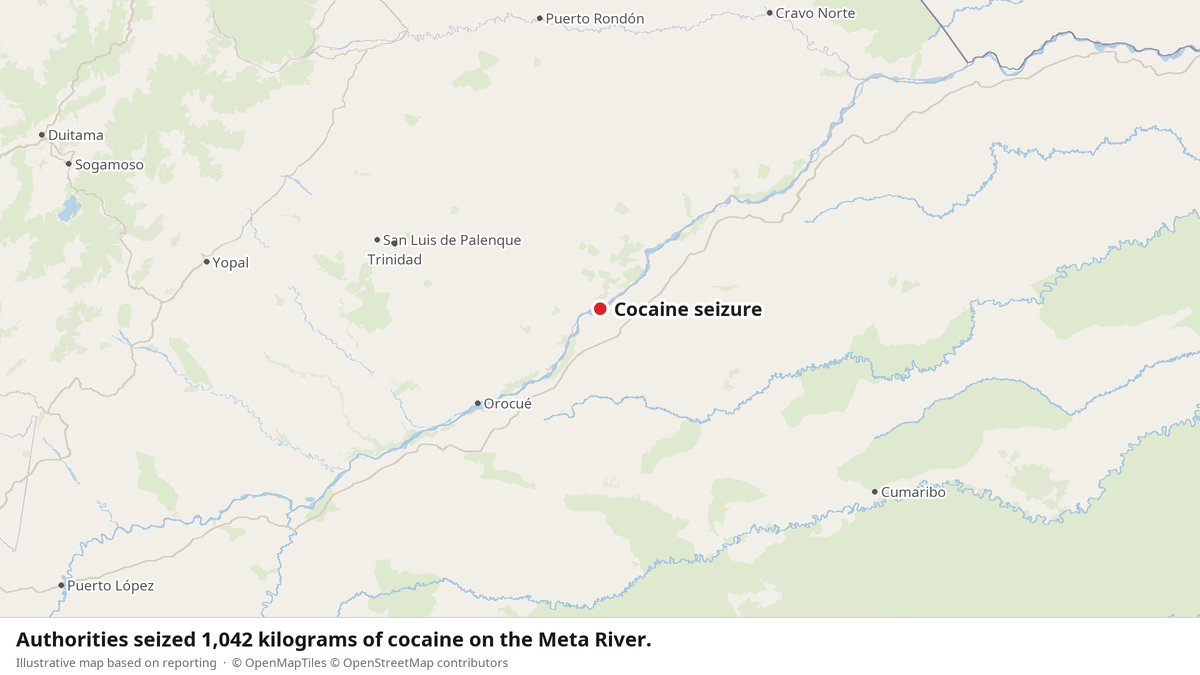
Colombian forces seized 1,042 kilos of cocaine hydrochloride from a boat on the Meta River in La Primavera, Vichada, the Defence Ministry announced Friday, 9 October. The Navy, Army, National Police and Office of the Attorney General joined the operation. The ministry said it kept more than 2.5 million doses off the streets.
A river route under scrutiny
The ministry said the seizure took drug seizures on the Meta River past 2.5 tonnes in less than 15 days. It said the operation struck criminal finances by more than US$56 million, but didn’t explain how it calculated that figure.
El Tiempo, citing a Navy report, said units of the Orinoquía Naval Force stopped the boat in the Nueva Antioquia area of La Primavera. The force commands the Navy’s operations across the eastern plains. According to the newspaper, the man steering the boat tried to escape when he saw officers. They moved the vessel to a safe port and inspected its cargo.
Officers found three drums of gasoline, an outboard motor and a Starlink satellite antenna, a service of U.S. company SpaceX. National Police antinarcotics investigators confirmed the substance as cocaine hydrochloride through a preliminary field test, El Tiempo reported.
The Defence Ministry wrote in a post on X, reproduced by Bogotá news magazine Semana: “Let there be no doubt: we will keep attacking narco-terrorism in Colombia with all our capabilities.” Military forces, police investigators and the national prosecution service took part. The Fiscalía leads criminal investigations.
Alleged links and unanswered questions
El Tiempo reported that intelligence information linked the boat to the José Daniel Pérez front of the National Liberation Army, or ELN. The group is a leftist guerrilla organisation that the U.S. State Department blames for bombings and kidnappings in Colombia and Venezuela. Washington listed the ELN as a foreign terrorist organisation on 8 October 1997. No response from the group to the reported link was cited, and the connection remains based on intelligence reports cited by El Tiempo.
The report said Colombia’s conservative president, Abelardo De la Espriella, ruled out a hostage exchange with the ELN in September. In its 2023 terrorism report, the State Department said Venezuela gave the group a safe haven. The same U.S. list has included two breakaway groups of the former FARC guerrillas since 1 December 2021. Knowingly providing money or other material support to a listed group is a federal crime for anyone under U.S. jurisdiction. U.S. banks holding linked funds must freeze them and report them to the Treasury Department.
Officials haven’t said whether the man steering the boat or anyone else was arrested. They also haven’t identified who owned the cocaine, the exact date the boat was stopped, or where the load was ultimately headed.
Routes toward foreign markets
The Meta crosses Colombia’s eastern plains, known as the Llanos, before joining the Orinoco at the border with Venezuela. El Tiempo said the river has returned to drug-trafficking routes. After a seizure in the area, military commanders said armed groups use river corridors to move drugs toward Venezuela.
NTN24 reported that about 1.5 tonnes were seized from a boat in the same Nueva Antioquia area on 25 September. Investigators are studying possible links between the latest load and routes toward Central America and Europe. El Tiempo said the drugs were most likely headed for international markets. The report said a study published this year found cocaine had become one of Colombia’s biggest earners.
The U.S. State Department rates Colombia at Level 3, Reconsider Travel, and lists the Colombia-Venezuela border region, Arauca, Cauca and Norte de Santander at Level 4, Do Not Travel. Vichada wasn’t named separately, although the department borders Venezuela. Bogotá, Medellín and Cartagena are far from the Meta River route.