
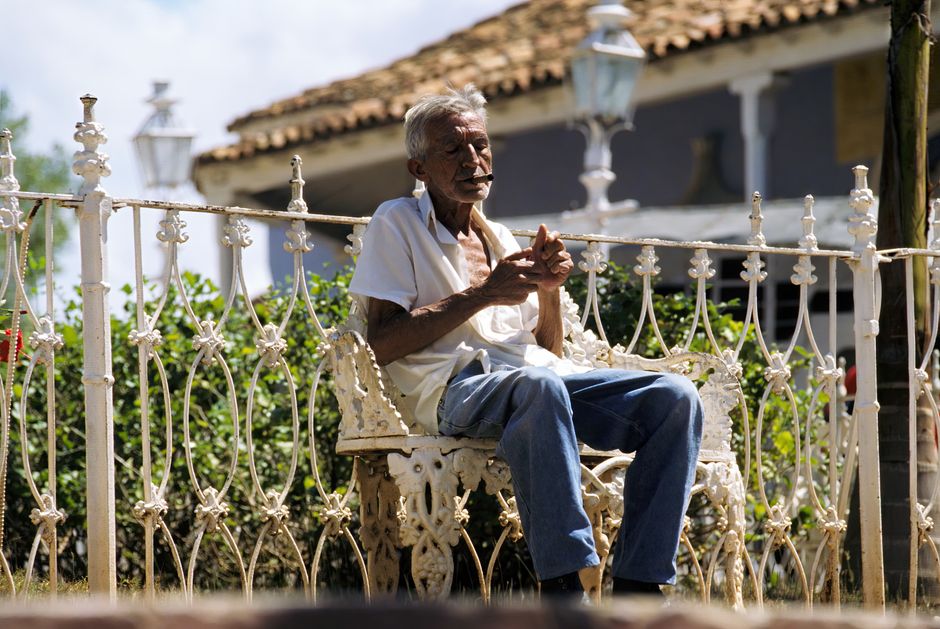
Many elderly Cubans are left to fend for themselves as the island’s economic crisis deepens, a situation exacerbated dramatically since the beginning of the year by an oil embargo imposed by U.S. President Donald Trump. This deepening crisis has forced the Cuban government to authorize private entrepreneurs to operate elder care services, marking a significant departure from the island’s traditional model of total state control and signaling a privatization of collective resources.
On a recent afternoon, nearly 50 elderly residents gathered for a modest meal at the Church of the Holy Spirit in Old Havana. This ritual, taking place three times a week, provides a crucial supplement to their meager state provisions. Among them was Carmen Casado, an 84-year-old retired chemical engineer, whose monthly pension of 2,000 Cuban pesos is equivalent to $4 at the informal exchange rate used daily. Casado, who lives alone with no children and receives no remittances from abroad, stated that the church meals are a “lifeline for us retirees with small pensions,” adding that “What we get from the bodegas alone is not enough.”
Who Pays the Price
The elderly are among the hardest hit by the severe economic crisis. Most are former government employees—teachers, doctors, nurses, technicians, custodians, lawyers—whose pensions are typically less than $10 a month. These workers, who dedicated their lives to state service, now face cuts to the basket of goods that have been subsidized for decades. They also contend with the loneliness brought on by the growing emigration of young people, a form of capital flight in human terms.
The impact of the crisis and the exodus of youth is starkly visible. Elderly people walk the streets alone, some rummaging through trash, others standing in long lines for the bread and rice provided by the ration book, which are the basic subsidized foods the state guarantees to every Cuban. The population on the island has declined by nearly 1.5 million over the last five years, falling from 11.1 million to just 9.7 million, primarily due to migration.
By the end of 2024, almost 26% of Cuba’s population was aged 60 or older, nearly twice the regional average of 14.2% in the same year, according to Cuba’s National Bureau of Statistics and the Economic Commission for Latin America and the Caribbean (CEPAL). This demographic reality amplifies the human cost of the economic downturn.
The State's Role and Imperial Pressure
The U.S. oil embargo, imposed by President Donald Trump, directly contributed to the dramatic worsening of the economic crisis since the beginning of the year. This act of economic warfare by an imperial garrison directly impacts the material conditions of the Cuban working class and the dispossessed, particularly the elderly. The state’s ability to provide for its citizens is systematically undermined by external pressures designed to destabilize the economy.
In response to the critical plight of the elderly, the Cuban government has authorized private entrepreneurs to operate elder care services and residential facilities. This move marks a significant departure from the island’s traditional model of total state control, representing a privatization of social provisions that were once part of the collective commons. While presented as a solution, this shift introduces market forces into a sector previously managed by the state, potentially creating new avenues for surplus extraction from a vulnerable population.
Despite the poverty and loneliness, Carmen Casado insists she is still privileged, being mentally sharp and physically able. She manages entirely on her own, with her only medication, a blood pressure tablet, “so far” remaining available at state-run pharmacies. Casado maintains faith in the government and attributes the country’s woes to the United States, stating, “We’re doing everything we can here to move the country forward. But the thing is, we have a very powerful enemy, and he’s right there, right on our doorstep.” Her perspective highlights the enduring impact of imperial policy on the daily lives and political consciousness of the working class.
Casado’s life has spanned defining moments, from the revolution led by Fidel Castro when she was a teenager, through the Bay of Pigs invasion (now in its 64th year), the 1962 Missile Crisis, and the so-called Special Period following the collapse of the Soviet Union. She also lived through the 1970s and 80s, when the island’s economy was heavily subsidized by the Soviets, and the Cuban system seemed to promise a brighter future. Now, her revolutionary spirit is tested as she, like many others, is forced to sell cigarettes on the streets, line up for bread, and seek free meals offered by churches and some state institutions.