
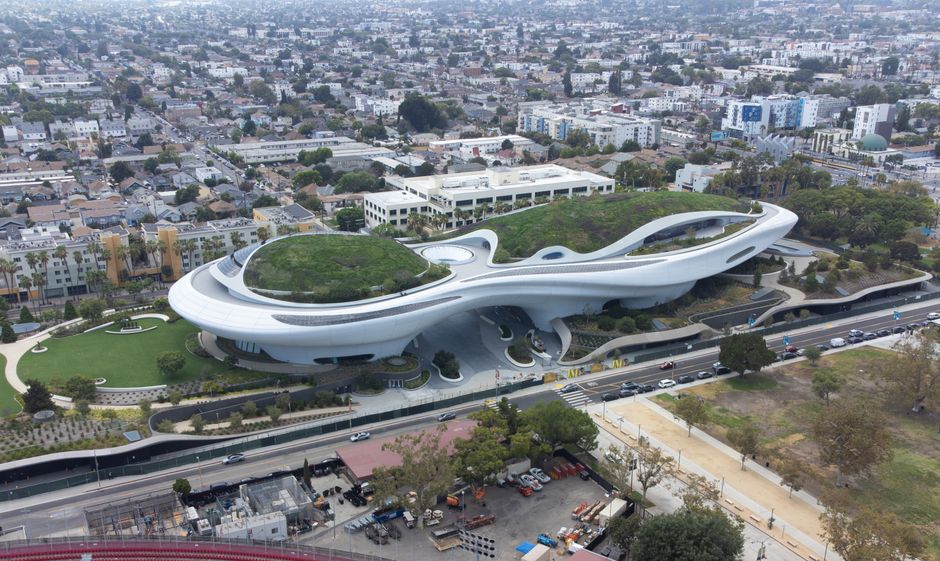
The Lucas Museum of Narrative Art opened in Los Angeles yesterday, offering free admission and more than 100,000 square feet of gallery space displaying about 1,200 works across roughly 30 galleries. George Lucas, 82, the director and creative mind behind the Star Wars and Indiana Jones franchises, has assembled an immense collection of roughly 40,000 works over 60 years and has never sold a single item from it.
The museum sits in Exposition Park in the deep south of Southern California, on what used to be a concrete parking lot next to the century-old Coliseum, which will host its third Olympic Games in two years. It stands in a 4.5-hectare park planted with 300 trees, including pines and jacarandas. The building is over 300,000 square feet and includes two theaters with seating for 600, cafés, restaurants, a library and study areas.
Breaking Down Cultural Hierarchies
About 1,200 works are on display, some devoted to individual artists and most organized thematically around love, family, school, cinema, manga and photography. Frida Kahlo's self-portraits sit alongside Beatrix Potter's illustrations, the ships from the Star Wars saga, works by Andy Warhol, photos by Robert Capa and the original lion costume from The Wizard of Oz. The grounds feature a dozen sculptures, including works by Fernando Botero, a Princess Leia, and one with Yoda and Grogu together.
The museum's CEO, the British-born Tracey Bates, has been in post since January this year and had nearly seven years as a consultant to Lucas and his wife, Mellody Hobson. She said the couple have been shaping the museum idea for 20 years. Bates said, "I think the Vatican is a great example," adding, "when you go to the Vatican and you are overwhelmed by it, it's an incredible experience. You assume everybody gets to go, and one, they don't, and I think we need to remember that. And two, you don't see it close up. You see the glory of the Sistine Chapel, but you don't see the story of the Sistine Chapel. So by it being so close to us, George is showing you the story. He's telling us, Michelangelo is a renowned artist, but ultimately in his day he was an illustrator, so we should pay illustrators of our day the same credit."
Challenging Museum Conventions
The first hall explains the origins of narrative, focusing on heroes, myths and the sacred. It includes original pieces such as a painting by Artemisia Gentileschi, along with copies and reproductions of the Vatican's Sistine Chapel and of Velázquez's Las Meninas. The fourth floor has roughly thirty galleries, including a room for Norman Rockwell with about 50 works, galleries devoted to N. C. Wyeth, Maxfield Parrish, Frank Frazetta, Thomas Hart Benton and Jessie Willcox Smith, and works by those artists elsewhere in the museum.
The cinema galleries feature Star Wars prominently, while Indy is represented only by a bronze statue. The saga includes original sketches and paintings, ships, costumes and props used in films across different decades. Nearby are paintings by Alphonse Mucha and Diego Rivera, an original Tintín by Hergé and a comic-style work by Pablo Picasso.
The museum has no wall labels. Bates said, "Yes, because we want to show the narrative in one frame, a story you can look at and understand. George was very conscious when working with the curatorial team that the art should speak," and added, "You go to a museum, you start reading about a piece and instantly your opinion of what you're looking at changes. We've been very intentional about not doing that here. We want the image and the story in that image to be what you see and what you engage with. Should you want further understanding, we have provided a free access digital guide. You just point your phone at the image and the context."
Murals and Political Art
The fifth and top floor is dedicated to muralism. Lucas describes murals in the catalog as "among the oldest forms of narrative art" and says that "in a world saturated with fleeting digital images, murals offer a different tempo, require physical presence, anchor stories to specific places." There is a large reproduction of Diego Rivera's work, and Bates said, "it wouldn't be right for us to take the Diego Rivera from Mexico. It remains where it remains, but that story doesn't get told." The floor also includes half a dozen original Banksy pieces from his walls and his stencils, and politically charged works such as Crash and Depression: Mexican Deportation and Red Fear and McCarthyism by Mexican-American Judith F. Baca, the mind behind The Great Wall of Los Angeles.
Bates said, "We're not bound by the same rules as a regular museum because we've built a museum, so the rules don't exist, which has been really fun." The works and galleries will rotate.
Designed by Ma Yansong of MAD Architects, the building was constructed with more than a thousand fiberglass panels by over 150 architects and engineers, using technology that didn't exist until about a decade ago. It took nearly 10 years to build and almost ended up in Chicago. The museum also includes a curved library with thousands of reference volumes on film and art, including 3,000 donated by actor Steve Martin, a dozen study rooms and two cinemas for documentaries and films about the works and creators on display and other programmed themes.
Bates said, "This was built for 100 years plus it is a work of art in itself, a sculpture," and added, "George has been building this for decades. I've had the pleasure of building it as a small cog for six and a half years. It will be thrilling to open the doors to the public. Because that is what a museum is for: for the people."
Why This Matters:
The Lucas Museum challenges the gatekeeping that's long defined high culture by placing commercial illustration, film props and comic art alongside old masters and celebrated painters. By offering free admission and refusing wall labels that require specialist knowledge to decode, it lowers barriers that keep working-class families and communities of colour out of traditional museums. The emphasis on narrative art — from Michelangelo to Banksy, from Diego Rivera to Star Wars — reframes cultural production as a continuum rather than a hierarchy. The inclusion of politically charged works by Judith F. Baca and the refusal to appropriate Diego Rivera's murals from Mexico reflects a respect for context and community ownership that many major institutions lack. In a city where cultural access often follows wealth, a museum built for ordinary people matters.