
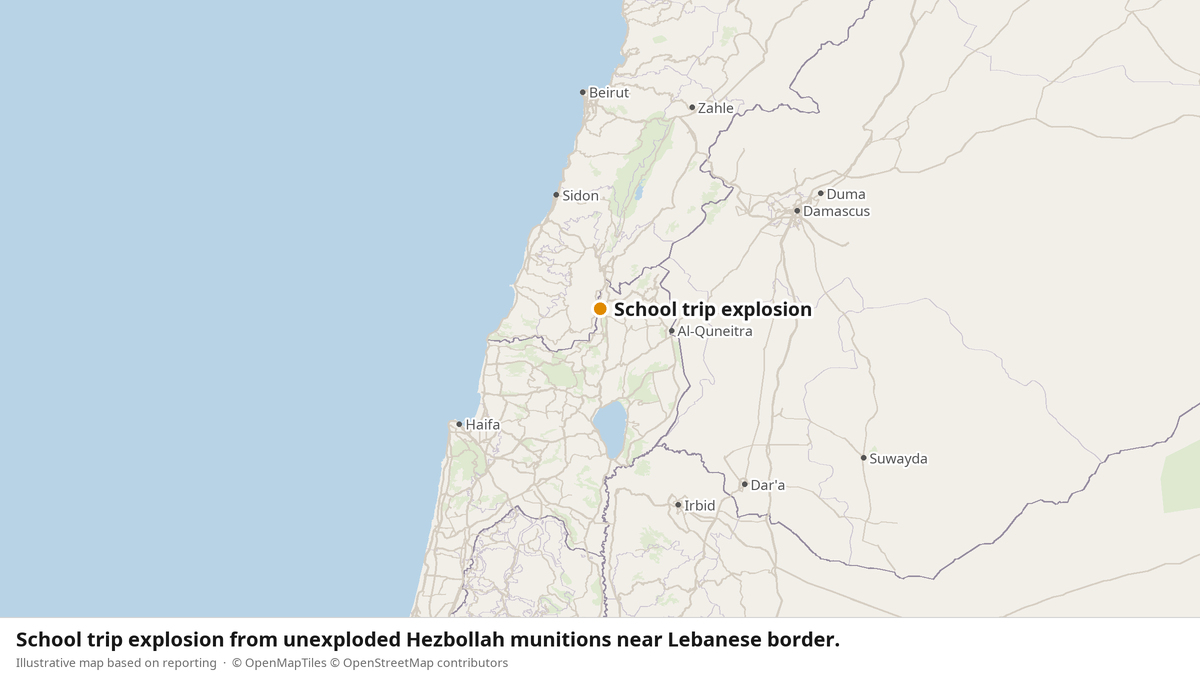
Elazar Yair Wilensky was 14 years old. He died Monday after unexploded Hezbollah ammunition detonated during a school trip near the Lebanese border, injuring 24 others. The Israeli military alleged Hezbollah fired the device, a cluster munition, during the war, though no independent investigation has established its origin.
The Terror Threat
The blast hit the Manara mountain range, roughly 50 to 100 metres from the Lebanese border, Israeli newspaper Maariv reported. The site lay close to an Israeli military post that combat engineering troops manned during the war. According to the report, Hezbollah subjected the post to heavy fire.
Students from ORT Ma'alot religious high school found the munition while hiking near the border. Haaretz reported that some students handled it and posed for photographs. "He was playing with the bomb," one student told the paper. "Some of the kids told him to leave it, but no one thought it contained explosives. We continued along the trail and stopped to pray at one point. After the prayer, he played with it again, put it back in his bag, and then there was a massive explosion."
The boy's funeral took place. He was described as "a child full of joy, a good and beloved friend."
On Tuesday, the US Embassy in Israel warned American citizens about unexploded ordnance and munitions across extensive areas of Israel, the West Bank and the Gaza Strip. The embassy said the danger was particularly great near border areas, where locations often lack signs. "Rain, flooding, agricultural work, and construction activities frequently bring buried munitions to the surface, making them more unstable," it said. It also warned that small, round cluster bomblets may look like balls or toys. "Assume that any unidentified object is dangerous," the embassy said. Its three-step rule is recognize, retreat, report. Report suspicious objects to Israel Police at 100.
Self-Defense Under Fire
The boy's death directly resulted from a war in which Hezbollah fired on Israeli positions and communities. Dozens of towns in northern Israel were evacuated during the conflict. Israeli forces still occupy parts of southern Lebanon, and they have expanded their operation since fighting with Hezbollah resumed in March. Israeli strikes have continued despite a framework agreement signed between Beirut and Tel Aviv in June 2026, about four months ago.
Lebanon's Health Ministry said Monday that Israeli attacks over the past three years killed 8,596 people and wounded 30,660. The ministry's figures don't separate combatants from civilians, and the base reporting provides no breakdown.
Questions on the Restricted Zone
An initial investigation found that officials had neither physically sealed off a nearby restricted zone nor clearly marked it. Israel's education ministry said Tuesday it was investigating whether the students had strayed from their approved route. The ministry said it had authorised the route and that it complied with restrictions imposed by the Jewish National Fund (KKL-JNF), which manages the area. "The planned route did not pass through the prohibited area," it said. The ministry added that pre-trip safety instructions barred students from touching unexploded ordnance and required them to report discoveries.
KKL-JNF officials told Haaretz that the organisation designated the dangerous area off-limits in May 2025, but left it physically accessible, without clear signs or barriers. It said it had informed the Education Ministry but lacked authority to approve school trips or seal the area. The ministry acknowledged that it knew KKL-JNF had closed a dangerous route along the Ramim Ridge. It said it approved an alternative route that took the restriction into account. That route passed close to another area closed because of unexploded ordnance, yet access there remained unrestricted. Investigators are examining whether students deviated or the ministry defined the route incorrectly.
Haaretz columnist Rogel Alpher criticised the supervision. He wrote that students passed the munition around, put it in bags, photographed themselves holding it and sent pictures to their parents. "At least some staff were aware of what was happening, yet they let it happen," Alpher wrote.
The embassy's guidance is blunt. Don't touch ordnance. Don't throw things at it. Don't use phones or two-way radios nearby. Don't collect casings, fragments or souvenirs. Stay on paved roads and familiar trails, and avoid areas marked as minefields.
A 14-year-old is dead. Twenty-four people are wounded. Hezbollah's fire left the weapon behind on Israel's northern border.