
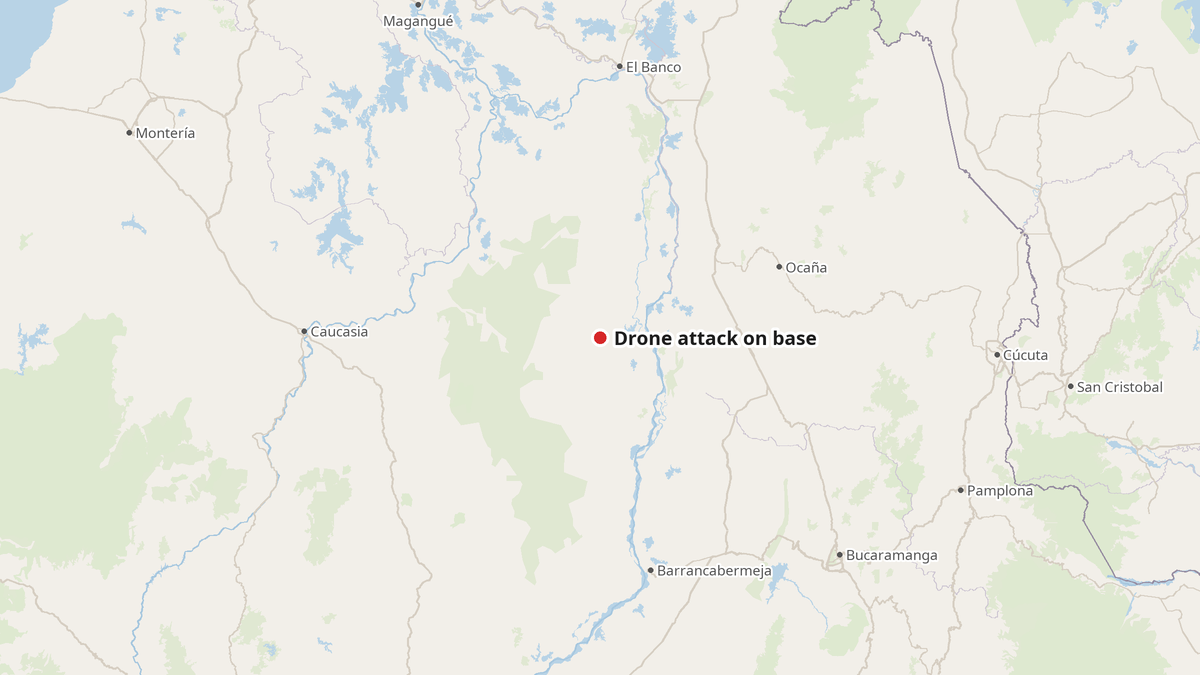
Three Colombian soldiers are dead and at least 16 more are wounded after a drone attack on a military base in Santa Rosa del Sur, a small town in the foothills of the San Lucas mountain range. The armed forces announced the toll in a statement on Saturday. Authorities haven't said who carried out the strike.
It's the latest in a string of attacks on security forces as violence climbs across rural parts of the country. Footage shared on social media showed smoke rising from the base after three explosions, with soldiers taking cover in shelters made of sandbags.
A Region Long Fought Over
Santa Rosa del Sur sits in gold-mining country, and armed groups have fought over it for years. The Gulf Clan, the National Liberation Army (ELN) and smaller groups led by former members of the Revolutionary Armed Forces of Colombia (FARC) all contest the area. Residents of places like this live with the consequences of that competition: groups that tax local businesses and profit from the drug trade.
The broader numbers point the same direction. State forces and illegal armed groups carried out 34 attacks with bombs or explosives in Colombia in the four weeks to October 16, according to ACLED, a group that monitors armed conflicts. That's a 9 percent increase on last year's four-week average.
A Hardline Turn
President Abelardo de la Espriella, a conservative, took office in August and has since cancelled peace talks with rebel groups. His government has favored a confrontational approach, including more air strikes, more troops deployed in some cities, and joint task forces to defend strategic assets such as a pipeline that runs from the Caribbean coast to central Colombia.
On X, the president promised a hard response to Saturday's attack. "Those who were behind this attack... will have nowhere to hide," he wrote. "Every attack against our soldiers strengthens our resolve to defend Colombia."
His government argues that armed groups used ceasefires granted by the previous government to consolidate their grip on rural areas. Some groups, the source reports, have answered by stepping up attacks on the armed forces.
Civilians Caught in the Crossfire
The cost of that escalation isn't limited to soldiers. Last week, a military base in Tolima province was targeted with missiles made from gas canisters. The attack killed four civilians, including a two-month-old baby. In the border city of Cucuta, police have been attacked several times with remotely activated bombs.
The pattern raises a hard question about whether a strategy built on force can protect the rural communities that live closest to the fighting. Cancelled negotiations leave fewer channels for de-escalation, and the weeks since August have brought more attacks, not fewer.
The 2016 peace deal with FARC led to the demobilisation of more than 14,000 fighters. This year marks its tenth anniversary. But smaller groups have since fought over the former rebels' territory, a reminder that a peace agreement can end one conflict without settling who governs the places it leaves behind.
Why This Matters:
Three soldiers are dead, 16 are wounded, and four civilians, including an infant, died in an attack just a week earlier. Those are the human stakes of a security policy now about three months old. The government says earlier ceasefires let armed groups dig in; the record since its confrontational turn shows violence still rising. Rural communities in contested areas like San Lucas bear the heaviest burden, caught between rebel taxation and military operations. The 2016 deal, ten years on, shows that demobilising fighters isn't enough without lasting state presence and public services in the territories they leave behind. Whether Colombia can protect civilians while pressing armed groups is the test facing de la Espriella's government.
- colombia
- drone attack
- santa rosa del sur
- colombian army
- armed groups
- soldiers killed
- gulf clan
- national liberation army