
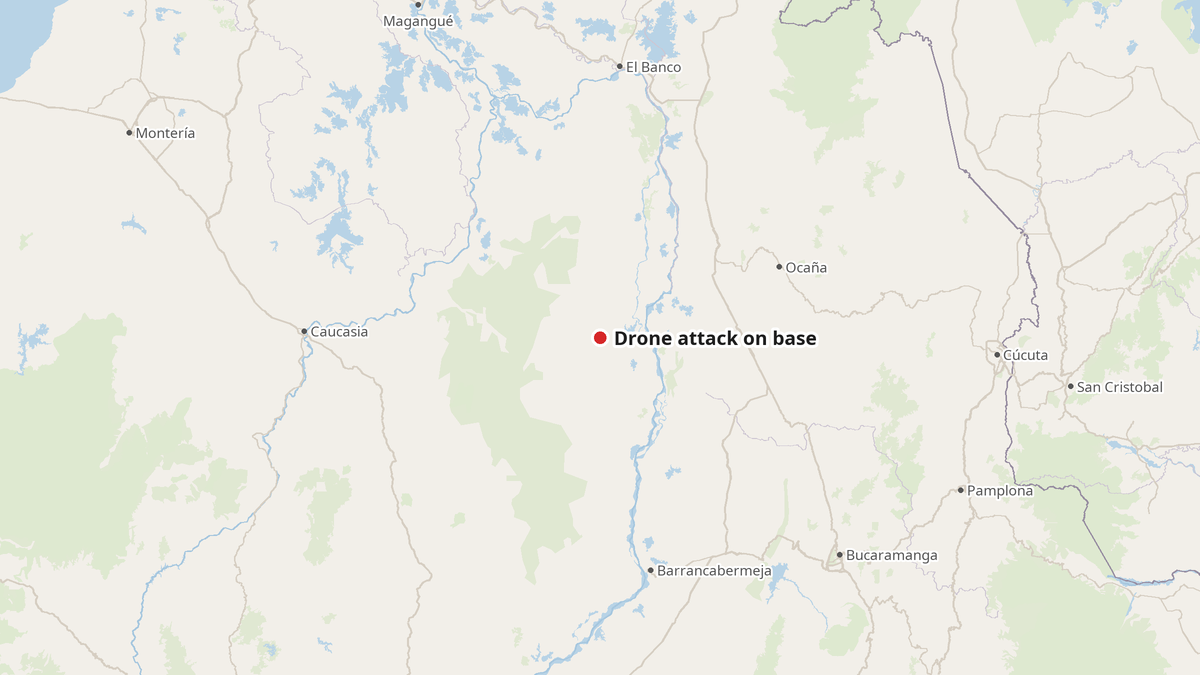
Three Colombian soldiers are dead and at least 16 are wounded after a drone attack on an army base in Santa Rosa del Sur, the country's armed forces said Saturday. It's the latest strike on security forces as violence climbs across rural Colombia, and it lands squarely on the new government's hard-line security strategy.
Authorities haven't said who carried out the attack. Footage shared on social media showed clouds of smoke rising from the base after three explosions, with soldiers taking cover in shelters made of sandbags.
The Attack
Santa Rosa del Sur is a small town in the foothills of the San Lucas mountain range, in the north of the country. A Rio Times report says drones carrying explosives hit the base on 7 November 2026 and that the army reported three soldiers dead.
The terrain matters. The area is rich in gold mines, and it has long been contested by armed groups, among them the Gulf Clan, the National Liberation Army (ELN) and smaller factions led by former members of the Revolutionary Armed Forces of Colombia (FARC). Where there's gold and weak state presence, criminal organizations tend to move in.
President Abelardo de la Espriella answered quickly on X. "Those who were behind this attack... will have nowhere to hide," he wrote. "Every attack against our soldiers strengthens our resolve to defend Colombia."
A Government Changing Course
De la Espriella, a conservative, took office in August, about three months ago. Since then he has cancelled peace talks with rebel groups and adopted a confrontational posture. His government has stepped up air strikes, put more troops in some cities and created joint task forces to defend strategic assets, including a pipeline that runs from the Caribbean coast to central Colombia.
The administration's reasoning is straightforward. It argues that armed groups used the ceasefires granted by the previous government to tighten their grip on rural areas, where they tax local businesses and profit from the drug trade. Negotiations, in this telling, bought the groups time and territory. Some have responded to the new approach by stepping up attacks on the armed forces.
A Widening Pattern
Saturday's strike didn't come in isolation. Last week, a military base in Tolima province was targeted with missiles made from gas canisters. The attack killed four civilians, including a two-month-old baby. Police in the border city of Cucuta have been hit several times with remotely activated bombs.
The numbers back up the trend. State forces and illegal armed groups carried out 34 attacks with bombs or explosives in Colombia in the four weeks to October 16, according to ACLED, a group that monitors armed conflicts. That's a 9 percent increase on last year's four-week average.
The backdrop is a 2016 peace deal with FARC that led to the demobilisation of more than 14,000 fighters. This year marks the tenth anniversary of that agreement. Yet smaller groups have since fought over the rebels' former territory, and the violence hasn't stopped.
Why This Matters:
Colombia's new government is betting that force and deterrence will do what a decade of negotiated arrangements didn't. The early returns are painful: soldiers killed, civilians killed, and a modest but measurable rise in bombings. Critics will point to those costs. Supporters will point to the government's argument that armed groups exploited ceasefires to entrench themselves and fund operations through taxation and drug profits. For investors and businesses, the stakes are concrete. Gold-mining regions, border cities and the Caribbean-to-interior pipeline are all exposed. A state that can't protect its own bases will struggle to protect commerce, property and ordinary citizens. Whether de la Espriella's approach restores that basic authority, or simply escalates the fight, is the question the next several months will begin to answer.
- colombia
- drone attack
- santa rosa del sur
- colombian army
- armed groups
- soldiers killed
- gulf clan
- national liberation army