
Congo's Ministry of Health says Ebola has killed 5,026 people out of 10,351 infected, a fatality rate of nearly 50 percent. One-third of the dead never received any care at all. They died before anyone tested them, before anyone tried.
"These are people we never had opportunity to try to save them and it is one of the biggest concerns for us in this outbreak," said Dr. Patrick Otim, a programme area manager with the World Health Organization. "How do we try to reach people early to get them to come to health facilities to get a fighting chance to survive?"
The outbreak, caused by the Bundibugyo virus, was declared in mid-May, about five and a half months ago. It caught authorities by surprise, and they've been struggling to manage it ever since. It's now the second deadliest Ebola outbreak in history, behind only the West Africa epidemic of 2014 to 2016, which killed 11,000 people across multiple countries. That one ended 10 years ago. The lesson, apparently, didn't stick.
Who Gets Crushed
The virus has reached 67 of the country's 178 health zones across eight of 26 provinces. Fifty of those zones have active cases. Ituri and North Kivu, in the east, are the epicenters, with 9,782 confirmed cases and 4,792 deaths between them. That's nearly the whole outbreak, packed into the regions furthest from the seats of power.
The Bundibugyo virus has no known vaccine or treatment. Health workers treat symptoms, and that's all they've got. So 2,788 people have recovered, largely on the strength of their own bodies and whatever supportive care reached them in time.
What They're Calling "Containment"
Contact tracing, the backbone of any outbreak response, is failing. According to the Africa Centers for Disease Control and Prevention, about 80 percent of new cases are coming from outside the chain of monitored contacts. Four in five new infections arrive from transmission chains that health authorities can't see. Officials admit that people dying outside treatment centers, untested, feeds community transmission beyond the reach of workers who could manage infection under medical protocols.
The surge, the article notes, is sparking concerns among experts about the authorities' ability to contain the virus. Concern is cheap. Clinics, tracers, test kits and transport cost money, and the report doesn't show where it went.
Borders Mean Nothing to a Virus
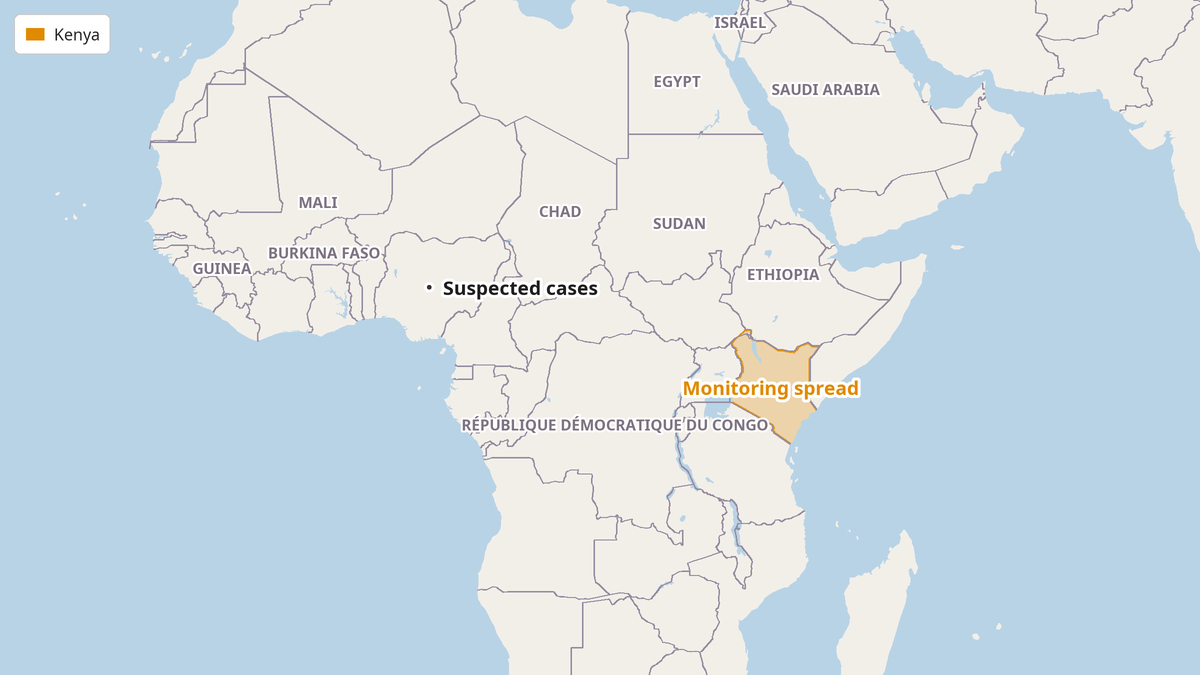
The outbreak has crossed lines drawn on maps. As of 28 October, WHO recorded 10,274 confirmed cases and 4,992 deaths in the DRC, nine confirmed cases and two deaths in Kenya, 20 confirmed cases and two deaths in Uganda, one confirmed case in Nigeria and one imported case in France. Overall: 10,305 confirmed cases and 4,996 confirmed deaths across the affected countries. Nigeria is one of five countries to detect Bundibugyo virus disease in this outbreak.
Nigeria's first confirmed case, a woman who travelled from Uganda to Abuja, tested positive on 20 October, 11 days ago. She was medically evacuated to Switzerland for continued treatment. Now the Nigeria Centre for Disease Control and Prevention reports two new suspected cases in the North-east region. Both people are isolated, contact listing is ongoing, and laboratory testing is underway. The agency hasn't said which states. "Further updates will be provided as verified information becomes available," it posted on X.
NCDC Director-General Jide Idris urged the public to avoid speculation and reinforce hygiene: handwashing, alcohol-based sanitisers, and seeking care at designated facilities if unusual symptoms arise. That's the instruction for people who, in eastern Congo, are already dying before they reach a facility.
The Alternative
The base reporting names no community burial teams, no neighborhood watch networks, no mutual aid brigades. The only actors in this story are ministries, agencies and international bodies, and the numbers above are their scorecard. One-third of the dead were never reached by any of them. Whatever stops the next chain of transmission will have to be something that gets to those people first.
Otim called 5,000 deaths "a very tragic milestone because it is just not a number. It is families and communities that have been devastated by this outbreak." He's right. And those families and communities are the ones still waiting.
- ebola
- ebola outbreak
- democratic republic of the congo
- nigeria
- world health organization
- bundibugyo virus
- disease outbreak
- epidemic