
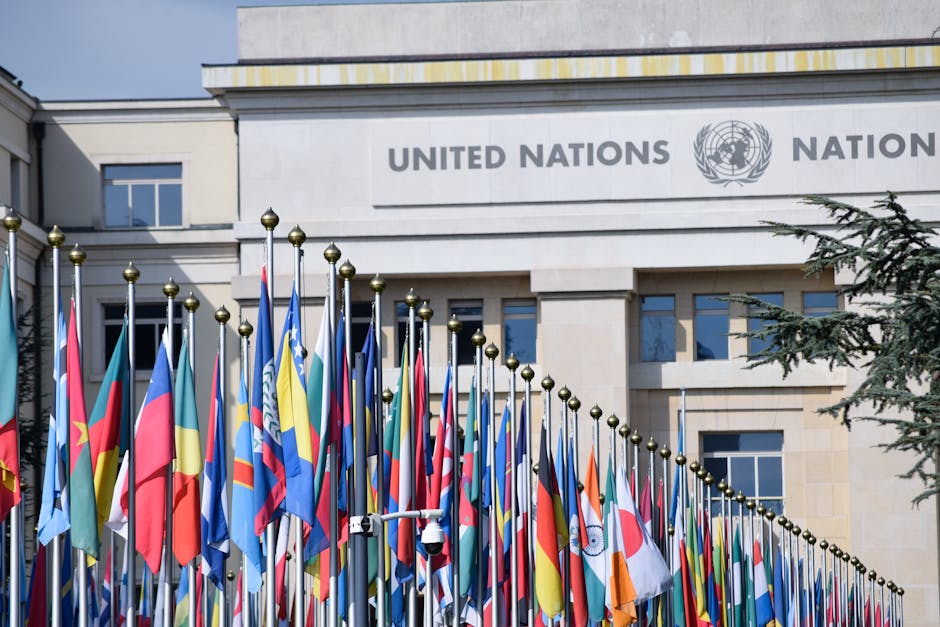
A senior United Nations official has warned Latin America to brace for a severe El Niño phenomenon from October to December 2026. This pronouncement, delivered to Reuters, signals a deepening of agricultural supply shocks already impacting the region. It's a stark reminder of how supranational bodies increasingly dictate the narrative of regional crises, often with direct consequences for the native working class.
The official's statement explicitly links the anticipated El Niño to existing agricultural disruptions. These shocks, the UN representative noted, have been exacerbated by ongoing conflict in the Strait of Hormuz. This connection reveals how distant geopolitical instabilities, interpreted and broadcast by globalist actors, are presented as direct threats to the stability of national economies and the livelihoods of working people across Latin America.
Elite Pronouncements and National Destiny
Such declarations from international institutions like the United Nations consistently frame the future for sovereign nations. They often bypass national governments in their public dissemination, instead opting for global wire services. The official’s statement underscores how globalist entities position themselves as central authorities in interpreting environmental and economic challenges for entire continents, reducing the self-determination of sovereign peoples.
This narrative, disseminated through major outlets like Reuters, forms part of a unified ideological apparatus. It shapes public understanding of global events, often at the expense of national sovereignty. We're seeing a pattern where national destinies aren't decided by their own citizens, but by pronouncements from unelected international bureaucrats.
The conflict in the Strait of Hormuz, a critical chokepoint for global trade, serves as a stark reminder of the fragility of supply chains that underpin national food security. It's a globalist mechanism, where events far removed from local communities are leveraged to explain domestic hardships, reinforcing the idea that nations are merely cogs in a larger, managed system.
The Cost to the Native Working Class
The potential worsening of agricultural supply shocks represents a direct and tangible cost to the native populations of Latin American nations. Stable food supplies are fundamental to the economic security and cultural continuity of communities. When these are threatened by global phenomena and distant conflicts, as interpreted by international bodies, the impact falls disproportionately on the working classes who rely on predictable local economies.
These agricultural disruptions threaten more than just commodity prices; they impact the daily lives of families, farmers, and laborers. Their interests are systematically overlooked in favor of transnational agendas. The narrative of global interconnectedness, consistently advanced by institutions like the United Nations, positions national economies as vulnerable components within a larger, borderless economic order.
This system, driven by transnational elite interests, treats national identity and traditional community as obstacles. The senior United Nations official’s warning, while framed as a neutral forecast, reinforces the perception that national futures are increasingly dictated by forces and pronouncements originating outside their borders. That's a direct consequence for the people who call those nations home, whose legitimate claim to their land, culture, and future is being systematically undermined.