
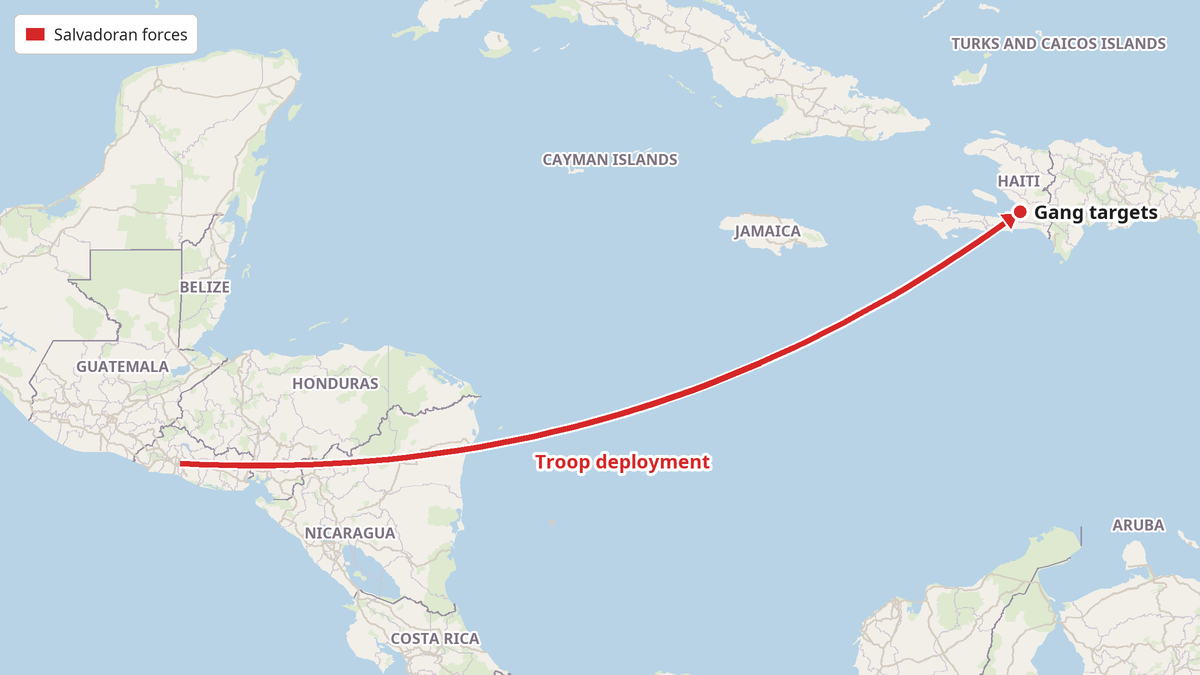
Salvadoran troops are bombing a gang leader's house in Haiti from helicopters, and the videos are already racking up views. Roughly 2,500 soldiers have gone to the Caribbean country since mid-October, "with little transparency or oversight," and the footage lands on the social media of President Nayib Bukele, Salvadoran officials and an army of pro-government influencers. The message arrives in Haitian Creole, English and Spanish: "We will help you take back your country ... Finally, Haiti will be free."
Nobody in Haiti was asked.
Who Has the Power
The offensive began about one month ago, after four Salvadoran aviation technicians working with a U.N.-backed mission went missing in a gang attack. A gang leader has since said the four are dead. The president's story shifted fast. First it was a rescue. Then, as international scrutiny mounted, it became a mission to eradicate Haiti's gangs.
"We kept our promise," Bukele posted on Tuesday, sharing video of Salvadoran forces bombing a gang leader's house after he'd asked on X for the coordinates. "Most of them ran away without even trying to fight. What cowards!"
Salvadoran political communications strategist Roberto Dubon read the production for what it is. "It's an electoral campaign to promote Nayib Bukele and portray him as if he's a superhero. They're selling an Avengers movie," he said. "He's using Haiti as a testing ground to implement his policies on an international level."
The timing isn't subtle. Presidential elections are about three months away, in February. Polling puts Bukele's approval well over 90%, and he's all but guaranteed to win. Still, the legislature controlled by his party moved the vote up from 2029 to 2027 and wrote the end of presidential term limits into the constitution, "paving the way for the populist to stay in power indefinitely." Security consultant Luis Enrique Amaya put it bluntly: "Bukele won't allow even a centimeter of his popularity and legitimacy to be lost. Not even a millimeter, not a single vote."
Who Gets Crushed
The people in the crosshairs are the ones with no say in any of this. Diego Da Rin, Haiti analyst for International Crisis Group, warned that "the Salvadoran troops' eagerness to secure quick, symbolic victories entails huge risks for civilians who can be caught in the crossfire." He added that the troops may not operate under the strict rules that bind the U.N.-backed force, and that the pressure could push rival gangs to unite into coalitions, as has happened before.
The record at home isn't comforting. Bukele's model suspended key constitutional rights and detained more than 1% of El Salvador's population, and it has "fueled accusations of mass human rights abuses." El Faro, the investigative outlet whose staff has since been exiled from the country, also reported that Bukele had negotiated with those same gangs. The tough-on-crime brand, in other words, may rest on a deal.
Analyst Tiziano Breda says the most likely path is quick shows of force to project victory before the troops are pulled out. The bill, which Bukele's government says it's footing, could breed resentment in a country where one in four people still live in poverty.
What They're Calling "Order"
Haiti's gangs are not a simple problem. Roughly two dozen well-known gangs operate in Port-au-Prince, with dozens more attacking outside the capital. They've spent years "leeching off political turmoil and overwhelmed police forces." They carry weapons smuggled mainly from the U.S., and they're "deeply entwined with some of the country's political elite." That last detail matters. The violence isn't separate from the ruling class. It's tangled up with it.
The usual guardians are keeping their distance. On Monday, Amnesty International called on both governments to publicly disclose the agreement allowing Salvadoran forces into Haiti and to "comply with international human rights law," warning the operations could worsen violence and harm civilians. The same day, U.S. Secretary of State Marco Rubio, a Bukele ally, said the U.S. was "not actively involved" and backed the U.N.-backed gang suppression force instead. "There is no plan B," Rubio said.
So the choices on offer to Haitians are a foreign army with its own electoral calendar, or a U.N.-backed force whose backers admit they have nothing else. The people living under the gangs get a say in neither.
- nayib bukele
- el salvador
- haiti
- gangs
- military offensive
- marco rubio
- amnesty international
- february elections