
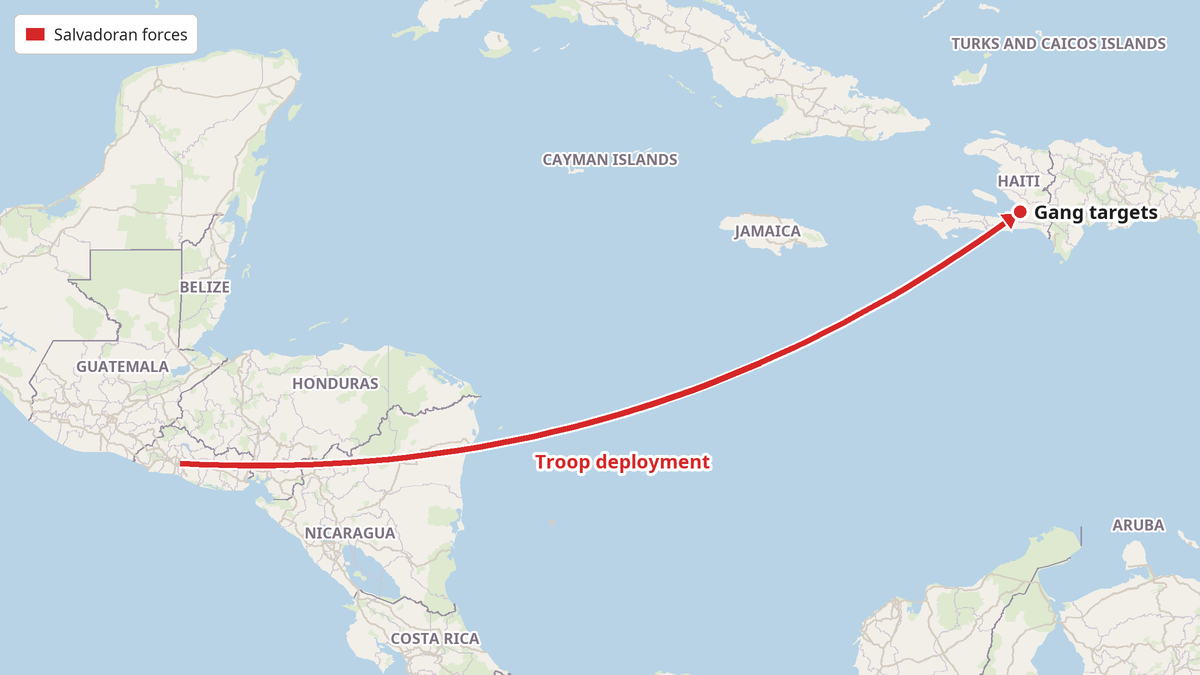
Amnesty International wants to see the deal. On Monday, the rights group called on El Salvador and Haiti to publicly disclose the agreement that lets Salvadoran forces operate on Haitian soil, and to "comply with international human rights law." The group warned that the operations could exacerbate violence and put civilians in harm's way.
It's a pointed demand. About 2,500 Salvadoran soldiers have been sent to Haiti with, by the account of experts, little transparency or oversight. The offensive began in mid-October, about one month ago, after four Salvadoran aviation technicians working with a U.N.-backed mission went missing in a gang attack. A gang leader has since said the four are dead.
A Campaign Fought on Social Media
The videos are hard to miss. Helicopters bombard a gangster's home. Armored cars roll through gang-ravaged streets. Civilians cheer marching soldiers. They flood the accounts of President Nayib Bukele, Salvadoran officials and an army of pro-government influencers, under a message in Haitian Creole, English and Spanish: "We will help you take back your country ... Finally, Haiti will be free."
"We kept our promise," Bukele posted on Tuesday, sharing video of Salvadoran forces bombing a gang leader's house. "Most of them ran away without even trying to fight. What cowards!"
Salvadoran political communications strategist Roberto Dubon sees a script. "It's an electoral campaign to promote Nayib Bukele and portray him as if he's a superhero. They're selling an Avengers movie," he said. "He's using Haiti as a testing ground to implement his policies on an international level." The tone and cinematic imagery mirror the videos the government produces at home to frame a gang crackdown that has fueled accusations of mass human rights abuses.
Elections, Term Limits and a Strained Economy
The timing matters. Salvadorans vote in February, about three months away, and Bukele is all but guaranteed to win. Polls put his approval well over 90%. But democratic concerns hang over the contest. The legislature, controlled by Bukele's party, moved elections up from 2029 to 2027 and eliminated presidential term limits in the constitution, paving the way for him to stay in power indefinitely.
The economy is lagging, too. One in four Salvadorans still lives in poverty. Security consultant Luis Enrique Amaya said the Haiti operation gives Bukele a way to remind voters of his security record. "He has to construct this narrative of success (in Haiti) to strengthen his image as president," Amaya said. "Bukele won't allow even a centimeter of his popularity and legitimacy to be lost."
ACLED analyst Tiziano Breda warned that the cost of the foreign offensive, which Bukele's government says it's footing the bill for, could fester resentment at home.
Why the Salvadoran Model Won't Travel
Bukele weakened El Salvador's two powerful gangs by suspending key constitutional rights and detaining more than 1% of the population. The Salvadoran investigative outlet El Faro, whose staff has since been exiled from the country, also reported that Bukele had negotiated with those gangs.
Haiti is a different problem. Roughly two dozen well-known gangs operate in Port-au-Prince, and dozens more have launched deadly attacks outside the capital. Their weapons are smuggled mainly from the U.S., and they're far better armed than Salvadoran gangs once were. They're also deeply entwined with parts of the country's political elite.
International Crisis Group analyst Diego Da Rin said Salvadoran troops could pressure Haitian police and international forces to organize better, something they've failed to do for years. But the offensive could also push rival gangs to unite in coalitions, as has happened before. "The Salvadoran troops' eagerness to secure quick, symbolic victories entails huge risks for civilians who can be caught in the crossfire," Da Rin said. He noted that the Salvadoran troops, unlike the U.N.-backed force, may not operate under strict rules.
Washington Keeps Its Distance
Even Bukele's allies are hedging. U.S. Secretary of State Marco Rubio said Monday that the U.S. was "not actively involved" in the Salvadoran offensive. He backed the U.N.-backed gang suppression force, which El Salvador isn't part of. "There is no plan B," Rubio said.
Why This Matters:
Haitian civilians have already endured years of gang terror and overwhelmed police. Now they face a foreign force that, by the account of experts, lacks public oversight, a disclosed legal agreement and the rules binding the U.N.-backed mission. Amnesty's call for transparency is a basic accountability demand: who authorized these operations, under what limits, and who answers when civilians are hurt? There's a domestic cost as well. A leader who has removed term limits and moved up elections is using a foreign deployment to burnish his image, while a quarter of his own people live in poverty. Security gains that depend on suspended rights and little scrutiny are hard to export, and the people most exposed to the gamble are those caught in the crossfire.
- nayib bukele
- el salvador
- haiti
- gangs
- military offensive
- marco rubio
- amnesty international
- february elections