
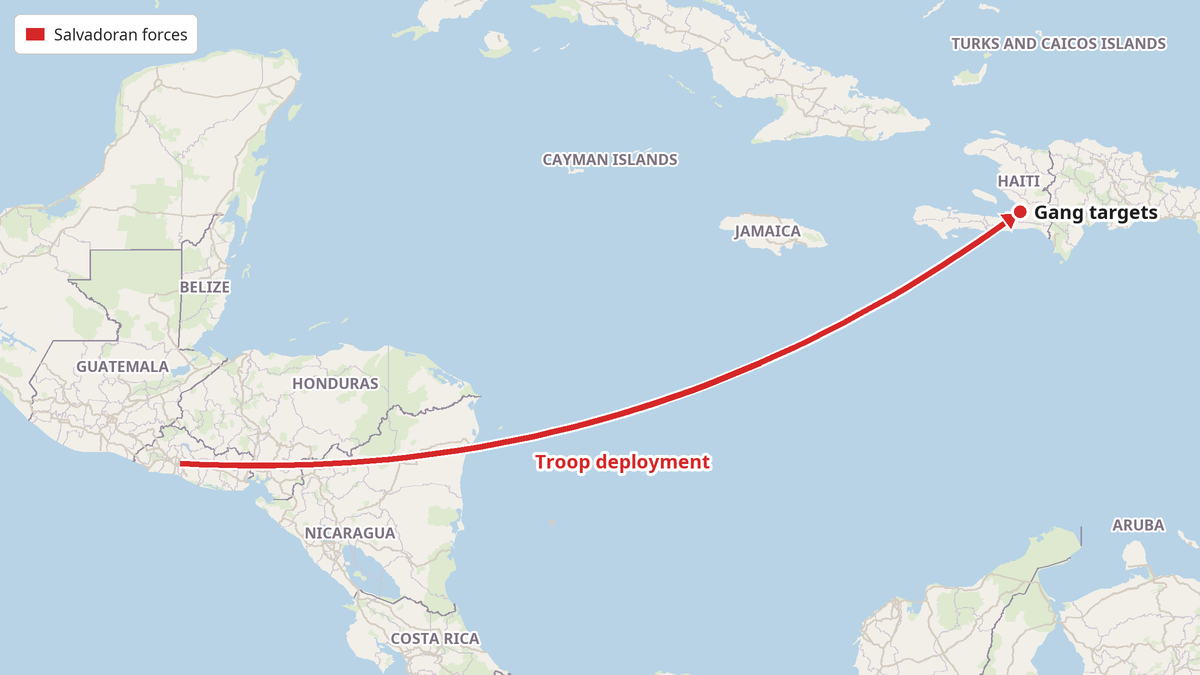
El Salvador has put 2,500 soldiers into Haiti with, in the words of the base reporting, "little transparency or oversight," and the footage of those troops is now doing campaign work for a president who has said he'll win re-election in February.
The offensive began in mid-October, about one month ago, after four Salvadoran aviation technicians working with a U.N.-backed mission went missing in a gang attack. A gang leader has since said the four are dead. The stated purpose shifted accordingly. What began as a rescue became, in the telling of President Nayib Bukele's government, a campaign to eradicate Haiti's gangs.
Who Profits
The images are the product. Salvadoran troops bombing a gang leader's house from helicopters. Civilians cheering marching soldiers. Armored cars on gang-ravaged streets. They flood Bukele's social media accounts, those of Salvadoran officials and what the article calls "an army of pro-government influencers," with the slogan: "We will help you take back your country ... Finally, Haiti will be free."
Roberto Dubon, a Salvadoran political communications strategist, put it plainly. "It's an electoral campaign to promote Nayib Bukele and portray him as if he's a superhero. They're selling an Avengers movie," he said. "He's using Haiti as a testing ground to implement his policies on an international level."
Luis Enrique Amaya, a Salvadoran security consultant, described the stakes in Bukele's own terms. "He has to construct this narrative of success (in Haiti) to strengthen his image as president," Amaya said. "Bukele won't allow even a centimeter of his popularity and legitimacy to be lost. Not even a millimeter, not a single vote."
The vote is already tilted. Polling puts Bukele's approval well over 90%. The legislature controlled by his party moved elections up from 2029 to 2027 and eliminated presidential term limits, "paving the way for the populist to stay in power indefinitely." The base article notes this unfolds against a lagging economy.
Who Pays
The bill is Salvadoran. Bukele's government says it's footing the cost of the foreign offensive. Tiziano Breda, an analyst with Armed Conflict Location & Event Data, warned those costs "could fester resentment in El Salvador, where one in four people still live in poverty."
The larger cost falls on Haitians. Diego Da Rin, Haiti analyst for International Crisis Group, said the troops' "eagerness to secure quick, symbolic victories entails huge risks for civilians who can be caught in the crossfire," especially if they don't operate under strict rules like the U.N.-backed force. He also warned the push could drive rival gangs to unite in coalitions, as has happened before. Amnesty International called on both governments to publicly disclose the agreement allowing the forces in, to "comply with international human rights law," and warned the operations could exacerbate violence and affect civilians.
The model being exported carries its own record. Bukele weakened El Salvador's two powerful gangs by suspending key constitutional rights and detaining more than 1% of the country's population. The crackdown, the article notes, "has fueled accusations of mass human rights abuses." The Salvadoran investigative outlet El Faro, whose staff has since been exiled from the country, reported that Bukele had negotiated with those gangs.
The Weapons and the Elite
The article's account of Haiti's gangs points to where the guns and protection come from. They wield weapons "smuggled mainly from the U.S." and are "deeply entwined with some of the country's political elite." Roughly two dozen well-known gangs operate in Port-au-Prince, with dozens more attacking outside the capital. They've spent years "leeching off political turmoil and overwhelmed police forces." That entanglement, the analysts say, makes Bukele's model nearly impossible to replicate.
The Allies Step Back
On Monday, U.S. Secretary of State Marco Rubio, described as a Bukele ally, distanced Washington from the operation. The U.S. was "not actively involved," he told the press, and he backed the U.N.-backed gang suppression force, of which El Salvador isn't part. "There is no plan B," Rubio said.
Breda expects the likelier outcome is "quick shows of force to project victory before retiring troops." Da Rin allowed that the Salvadoran presence might pressure Haitian police and international forces to organize better, something they've failed to do for years. The election comes in February, about three months away.
- nayib bukele
- el salvador
- haiti
- gangs
- military offensive
- marco rubio
- amnesty international
- february elections