
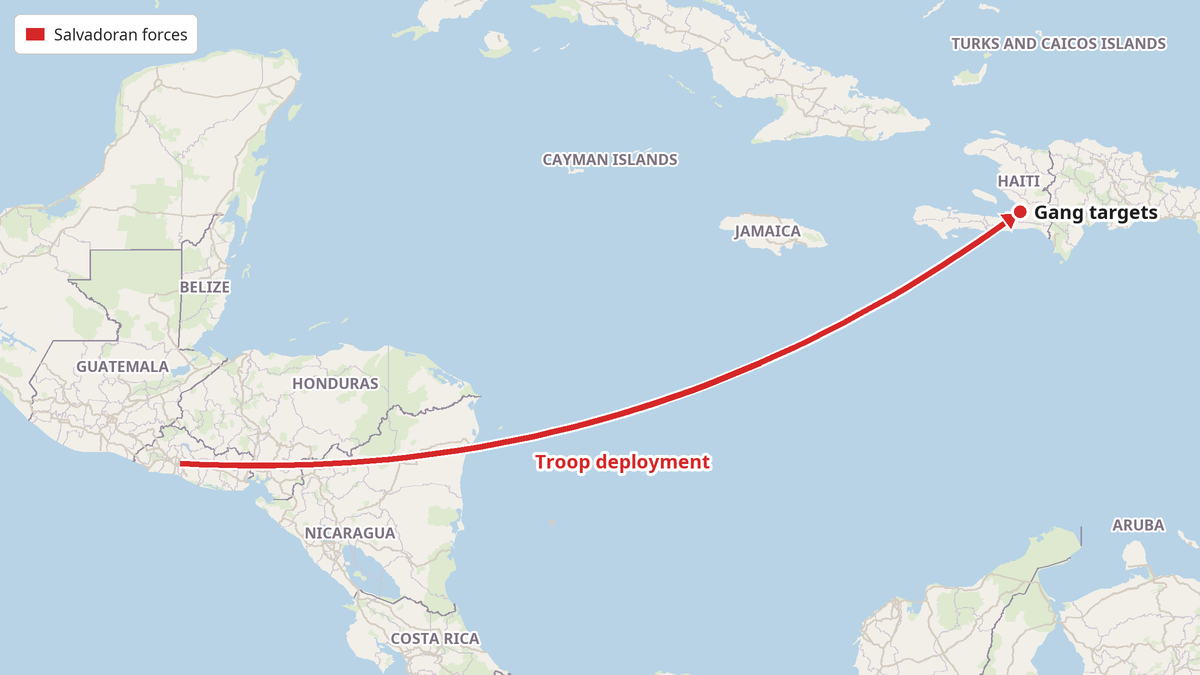
El Salvador has put 2,500 soldiers on Haitian soil with, in the words of the reporting, "little transparency or oversight." No published agreement. No public mandate. And Amnesty International, on Monday, had to ask both governments to disclose the deal that let the forces in.
The offensive began in mid-October, about one month ago, after four Salvadoran aviation technicians working with a U.N.-backed mission went missing in a gang attack. A gang leader has since said the four are dead. Since then, the stated aim has shifted. Rescue is out. Eradicating Haiti's gangs is in.
Who Decided
The decision runs through one man's social media feed. President Nayib Bukele posted a video Tuesday of Salvadoran forces bombing a gang leader's house, after asking publicly on X for the coordinates. "We kept our promise," he wrote. "Most of them ran away without even trying to fight. What cowards!"
The videos carry a message in Haitian Creole, English and Spanish: "We will help you take back your country ... Finally, Haiti will be free." Salvadoran officials and what the report calls "an army of pro-government influencers" amplify it.
Salvadoran political communications strategist Roberto Dubon called it "an electoral campaign to promote Nayib Bukele and portray him as if he's a superhero. They're selling an Avengers movie." He added that Bukele is "using Haiti as a testing ground to implement his policies on an international level."
The Sovereignty Question
A foreign army is operating inside a sovereign Caribbean nation under terms its own public hasn't seen. Amnesty International urged El Salvador and Haiti to "publicly disclose the agreement allowing forces into Haiti" and to "comply with international human rights law," warning the operations could exacerbate violence and affect civilians.
The U.N.-backed gang suppression force, of which El Salvador isn't a part, operates under strict rules. Salvadoran troops, analyst Diego Da Rin of International Crisis Group warned, may not. "The Salvadoran troops' eagerness to secure quick, symbolic victories entails huge risks for civilians who can be caught in the crossfire," he said.
Haitian police and international forces, meanwhile, have failed for years to push back the gangs. Da Rin said the Salvadoran presence could force them to organize better. It could also push rival gangs to unite in coalitions, as has happened before.
Elite Entanglement
Haiti's gangs aren't a foreign import. Roughly two dozen well-known gangs operate in Port-au-Prince, with dozens more attacking outside the capital. They wield weapons smuggled mainly from the U.S. And they are, per the reporting, "deeply entwined with some of the country's political elite."
That entanglement is why the model Bukele sells at home may not travel. In El Salvador he suspended key constitutional rights and detained more than 1% of the population. El Faro, the Salvadoran investigative outlet whose staff has since been exiled, also reported that Bukele negotiated with those gangs.
What It Costs the People
Back home, Bukele is all but guaranteed victory in February. Polling puts his approval well over 90%. But the legislature controlled by his party moved the election up from 2029 to 2027 and eliminated presidential term limits, "paving the way for the populist to stay in power indefinitely."
One in four Salvadorans still lives in poverty. Bukele's government says it's footing the bill for the Haiti deployment. ACLED analyst Tiziano Breda warned those costs "could fester resentment in El Salvador."
Security consultant Luis Enrique Amaya put the logic bluntly: "Bukele won't allow even a centimeter of his popularity and legitimacy to be lost. Not even a millimeter, not a single vote."
U.S. Secretary of State Marco Rubio, a Bukele ally, distanced himself Monday. The U.S. was "not actively involved," he said, backing the U.N.-backed force instead. "There is no plan B," Rubio said.
Whether troops stay for an extended conflict or, as Breda expects, make quick shows of force before retiring, the Salvadoran public will likely foot the bill either way.
- nayib bukele
- el salvador
- haiti
- gangs
- military offensive
- marco rubio
- amnesty international
- february elections