
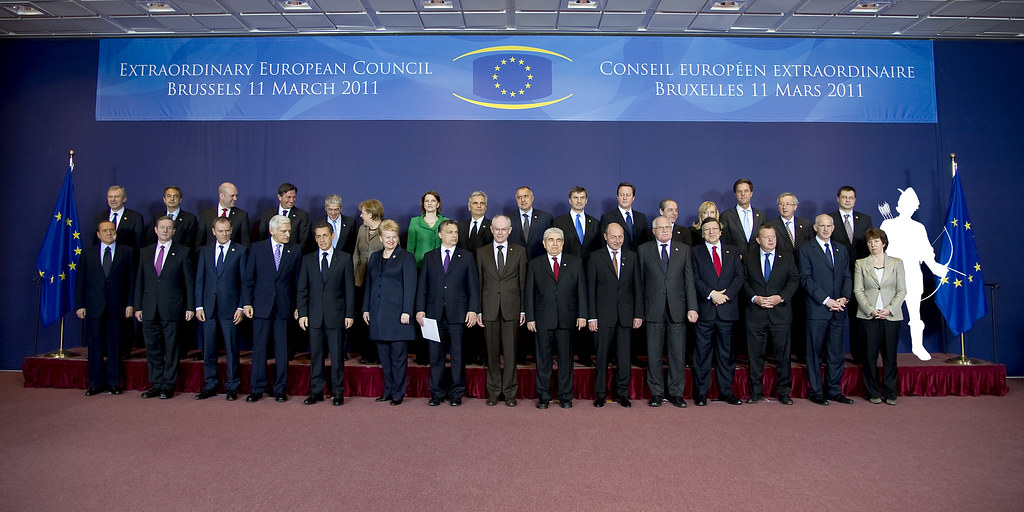
EU leaders arrived in Dublin on Friday for an informal summit on artificial intelligence and spent the day fighting over something else entirely: who gets to speak for Europe at a negotiating table where two Americans already sit. POLITICO described the preceding day as one of "ferocious diplomatic activity." Nobody was ferocious about the people who live and die under the war itself.
The Seat Auction
The row started with a letter. Italian Prime Minister Giorgia Meloni wrote to European Council President António Costa warning that the multiple formats in which the EU engages in the talks made it "less credible." Her argument: "By projecting the image of a Europe that is in disarray, we are merely serving the interests of those who want this war to continue." She wants "a single, authoritative voice" and a decision by Friday, formalised in December in coordination with non-EU partners like Britain and Norway.
Costa agreed to add the item, and appeared to put himself forward for the job, noting that "the European Union's interests need to be represented by its institutions, in accordance with the Treaties." The informal format means no political statements get adopted at the end. So leaders can speak openly, and nobody has to be held to anything.
POLITICO reports the bloc has split into at least three camps. One backs Costa. One is France and Germany, both reluctant to hand their own chairs to Brussels. The third, which POLITICO called the loneliest, backs Kaja Kallas, the bloc's top diplomat, whose hawkishness on Russia some diplomats say makes her a liability. One European diplomat called her "probably the worst person you could pick." A second argued the opposite, that Putin would do exactly that, picking whoever you don't want to talk to.
Kallas, for her part, pointed to the carve-up of top jobs. "Or we should just stick to the agreements that we made in 2024," she said, as if the horse-trading of two years ago were scripture. Asked by DW why Europe should get one seat at the table while the US gets two, she answered with a wry, ironic laugh.
Who Speaks for Whom
French MEP Fabrice Leggeri of National Rally said France holds a permanent UN Security Council seat and Europe's only nuclear arsenal, and he could "hardly imagine" Costa or Kallas speaking for Paris. German Chancellor Friedrich Merz defended the E3 format of Germany, France and the UK, adding that they also work with Poland and Italy: "I see absolutely no problem with keeping it that way." AP noted that an E3 envoy would leave out the other 25 EU nations and rankle smaller states on the eastern flank.
The Kremlin enjoyed the show. Spokesperson Dmitry Peskov: "The Europeans squabble like spiders in a jar." Estonian Prime Minister Kristen Michal joked to POLITICO that "you could even have a TV show about it. But we are saving the best part for tomorrow."
Meanwhile, US envoys Steve Witkoff and Jared Kushner met Putin in Moscow, then flew to Dublin to brief Zelensky. Kushner said that "if Europe could identify one person to speak on their behalf, that would be a bigger achievement than getting the Russians to include them in the negotiation." The Europeans do not trust Donald Trump to negotiate for them after tense standoffs over trade, Greenland and conflicts in Iran and Ukraine, yet they are arguing about how to get a chair at his table.
Armies Before Anything Else
The security vocabulary is all troops and guarantees. Putin said that Europeans deploying troops in Ukraine after a deal would be "a legitimate target for us, so the war will resume immediately." Macron said Europe should design "our own architecture of security." British Prime Minister Andy Burnham promised "a ring of steel" around Zelensky. Latvian Prime Minister Andris Kulbergs pointed to cyberattacks, arson and a drone attack in Leipzig, adding: "We're going to see more and more and more."
The money question is no gentler. In October the European Commission identified a €70 billion hole in the funding it had promised Ukraine's economy. Merz threatened to block the EU's next seven-year budget unless member states contribute to Ukraine's financing, prompting a backlash from several leaders. Slovakia's Robert Fico opposes any further financial and military support. A special European Council on 26-27 November, less than two weeks away, will take it up.
The AI Footnote
The actual agenda item got little oxygen. Mistral AI's Arthur Mensch and Nobel laureate Geoffrey Hinton were due to brief leaders. Hinton estimates a 10% to 20% risk that AI could cause human extinction by escaping human control. The EU is advancing rules to ensure public contracts in sensitive use cases go only to European companies. Sovereignty, in other words, means procurement. The leaders will get a "common understanding" and no obligation to do anything about it.
Dublin offered a clear picture of how power works at the top: the question of who holds the pen outranks what gets written. Costa and Kallas serve until 2029. The war is in its fifth year.
- ukraine peace talks
- european union
- antónio costa
- giorgia meloni
- dublin summit
- volodymyr zelensky
- eu envoy
- kaja kallas