
The European Central Bank has shortlisted 10 proposals for the first full redesign of euro banknotes since the single currency's paper money entered circulation 24 years ago, offering Europeans a choice between cultural icons and native wildlife in a public consultation that closes on 21 September.
The redesign won't be cheap. New security features and updated printing infrastructure across the eurozone will require significant investment from national central banks, though the ECB hasn't yet published cost estimates. The new notes won't enter circulation until 2030 or 2031, giving member states time to prepare their minting facilities.
The Cultural Lineup
Five of the 10 proposals feature Europe's cultural heritage. The figures include Maria Callas, the American-Greek soprano; Beethoven, the German composer; Curie, the Polish-French scientist; Cervantes, the author of Don Quixote; Leonardo da Vinci, the Renaissance polymath; and Bertha von Suttner, the Austrian pacifist and women's liberation leader. The lineup is intended to represent different corners of the eurozone, albeit with a glaring hole in the Baltics.
Callas was born in New York but her career flourished in Greece and Italy. Curie discovered radium and polonium with her husband, Pierre, and her career spanned Warsaw and Paris. Von Suttner spent time in Prague, Tbilisi and Vienna.
Dutch book designer Joost Grootens has cropped the images of cultural figures tightly around their eyes, accentuating their vision rather than their iconic status. Jan Robert Dünnwelle, a German illustrator, has rendered the same personalities in a free-flowing, sketchy style of a graphic novel.
Wildlife Alternative
The other five proposals feature European birds: the wallcreeper, the kingfisher, the bee-eater, the white stork, the avocet and the northern gannet, over different landscapes typical of the continent. While none of the birds are exclusively found in Europe, they'd be paired on their flipside with pictures of buildings that house the EU's political, legal and financial institutions in Brussels, Strasbourg, Luxembourg and Frankfurt.
French artist Isabelle Daëron's proposals show the birds flying across a vertical layout rather than the more conventional horizontal one, as are those of Ville Tietäväinen, a Finnish graphic designer, who has depicted the bird's journeys in sequence, progressively moving from the mountains to the sea.
The Decision Process
The public survey on the ECB's website will feed into but not solely determine which design the central bank chooses as a winner at the end of 2026. A second, quantitative survey and the verdict of a jury of designers will also have a bearing on the choice. A combination of the two themes isn't expected.
The 10 shortlisted designs were picked from 1,241 applications to an open call 1 year ago. Each proposal offers a different graphic interpretation of colours and motifs for the €5, €10, €20, €50, €100 and €200 notes that were determined by the ECB in advance. The new notes will continue to be printed on paper rather than polymer, as in some countries such as the UK.
Philippe Geoffroy, the head of section for new banknotes at the ECB, said: "The feedback from the public has been very clear. They want money that feels European." He also said: "The main reason behind the re-design is to stay well ahead of counterfeiting. But along the way we want to increase identification with the single currency and make it more graphically meaningful. We want to move away from neutrality."
Breaking with Neutrality
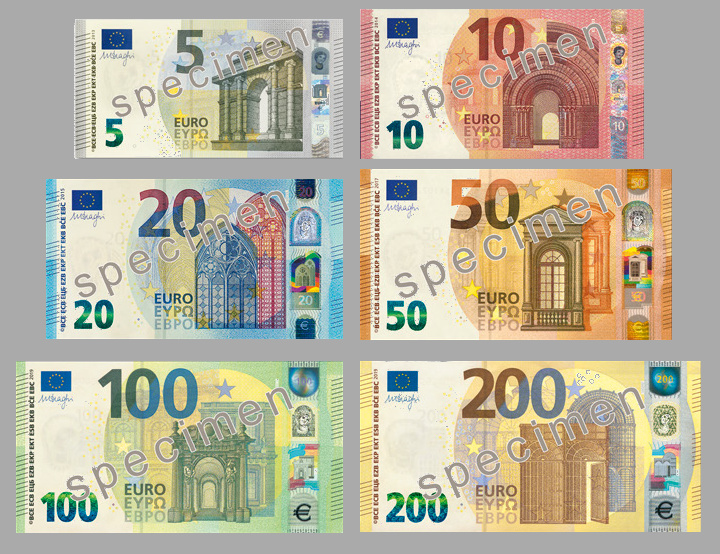
The current euro banknotes deliberately depict neutral motifs in order to avoid offending individual member nations: imaginary bridges, doorways and windows that exemplify historic architectural styles without depicting specific real-life European buildings or places. New notes including the face of the mythological princess Europa in the watermark and the hologram stripe were introduced 13 years ago without changing the overall design.
In Britain, the Bank of England drew some ire earlier this year when it announced that redesigned notes would depict wildlife instead of historical figures such as Winston Churchill or William Shakespeare.
Why This Matters:
The redesign represents a shift in how the ECB views the euro's role in European identity. Moving away from neutral architectural motifs to either cultural figures or wildlife is a statement about what binds the eurozone together. But it's also a practical necessity: counterfeiting technology advances, and central banks must stay ahead. The choice between culture and nature will reveal whether Europeans see their common currency as a celebration of shared civilizational achievement or as a symbol of the continent's natural heritage. Either way, the decision will be made in Frankfurt, not by national governments — a reminder that monetary sovereignty was surrendered when countries joined the euro. The public consultation gives citizens a voice, but the ECB retains final authority. That's the bargain of monetary union.