
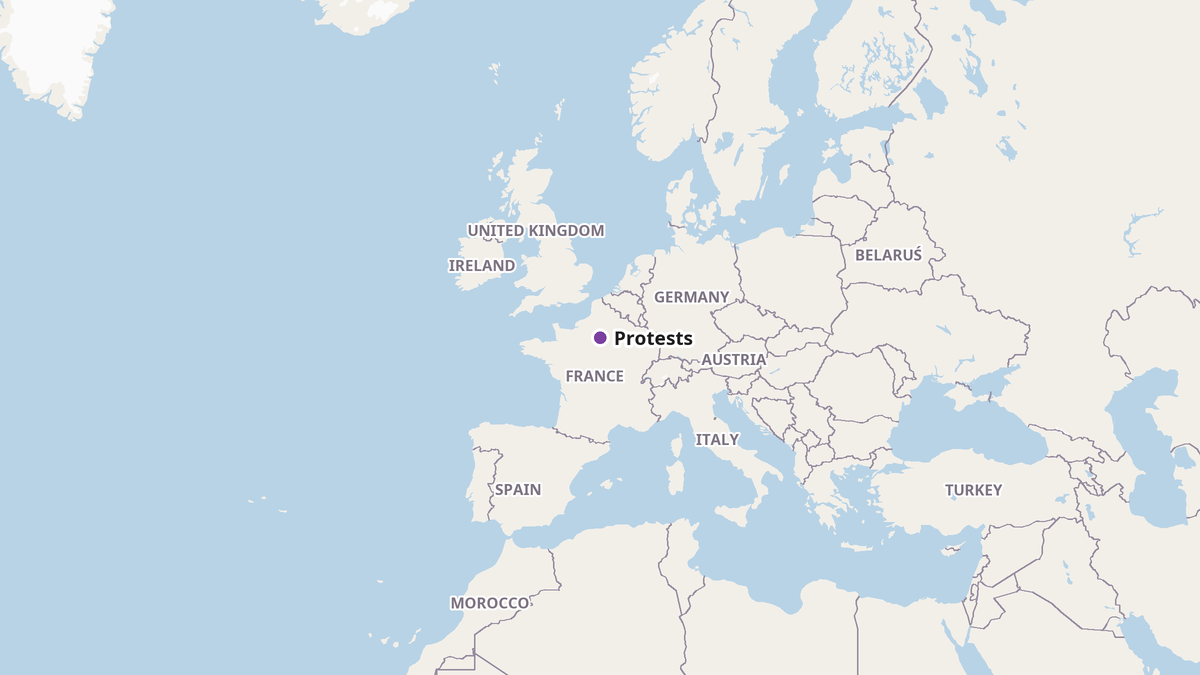
Demonstrations spread across more than 25 European countries on Friday, as workers and students called for higher wages, better living conditions and investment in public services. Protests are expected to continue through the weekend. Their demands range from housing and education to healthcare, welfare and climate action. In several countries, opposition to increased military spending has become a rallying cry.
The numbers behind the anger are blunt. Eurostat says everyday costs, including food, energy, transport and bills, have risen by between 59 and 78 percent since 2000 in France, Italy, Spain and Portugal. After inflation, the average full-time wage in Italy fell by almost 5 percent between 2000 and 2025. Over the same period, real wages rose by 7 percent in Spain, 11 percent in France and 20 percent in Portugal, according to OECD wage data adjusted using Eurostat’s price index.
Budgets, wages and the street
Demonstrations took place in more than 100 locations across Italy, alongside a 24-hour general strike called by the Italian General Confederation of Labour (CGIL), the country’s largest trade union. Tens of thousands of workers and students joined. Public- and private-sector workers, including those in schools and healthcare, took part, disrupting public transport in several cities, schools and some health facilities.
Organisers condemned stagnant wages, rising living costs and what they called the government’s failure to improve public services and protect workers’ rights. Planned air transport workers’ strikes were cancelled for Friday, but airport-staff walkouts remained scheduled for Sunday at Milan and Venice airports. Authorities sent additional police to several Italian cities where multiple demonstrations took place.
“Across Europe and among ordinary people, the demand for change is growing,” CGIL leader Maurizio Landini said at a rally in Rome. Demonstrators in Rome threw objects at the Ministry of Education, while some protesters clashed with police in Bologna, the news agency ANSA reported. In Milan, demonstrators set fire to a cardboard tanker and cardboard figures depicting Israeli Prime Minister Benjamin Netanyahu and United States President Donald Trump.
Italy’s rallies followed a nationwide mobilisation on October 17 that descended into rioting and looting. Prime Minister Giorgia Meloni’s right-wing government then approved sweeping security measures and sent the army alongside police to later demonstrations. Student groups have continued protests and occupations at schools and universities. Opposition to higher military spending has also become a rallying cry.
Elly Schlein, leader of the centre-left Democratic Party, criticised the government’s budget policies. The 2027 Budget Law, she said, “does not have a vision for the future of the country” because it doesn’t help industries but cuts funding for public healthcare and education.
Security for the state, pressure on the street
In France, the Interior Ministry said 146,000 people took part in protests nationwide, including 28,000 in Paris. The CGT trade union put the national total at just over 500,000. Protests across Europe drew inspiration from demonstrations in France in recent months, which began in September and descended into violent confrontations with police and looting.
In Germany, the campaign group “Gen Z regelt” (“Gen Z sorts it”) said it was organising protests in 73 cities and towns. Roughly 4,000 people attended a protest at Berlin’s Alexanderplatz square. Police said fewer people than the expected 5,000 turned out for the Cologne protest, though demonstrators still numbered in the thousands. Protesters demanded greater investment in education and opposed a possible return to compulsory military service. The rallies followed protests on 31 October that brought thousands into the streets, with violence reported in some cities.
Several hundred people gathered outside the University of Vienna for a youth-led demonstration calling for more education funding and less spending on weapons. Police dispersed the protest after reported disturbances, using pepper spray and making several arrests. In Croatia, students boycotted classes and protested in about a dozen cities, demanding investment in education, housing and public services rather than military spending. Demonstrations also took place in the United Kingdom, Spain and Sweden.
Public demands, institutional choices
The protests put public priorities in direct view: wages, housing, education and healthcare on one side; rising military spending and security measures on the other. In Italy, the army appeared alongside police at later demonstrations after the government introduced security measures. In Austria, police used pepper spray and made arrests as officers dispersed a youth-led protest. Across the countries named in the reports, people took to streets, schools and universities to press governments over demands they haven’t met.
The political arguments aren’t abstract for people facing rising bills and stagnant pay. They concern who gets resources, who gets policed, and whether public services receive investment or cuts. Protests are expected to continue through the weekend. The gap between those demands and government decisions remains on display.
- european protests
- wages
- cost of living
- public services
- general strike
- trade unions
- education funding
- military spending