
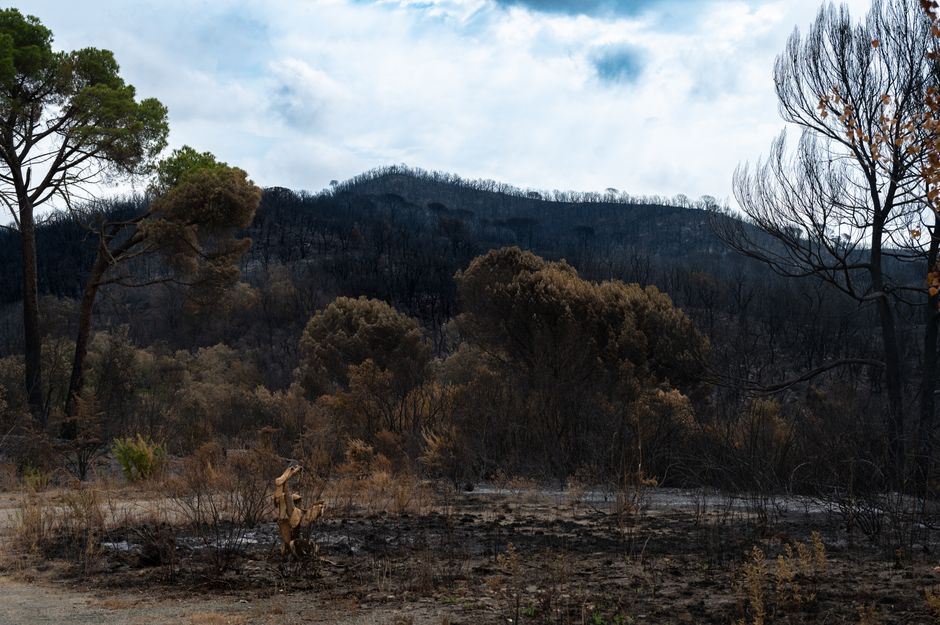
Firefighters across Europe battled multiple wildfires on Friday as a new wave of record-breaking heat baked a swath of the continent and exceptionally parched landscapes made the work harder. The fires forced evacuations in Croatia and Greece, burned in France and the UK, and prompted warnings from weather and climate agencies about extreme conditions across much of Europe — a climate reality that's hitting ordinary families, tourists, and emergency workers hardest.
In Croatia, a wildfire on the coast left at least 10 people in intensive care and dozens more injured after crews fought overnight with what officials called one of the worst blazes in the country's history. Around 2,000 people were evacuated from nearby villages as the fire ripped through surrounding hills, damaging homes and destroying cars in the early hours of Friday. Hospital officials said 40 people had been admitted to Split hospital so far, including a German and Polish tourist. Hundreds of tourists were among those evacuated to a shelter set up by the Red Cross in Omiš, according to Euronews. Ana Stejskal, the organisation's director in the town of Omiš, told national broadcaster HRT that hundreds of tourists were evacuated there. Tomašlav Gojo, director of the Red Cross in Split, said, "People have a bed, a shower, a toilet and food, but it's difficult to predict how long this situation will last."
Nearly 300 firefighters were deployed overnight, but they were often outpaced by the blaze, according to the country's fire chief, Slavko Tucaković, who described it as one of the worst in Croatia's history. He said, "It was frightening even to watch. Many houses, cafes, restaurants, cars, and boats that were on dry land were damaged." During a visit to the area, Prime Minister Andrej Plenković stressed the dangers of the fire and praised the firefighters. "This fire spread at lightning speed," he told reporters. "What the firefighters managed to save is truly a miracle." Plenković said the region was very densely populated, with a township of 15,000 currently bolstered by 12,000 tourists. After four Canadair water bombers were deployed at dawn, authorities said the situation was calmer. As conditions eased in Omiš, the aircraft were sent to another blaze on the Pelješac Peninsula, about 70 kilometres south, where homes were under threat.
Greece: Tourists Forced Into the Sea
In Greece, a three-kilometre wall of flames up to 30 metres high forced hundreds of tourists into the sea off northern Greece. More than 200 firefighters, water-bombing planes and helicopters battled for hours to stop a blaze spreading across the Halkidiki peninsula, south of Thessaloniki, as it bore down on the resorts of Siviri and Fourka, packed with summer tourists. Officials judged evacuation by road too dangerous and sent around 500 tourists into small boats, coast guard vessels and fire brigade craft, including roughly 200 taken to a ship waiting offshore, while cars trying to flee by road became gridlocked. One local homeowner, Sophia, told AFP, "We are on the beach and looking for a way to get away," saying flames had already reached the town's houses. Two firefighters were hospitalised, and authorities banned public access to the region's pine forests as forecasters warned of winds up to 100 km/h. The fire was later brought under control, though crews stayed on alert for flare-ups. Greece remained under its highest wildfire alert nationwide, still reeling from a blaze near Athens this month that killed two helicopter crew and burned 110 square kilometres of forest.
France: Heat Shuts Down Nuclear Reactors
In France, firefighters struggled against multiple fires as record heat and drought continued. Météo France placed four departments under its highest wildfire alert on Friday, warning that weather conditions made the risk of fires starting and spreading very high compared with summer norms. Overnight, firefighters brought the Aude blaze near Carcassonne under control after saving 73 homes, while the Pas-de-Calais fire near Mont-Frieux remained active into Friday morning. With the heatwave persisting, authorities urged continued vigilance heading into the weekend. France's driest year ever also fed a new fire in the Landes region on the southwest coast, where the blaze forced more than 500 people to evacuate their homes in Luglon as hundreds of firefighters deployed to the area, the regional administration said Friday.
France also shut down six nuclear reactors in recent days because of extreme heat and drought and because a mass of jellyfish washed up outside one power plant on the English Channel coast, utility company EDF said. EDF said the shutdowns had minimal impact on electricity production and that extreme weather posed no safety risks to the reactors themselves. A separate French case involved a 15-year-old placed under formal investigation and held in juvenile detention over a forest fire near Bordeaux airport that killed two firefighters trapped in their truck on 21 July. The deaths, along with that of a volunteer firefighter in southeast France, angered fire unions, whose representatives met Interior Minister Laurent Nunez this week but said his commitments fell short, threatening strike action in September over inadequate resources. The Guardian reported that nearly 500 people had been arrested on suspicion of starting wildfires in France since the start of the summer.
UK: Homes Destroyed on Hottest Day of the Year
In the UK, a wildfire with multiple points of origin tore through homes near Stourbridge on the region's hottest day of the year, damaging at least six properties and forcing evacuations. Three firefighters and a child were hospitalised, while six others were treated for smoke inhalation. West Midlands Chief Fire Officer Simon Tuhill called it one of the most significant incidents the service had ever attended, blaming rapid spread on tinder-dry conditions. About 20 to 30 homes were completely destroyed, Stourbridge lawmaker Cat Eccles told the BBC. A woman evacuated from her Stourbridge home, Jane Baxter, told BBC Radio that police knocked on her door and urged her to leave immediately. "They thought the fire was changing directions, and they didn't know which direction it was going in," she said. "So, it was literally 'grab what you need and get out.'" Simon Tuhill said an investigation would be launched but the fire was believed to have started in grassland before spreading to nearby homes. Nineteen people and six firefighters were hospitalized for smoke inhalation and other injuries from multiple wildfires in the West Midlands region. In nearby Stoke-on-Trent, a 23-year-old man and a 24-year-old woman were arrested Friday on suspicion of arson over a large grass fire that spread quickly. The Met Office said 38.1C was recorded in west London on Thursday, marking the hottest day of the year, and that July had been the driest in England and Wales since records began in 1836.
Across the Continent: From Spain to Germany
Spain moved the remains of three 11th Century kings from a monastery in the northeastern Aragón region near an active wildfire. The remains were taken to a museum about 80 kilometers south of the 10th-century San Juan de la Peña monastery, which remained unharmed Friday, according to regional authorities. Paintings, liturgical objects and the clothes of a notable 18th-century Spanish count were among the other items removed from the monastery. The wildfire was not yet contained by midday Friday, with some 800 residents evacuated. A separate, much larger wildfire in southern Spain had burned more than 300 square kilometers in the province of Huelva, also forcing evacuations.
Germany evacuated all 1,800 residents of the village of Gey in western Germany after a wildfire with shifting winds in the nearby Hürtgen forest threatened to reach their homes. Nearly 300 hectares of forest were ablaze on Friday morning, local authorities said. Unexploded ordnance from World War II in the forest hampered firefighting efforts, German news agency dpa reported. The fire advanced to within 300 meters of Gey, which sits on the edge of the forest near the Belgian border. Germany also set a new record for heat-related deaths so far this year, surpassing the 2018 level for the entire year, the Robert Koch Institute said Thursday. It estimated 12,500 people died from heat-related causes between Jan. 1 and Aug. 2.
Albania was battling dozens of wildfires in recent weeks, with 11 active fires reported across the country Friday. The largest fire was in the Gure-Lure area, where the perimeter near residential homes had been brought under control. Three people had been prosecuted over that fire, which engulfed Lura National Park, and they were suspected of failing to take measures to protect the territory from fire, authorities said. Belgium was expecting to hit its highest temperature of the summer on Friday, climbing to 37 C in Brussels. The mercury was also set to hit 37 C in the neighboring Netherlands. The Netherlands was suffering from severe drought, with water shortages in some areas, but Dutch authorities had held off declaring a water crisis as rain was expected in the coming days.
The Copernicus Climate Change Service warned of very extreme conditions across central and eastern Europe, with pockets in southern Britain, Ireland, northern France and southern Sweden in the outlook for the week to Aug. 19. The warning underscored the broader climate backdrop to the fires and heat across the continent.
Why This Matters:
These aren't isolated disasters. They're the consequences of a climate crisis that European leaders have acknowledged but haven't adequately prepared for. Emergency services are stretched beyond capacity, firefighters are dying in preventable incidents, and ordinary families are losing their homes and livelihoods. France's fire unions are threatening strikes because they don't have the resources to do their jobs safely — a failure of political will, not resources. Germany's heat-related death toll has already surpassed an entire year's worth from 2018, and we're only in August. The fact that nuclear reactors had to shut down because of heat and jellyfish shows how fragile our infrastructure is in the face of climate extremes. Europe needs coordinated climate adaptation funding, cross-border firefighting capacity, and a just transition that protects workers and communities on the frontlines of this crisis. The fires will keep coming. The question is whether Europe will invest in the people who fight them and the communities they're trying to save.