
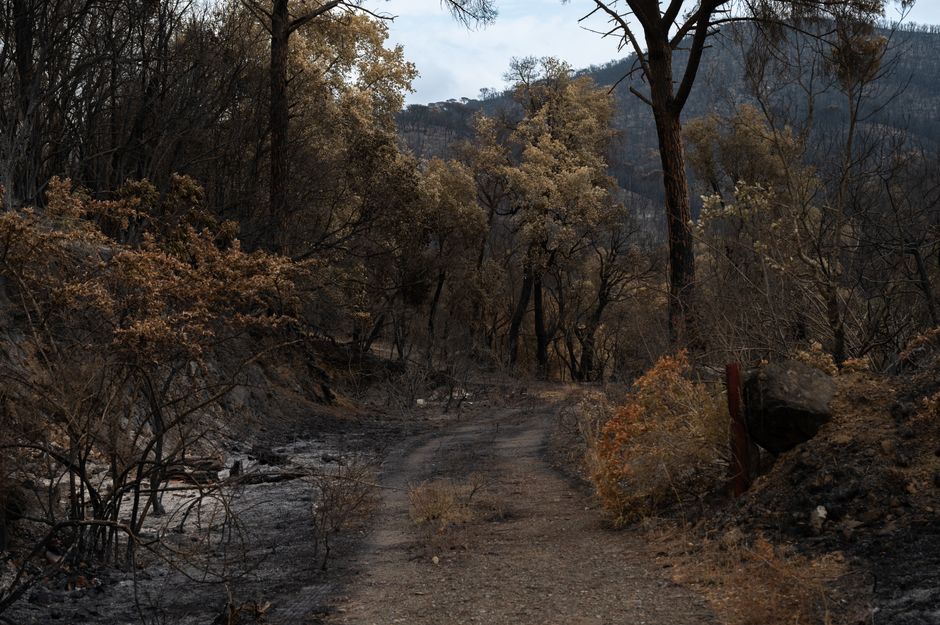
French authorities ordered evacuations for three suburbs of Bordeaux in southwestern France as wildfires kept tearing through southern Europe, forcing ordinary people to move on command while governments coordinated the response from above. Residents of Le Haillan, Eysines and Mérignac were told to leave immediately via planned evacuation routes. The fire has burned through around 32,700 hectares in the Gironde department this week, and 167,000 people have been evacuated.
State Power on the Ground
The blaze began in Saumos on Tuesday and moved toward Le Porge and Lège Cap-Ferret before spreading east toward the Bordeaux metropolitan area, where smoke was visible from fires raging in the Arcachon Basin. Bordeaux opened the Parc des Expositions exhibition centre to accommodate evacuees. Local authorities said on Saturday afternoon that falling temperatures and increasing humidity were making the fire less intense, allowing fire crews to get on the front foot. The language is tidy. The reality is people being pushed out of their homes while officials describe the situation as if it were a campaign briefing.
Two firefighters died while tackling flames in Mérignac on Tuesday. French President Emmanuel Macron paid tribute to them in a post on social media, writing: "I extend the nation’s condolences, gratitude and support to their families, their loved ones and the firefighters of France," he wrote. The tribute sits beside the scale of the evacuation and the dead, a familiar state ritual: praise the workers who absorb the danger, then move on to the next emergency.
French Interior Minister Laurent Nuñez said on Saturday that the fires blazing across France had burnt around 98,000 hectares so far, calling it a "historic record." That record is measured in scorched land, displaced residents and exhausted crews. It is also measured in the speed with which the state turns catastrophe into administration.
Brussels, Capitals, and the Firefighting Chain
France requested assistance through the European Union's civil protection mechanism on Friday. The bloc said planes and helicopters from Portugal, Croatia, the Czech Republic and Slovakia would be sent to help. Swedish Prime Minister Ulf Kristersson also announced that Sweden was sending firefighting aircraft as part of the programme. The EU presents this as coordination. In practice, it is the continental machinery of crisis management: national governments, the Brussels apparatus and allied states moving resources around after the damage is already done.
In Spain, fires continued to rage in the Madrid area and in the province of Ávila, with tens of thousands forced to flee their homes. The Spanish government declared a national emergency over fires threatening communities in the regions, where more than 60,000 people have reportedly been evacuated. Isabel Díaz Ayuso, the president of the Community of Madrid, said on Friday that the blaze affecting the area was "the worst" in local history. Pedro Sánchez said on Saturday that the priority was to "safeguard lives, protect communities and fight the fires." He said all levels of government were working together to coordinate resources to provide an effective response and help evacuees, and that affected areas would also receive governmental support during recovery.
That coordination came with uniforms and hardware. Spain's Civil Guard mobilised 650 officers, 60 vehicles and two helicopters to help with evacuations. The numbers show how quickly the state can assemble force when homes are threatened and movement has to be managed. They also show who gets to decide where people go when the ground beneath them turns to ash.
A Continental Emergency, Managed from Above
According to EU figures, 1,254 fires have burned through around 254,388 hectares in Europe since the beginning of the year. The scale is vast. The response is familiar. Governments declare emergencies, deploy aircraft, move police and civil protection units, and open exhibition centres for evacuees. The people most affected are told to leave immediately, follow planned routes, and wait for recovery support from the same institutions that can only arrive after the fire has already done its work.
The pattern is plain enough. The state appears strongest when it is organising evacuation, weakest when it is preventing the conditions that make evacuation necessary. Brussels calls it solidarity. National capitals call it coordination. For the people in Le Haillan, Eysines, Mérignac, Madrid and Ávila, it looks like a system that manages disaster after the fact and calls that governance.