
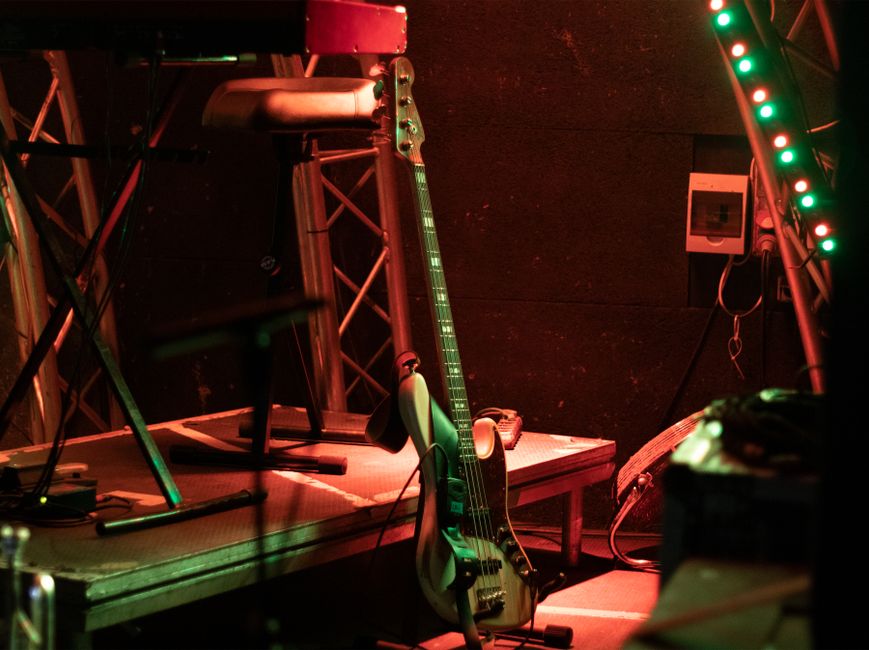
Flea performed at NPR's Tiny Desk Concert series with the Honora Band, stepping outside his four-decade role as founding bassist for Red Hot Chili Peppers to showcase his debut solo album in the intimate setting of NPR Music's office space. The performance, published July 13, 2026, captures the rock icon playing trumpet, doubling on bass, and delivering spoken-word poetry alongside a collective of acclaimed jazz musicians.
An Ensemble Approach
The night before at Washington, D.C.'s Black Cat, Flea described performing with a jazz band as "an adventure." That spirit comes through in the Tiny Desk set, where he's joined by Tiny Desk alumni Jeff Parker on guitar, Josh Johnson on sax and keys, and Anna Butterss on bass, along with Deantoni Parks on drums and keys. These aren't session players filling out a rock star's vanity project. They're musicians with deep catalogs across creative music, each bringing their own voice to the collaboration.
"I'm just one part of this ensemble," Flea said, a statement that reflects the democratic ethos of the performance. It's a far cry from the stadium-filling hierarchy of a major rock band, where the frontman commands the spotlight and the rhythm section serves the song. Here, the structure's more fluid, more conversational.
The Set and the Tour
The performance includes "Traffic Lights," "Morning Cry" and "A Plea," tracks from Honora, the album Flea's been touring in small venues rather than arenas. That choice matters. Small rooms force intimacy. They don't allow distance between performer and audience, between concept and execution. What works in a club has to work on a human scale.
Afterward, Flea reflected on the process: "Working with the musicians that I've worked with has been the most exciting part, just jamming, connecting and feeling who they are." It's a statement about collaboration as discovery rather than control, about what emerges when artists listen to each other instead of asserting dominance.
The Tiny Desk Team
The production involved a substantial crew: producers Kara Frame and Josh Newell; director and editor Maia Stern; audio director and mix engineer Josh Newell; host and series producer Bobby Carter; videographers Maia Stern, Joshua Bryant and Kara Frame; audio engineer Neil Tevault; production assistant Ashley Pointer; photographer Michael Zamora; series editor Lars Gotrich; executive producer Suraya Mohamed; executive director Sonali Mehta; and series creators Bob Boilen, Stephen Thompson and Robin Hilton. That's a lot of names, and they deserve recognition. NPR's Tiny Desk series has become a vital platform for artists precisely because of this kind of institutional support for music that doesn't always fit commercial radio formats.
Why This Matters:
Public media creates space for artistic risk that commercial platforms often can't justify. Flea's Tiny Desk performance exemplifies what happens when an established artist uses institutional support to explore new creative territory rather than repeating what's already worked. The fact that NPR Music provides the resources, crew and platform for a rock bassist to perform experimental jazz with a collective of creative musicians demonstrates the cultural value of publicly funded arts programming. Small venues and public media outlets offer artists freedom from the commercial pressures that shape mainstream music, allowing collaboration and experimentation that serves artistic growth rather than market demands. That Flea chose this path after four decades of commercial success suggests what's possible when cultural institutions prioritize creativity over profitability.