
Nearly 7,000 people, 86% of them minors, have been taken into police custody since mid-September as French students protest conditions in public schools. The demonstrations entered their fifth consecutive day on Friday. Students want action on teacher shortages, overcrowded timetables and deteriorating buildings. Police used tear gas, batons and blast balls. Authorities opened 18 internal investigations into alleged police misconduct.
The UN said it was monitoring the protests “with concern.” Shabia Mantoo, spokesperson for the UN human rights agency, said: “We are following with concern incidents related to the student protests and high school blockades in France, some of which have turned violent.” Demonstrations remained largely peaceful, though some protesters set fires and vandalised bus shelters. Authorities responded with force, custody and investigations into that force.
Schools, promises and police
France’s Education Ministry said 141 of the country’s 3,700 high schools were closed Friday. Mostly aged 15 to 18, the students say schools face teacher shortages, long school days, overcrowding and facilities ill-equipped for rising temperatures. Thousands returned to the streets the previous day. Images showed Paris’s Place de la Bastille full of demonstrators, and reports of clashes with police came by evening.
Education Minister Edouard Geffray announced that around 3,000 substitute teachers would go to the 114 high schools most affected by protests in the coming days. He met three major student groups Thursday and announced measures that included more than 3,000 substitute teachers without current assignments and hundreds of additional staff. Prime Minister Sebastien Lecornu pledged a plan to address the crisis by the end of October.
The government’s promises haven’t settled the dispute. Student union representative Marius Mesnil said, “we’re being offered a few crumbs,” and called for another wave of demonstrations Tuesday. The gap is plain. Students describe crowded schools and absent teachers; ministers offer staffing measures and a future plan.
Budgets for classrooms, reassurance for markets
Economy Minister Roland Lescure said the government could meet demands for additional school funding, despite tight constraints on the 2027 budget. Under the current draft, education is set to get the second-largest funding increase after defence, as spending rises 1.4% to €90.9 billion. Defence still comes first.
France’s worsening economic outlook and sovereign debt crisis have shaken investor confidence. The 10-year yield hit 4.96% Thursday, its highest since July 2002, while the already-high deficit was projected to rise next year. EU Economy Commissioner Valdis Dombrovskis urged France to pass a budget to calm bond markets. “Putting in place a sound budget for the next year will be important to ensure this predictability and credibility and to reassure markets,” he said after a meeting of Eurogroup finance ministers in Luxembourg.
The words name the priority: predictability for markets. European Central Bank President Christine Lagarde declined to comment specifically on France, saying the ECB had instruments to counter disorderly market dynamics. Bank of France chief Emmanuel Moulin said ECB intervention wasn’t needed in the “current conditions.” Students, meanwhile, are still asking for functioning schools.
A symbolic gesture in Strasbourg
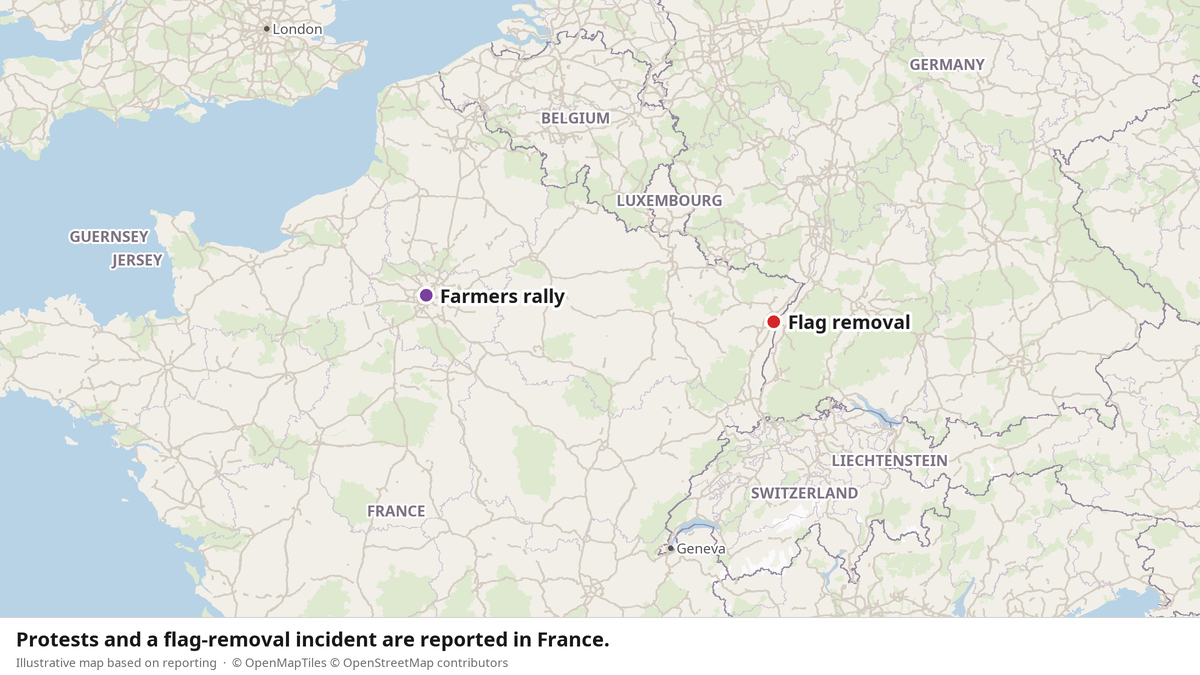
The protests revived memories of the Yellow Vests movement, as leaders on both the far-left and far-right sought to capitalise on public discontent. At the European Parliament in Strasbourg, France Unbowed MEP Rima Hassan defended removing an Israeli flag from an October 7 commemoration, describing it as a protest against the Israeli state. Photographs showed the Israeli flag on the floor alongside the EU flag, prompting backlash and allegations of antisemitism against Hassan.
Hassan said she opposed inviting the Israeli embassy to the Parliament, comparing its position with the Russian embassy, which she said could not organise or co-organise events, address Parliament or have a platform there. She said CCTV footage reviewed with European Parliament President Roberta Metsola showed her “rather softly, taking the Israeli flag down from its stand.” Hassan denied intentionally knocking down the EU flag and said neither flag was “trampled on, thrown about or damaged.” Asked if she regretted how she expressed her views, she said: “Sometimes, a political mandate can be accompanied by an activist gesture, a symbolic gesture.”