
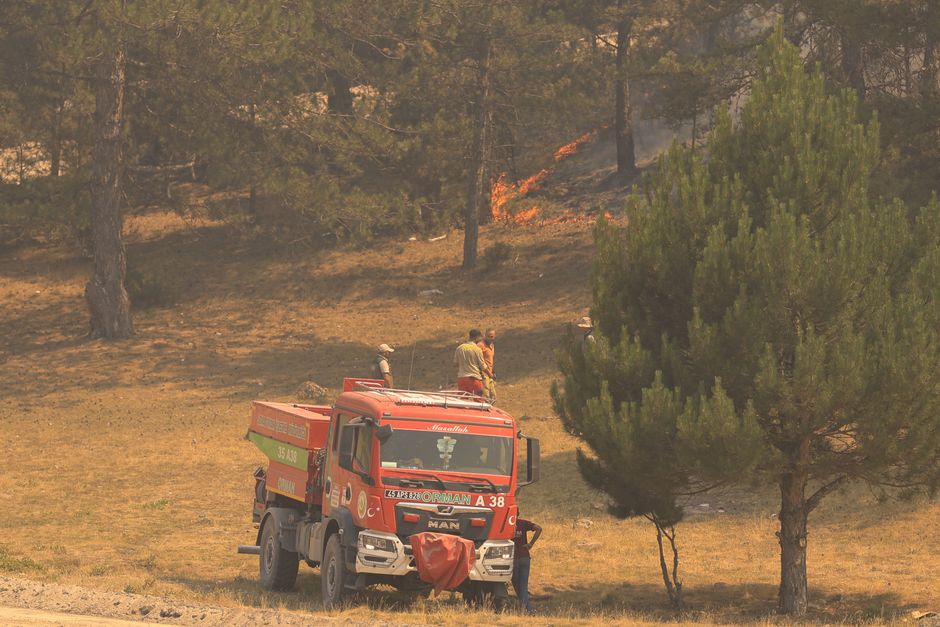
France has deployed nearly 3,000 firefighters across multiple fronts as wildfires continue to ravage the country, with the Bordeaux blaze now contained after consuming 420 square kilometers but a separate Provence fire still raging across the southeastern Var department.
The scale of the disaster is staggering. Since the beginning of the year, more than 1,170 square kilometers—or 452 square miles—have burned across France. The Gironde megafire alone scorched 162 square miles before being fixed, though officials cautioned that "fixed" doesn't mean extinguished. The Provence blaze, meanwhile, has burned roughly 7 square miles in little more than a day and remains unstabilized, forcing the evacuation of about 2,500 residents from threatened communities.
The Scope of Destruction
This marks the fourth major fire to strike the central Var since July 19. The Provence operation alone required roughly 1,500 firefighters to contain the advancing flames. Earlier in the week, a smaller fire near Brignoles forced Hollywood actor George Clooney and his family, along with approximately 700 other residents, to evacuate before crews brought it under control.
The Gironde prefecture acknowledged the ongoing challenge in a statement: "The fire is now fixed, which does not mean that the fire is extinguished." This distinction matters. Containing a wildfire and extinguishing it are fundamentally different operations, each requiring sustained resource commitment and careful management.
Government Response and Reconstruction
Prime Minister Sébastien Lecornu said France's wildfires were generally under control but warned that conditions remained highly changeable. He announced a significant institutional shift: a national coordinator attached to the prime minister's office would oversee reconstruction in fire-ravaged areas. This centralization of reconstruction authority represents a substantial commitment of government resources and oversight to the recovery process.
Lecornu's cautionary stance reflects the unpredictability inherent in wildfire management. Weather conditions, wind patterns, and terrain all influence whether containment efforts succeed or fail. The prime minister's acknowledgment that conditions remain volatile underscores why sustained vigilance—and adequate funding—remain essential.
Climate Context and Regional Challenges
Europe has heated at more than twice the global average since the 1980s, according to the European Union's Copernicus Climate Change Service. This warming trend creates conditions favorable for larger, faster-spreading fires. France's experience this summer reflects a broader European crisis.
Greece faces its own catastrophe. Gale-force winds drove flames deeper into western Attica, the administrative region that includes Athens, prompting authorities to order three additional communities evacuated on Sunday. Nearly 500 firefighters and 23 aircraft were deployed to combat the blaze, which began Friday near Agios Vasileios and has affected an estimated 40 to 50 square kilometers.
Evacuation operations have been harrowing. Firefighters evacuated 254 people by sea from Agios Vasileios on Friday and another 12 from Porto Germeno on Saturday. Authorities remained particularly concerned about Porto Germeno, a seaside community on the Gulf of Corinth that could face the same fate as Mati.
Local farmer Minas Tzortzanis captured the human cost: "A pristine forest, a paradise, was surrendered to the hands of the fire. There are no words to explain what has happened. Destruction. Total destruction."
The stakes carry grim historical weight. In 2018, a wind-driven wildfire trapped residents in the seaside community of Mati, east of Athens, killing 104 people in Europe's deadliest wildfire this century. Greek officials know this history intimately, which explains their aggressive evacuation strategy and visible concern about Porto Germeno's safety.
Why This Matters:
These wildfires represent both an immediate public safety crisis and a test of government capacity to manage large-scale disasters efficiently. The decision to establish a national reconstruction coordinator signals that France recognizes the scale of recovery required—but also raises questions about whether centralized bureaucratic oversight accelerates or delays rebuilding. The fact that Europe is warming at double the global rate suggests these fires won't be anomalies; they're becoming the new normal. For taxpayers funding firefighting operations and reconstruction, and for property owners facing potential losses, the fiscal and personal costs are mounting. Greece's experience shows that evacuation planning and rapid response save lives—a lesson that demands investment in preparedness, not just recovery spending after catastrophe strikes.